Image sourcing: see credits & licences
Quick answer
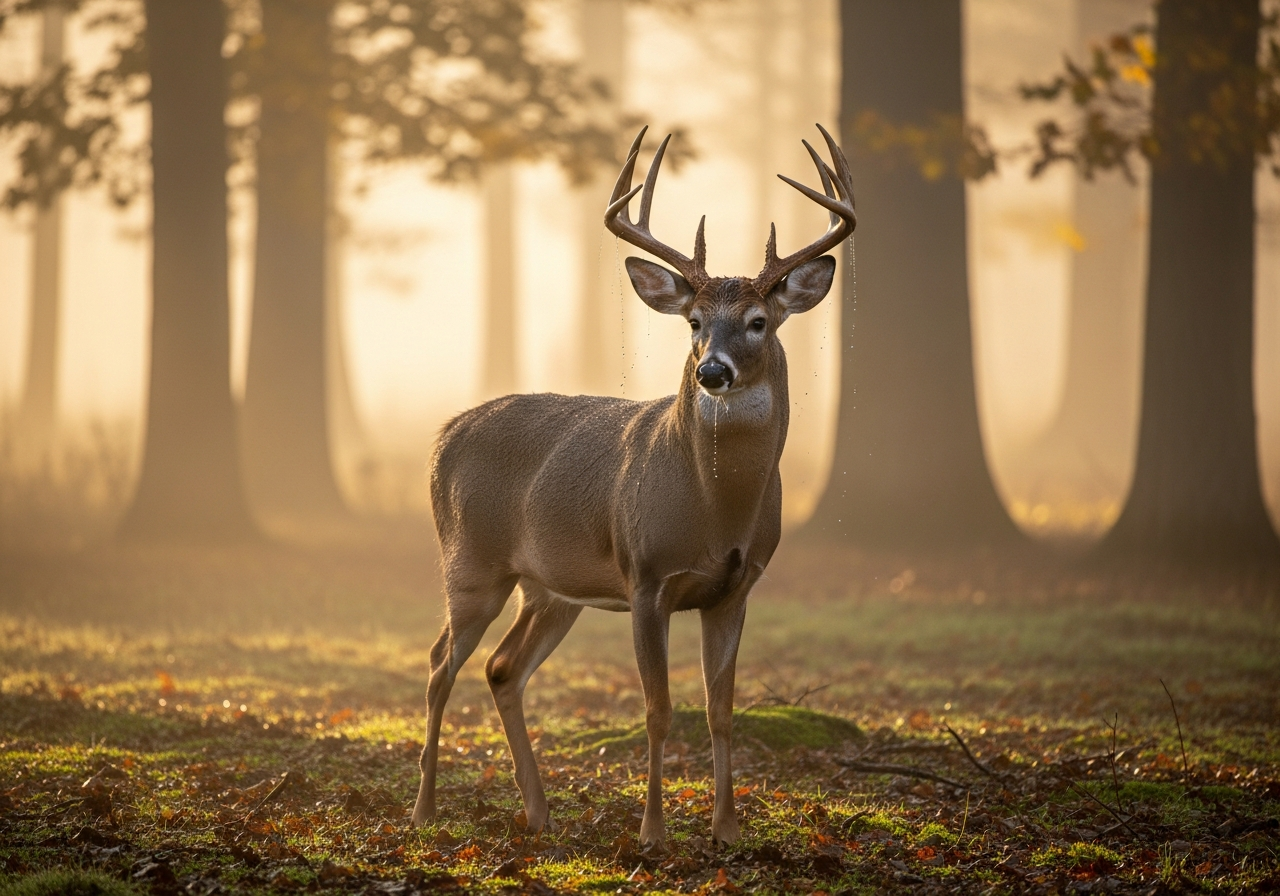
The white-tailed deer is a medium-sized deer named for the white underside of its tail, which it flashes as an alarm signal. Found from Canada to South America, bucks grow and shed antlers each year, and the species can run up to 48 km/h (30 mph) and leap tall fences. Wild white-tailed deer typically live 6 to 10 years.
Top questions about the White-tailed Deer
White-tailed Deer facts at a glance
- Weight 90 kg
- Length 1.8 m
- Top speed 48 km/h
- Lifespan 10 years
| Scientific name | Odocoileus virginianus |
|---|---|
| Diet | Herbivore |
| Habitat | Woodland, edges, and farmland |
| Lifespan | 6–10 years in the wild |
| Weight | 45–135 kg (100–300 lb) |
| Top speed | 48 km/h (30 mph) |
| Conservation status | Least Concern (IUCN) |
| Kingdom | Animalia |
|---|---|
| Phylum | Chordata |
| Class | Mammalia |
| Order | Artiodactyla |
| Family | Cervidae |
| Genus | Odocoileus |
Where it lives
The white-tailed deer (Odocoileus virginianus) is native to Woodlands and forest edges from southern Canada through Central America into northern South America. — recorded across North America, South America in this guide’s range summary.
For occurrence records, see GBIF species search and sources below.
How big is a white-tailed deer?
An adult white-tailed deer measures 1.8 m long — about 1.0× the height of an average adult person (1.73 m) — and weighs around 90 kg, about 1.3× an average adult’s body weight (70 kg).
Length vs an average adult’s height (to scale)
What is a group of white-tailed deer called?
Group name (collective noun)
A group of White-tailed Deer is called a herd.
Baby name
A baby White-tailed Deer is called a fawn.
Explore more animal collective nouns and baby animal names .
The warning flag
The deer's name comes from its tail, which is brown above and bright white underneath. When alarmed it raises the tail like a flag, flashing the white to warn other deer and signal that it has been spotted before bounding away.
Antlers and the rut
Each year bucks grow a fresh set of bony antlers, covered in soft 'velvet' as they develop, then shed them in winter. During the autumn breeding season, the rut, bucks spar with their antlers to compete for mates. A buck's antler size depends on age, genetics, and nutrition.
Diet and habitat
White-tailed deer are browsers that feed on leaves, twigs, grasses, fruit, and crops, adapting easily to forest edges, farmland, and suburbs. This adaptability, along with the loss of large predators, has made them one of the most abundant large mammals in North America.
Population and management
Listed as Least Concern, white-tailed deer are thriving and in many areas overabundant, which can lead to crop damage, vehicle collisions, and pressure on forests. Regulated hunting and habitat management are widely used to keep populations in balance.
Dig deeper into the White-tailed Deer
- How Fast Is A White-tailed Deer?
White-tailed Deer top speed is about 48 km/h (30 mph). Sprint vs endurance and what limits pace.
- How Long Do White-tailed Deer Live?
White-tailed Deer lifespan is typically 6–10 years in the wild. What shortens or extends life, life stages, and status (Least Concern).
- What Do White-tailed Deer Eat?
What white-tailed deer eat: Herbivore, foraging style, and seasonal shifts in Woodland, edges, and farmland.
- Where Do White-tailed Deer Live?
Where white-tailed deer live: Woodland, edges, and farmland, native range cues, and human overlap. Status Least Concern.
- White-tailed Deer: Key Facts
The white-tailed deer is a medium-sized deer named for the white underside of its tail, which it flashes as an alarm signal.
Explore the White-tailed Deer
Range & geography
Did you know? White-tailed Deer facts
- The white-tailed deer is a medium-sized deer named for the white underside of its tail, which it flashes as an alarm signal.
- The deer is named for the white underside of its tail. When startled it raises the tail upright, flashing the white as an alarm signal to other deer before it flees.
- Yes. Only bucks grow antlers, and they shed and regrow them every year. Antlers fall off in winter after the breeding season and a new set begins growing in spring.
- White-tailed deer can run up to about 48 km/h (30 mph) and leap fences nearly 2.5 m (8 ft) high, helping them escape predators in dense cover.
- They are herbivores that browse on leaves, twigs, shoots, grasses, acorns, fruit, and farm crops, shifting their diet with the seasons and what is available.
- Conservation: Least Concern (IUCN).
Diet & feeding
White-tailed Deer feeds primarily as a herbivore. The deer's name comes from its tail, which is brown above and bright white underneath. When alarmed it raises the tail like a flag, flashing the white to warn other deer and signal that it has been spotted before bounding away.
Adaptations
- The deer's name comes from its tail, which is brown above and bright white underneath. When alarmed it raises the tail like a flag, flashing the white to warn other deer and signal that it has been spotted before bounding away.
- Each year bucks grow a fresh set of bony antlers, covered in soft 'velvet' as they develop, then shed them in winter. During the autumn breeding season, the rut, bucks spar with their antlers to compete for mates. A buck's antler size depends on age, genetics, and nutrition.
Behaviour & ecology
- The deer's name comes from its tail, which is brown above and bright white underneath. When alarmed it raises the tail like a flag, flashing the white to warn other deer and signal that it has been spotted before bounding away.
- Each year bucks grow a fresh set of bony antlers, covered in soft 'velvet' as they develop, then shed them in winter. During the autumn breeding season, the rut, bucks spar with their antlers to compete for mates. A buck's antler size depends on age, genetics, and nutrition.
- White-tailed deer are browsers that feed on leaves, twigs, grasses, fruit, and crops, adapting easily to forest edges, farmland, and suburbs. This adaptability, along with the loss of large predators, has made them one of the most abundant large mammals in North America.
Communication
- White-tailed Deer uses scent, posture, and vocal signals to mark territory and coordinate social behaviour.
- Communication intensity often peaks during breeding seasons and territorial disputes.
Habitat & range
Woodland, edges, and farmland
Ecological role
White-tailed Deer shapes vegetation through grazing or browsing and serves as prey for larger predators where ranges overlap.
Conservation status of the White-tailed Deer
The white-tailed deer (Odocoileus virginianus) is listed as Least Concern on the IUCN Red List. Least Concern (LC) is the IUCN's lowest-risk category, assigned to widespread, abundant species that have been evaluated and found not to be threatened. It does not mean a species faces no pressures — only that it is not currently at risk of extinction.
The white-tailed deer (Odocoileus virginianus) is assessed on the IUCN Red List. Look up on the IUCN Red List .
Frequently asked questions about the White-tailed Deer
Why is it called a white-tailed deer?
The deer is named for the white underside of its tail. When startled it raises the tail upright, flashing the white as an alarm signal to other deer before it flees.
Do white-tailed deer shed their antlers?
Yes. Only bucks grow antlers, and they shed and regrow them every year. Antlers fall off in winter after the breeding season and a new set begins growing in spring.
How fast can a white-tailed deer run?
White-tailed deer can run up to about 48 km/h (30 mph) and leap fences nearly 2.5 m (8 ft) high, helping them escape predators in dense cover.
What do white-tailed deer eat?
They are herbivores that browse on leaves, twigs, shoots, grasses, acorns, fruit, and farm crops, shifting their diet with the seasons and what is available.
Where do white-tailed deer live?
White-tailed deer range from southern Canada through the United States and Central America into northern South America, thriving in woodland, forest edges, farmland, and even suburbs.
What is a group of white-tailed deer called?
A group of White-tailed Deer is called a herd.
What is a baby white-tailed deer called?
A baby White-tailed Deer is called a fawn.
Sources & references
This guide is compiled and reviewed against established zoological and conservation references. Key sources for the White-tailed Deer:
-
IUCN Red List of Threatened Species
Conservation status (Least Concern) reflects the IUCN Red List category for Odocoileus virginianus.
-
iNaturalist — observations & photos
Search citizen-science observations and community IDs for Odocoileus virginianus. Useful for range checks and recent sightings — not a substitute for formal Red List status.
-
GBIF — occurrence data
Global Biodiversity Information Facility species search for Odocoileus virginianus. Explore published occurrence records used in range research.
- IUCN Red List — Odocoileus virginianus.
Conservation status (Least Concern) and population trends.
- Animal Diversity Web — Odocoileus virginianus. University of Michigan Museum of Zoology.
Life history, morphology, and range.
- Wikipedia — White-tailed Deer.
General taxonomy and overview (cross-check primary sources).
-
Global Animal Guide editorial standards
How we research, source, review, and update every guide for accuracy.