Image sourcing: see credits & licences
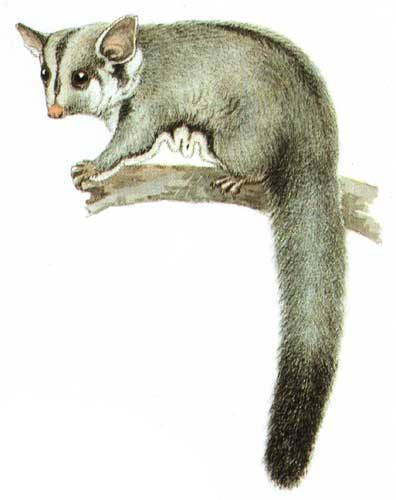
The sugar glider (Petaurus breviceps) is a mammal of the family Petauridae, in the order Diprotodontia.
Quick answer
Sugar gliders (Petaurus breviceps) are nocturnal marsupials that glide between eucalypt trees on a membrane stretching from wrist to ankle. Native to eastern and northern Australia, New Guinea, and nearby islands, they eat nectar, sap, pollen, and insects, weigh about 120 g, and are listed Least Concern.
Top questions about the Sugar Glider
Also available in Español (Petauro del azúcar)
Sugar Glider facts at a glance
- Weight 120 g
- Length 30 cm
- Top speed 20 km/h
- Lifespan 10 years
| Scientific name | Petaurus breviceps |
|---|---|
| Diet | Omnivore (nectar, sap, insects) |
| Habitat | Eucalypt forests and woodland canopies |
| Lifespan | Around 10 years in the wild (varies by population and captivity). |
| Weight | About 0.12 kg typical adult mass (sex and region vary). |
| Top speed | Up to roughly 20 km/h when moving at speed. |
| Conservation status | Least Concern (IUCN) |
| Kingdom | Animalia |
|---|---|
| Phylum | Chordata |
| Class | Mammalia |
| Order | Diprotodontia |
| Family | Petauridae |
| Genus | Petaurus |
Where it lives
The sugar glider (Petaurus breviceps) is native to Eastern and northern Australia, New Guinea, and nearby islands. — recorded across Oceania in this guide’s range summary.
For occurrence records, see GBIF species search and sources below.
How big is a sugar glider?
An adult sugar glider measures 30 cm long — about 17% of the height of an average adult person (1.73 m) — and weighs around 120 g, a small fraction of an average adult’s body weight (70 kg).
Length vs an average adult’s height (to scale)
What is a group of sugar gliders called?
Group name (collective noun)
A group of Sugar Gliders is called a colony.
Baby name
A baby Sugar Glider is called a joey.
Explore more animal collective nouns and baby animal names .
Wrist-to-ankle gliding membrane
The patagium lets sugar gliders sail 50 m or more between trunks, steering with the tail and limbs. Soft grey fur, a dark dorsal stripe, and huge eyes suit night foraging. Social groups share tree hollows and use scent glands to mark territory and group members.
Sap, nectar, and insects
They lap eucalypt and acacia sap, take nectar and pollen from blossoms, and catch moths, beetles, and spiders. Incisors help strip bark to reach gum flows. Seasonal flowering and insect pulses shift how much sugar versus protein they eat.
Canopy life in Oceania
Eastern and northern Australia, New Guinea, and adjacent islands hold wild populations in eucalypt forests and woodland. They need connected canopy and hollow-bearing trees; cleared farmland can isolate colonies.
Pet trade versus wild needs
Wild populations remain Least Concern, but hollow loss and fragmentation shrink local groups. As pets they need specialised diets and social housing — poor captive care, not IUCN status, is the usual welfare issue people encounter.
Explore the Sugar Glider
Close relatives
- Red-necked Wallaby Same order
- Goodfellow's Tree-kangaroo Same order
- Koala Same order
- Red Kangaroo Same order
Range & geography
Conservation status of the Sugar Glider
The sugar glider (Petaurus breviceps) is listed as Least Concern on the IUCN Red List. Least Concern (LC) is the IUCN's lowest-risk category, assigned to widespread, abundant species that have been evaluated and found not to be threatened. It does not mean a species faces no pressures — only that it is not currently at risk of extinction.
The sugar glider (Petaurus breviceps) is assessed on the IUCN Red List. Look up on the IUCN Red List .
Frequently asked questions about the Sugar Glider
How far can a sugar glider glide?
Documented glides often reach 50 m between trees when launching from height, using the membrane and tail for steering.
Are sugar gliders flying squirrels?
No. They are marsupials; flying squirrels are placental rodents. Similar gliding membranes evolved independently.
What do wild sugar gliders eat at night?
Nectar, pollen, tree sap and gum, plus insects and spiders — not a fruit-only diet.
Do sugar gliders live in groups?
Yes. Small colonies share nests in hollows and communicate with scent and soft calls.
Is a baby sugar glider called a joey?
Yes — like other marsupials, young are joeys and spend early life in the mother's pouch.
What is a group of sugar gliders called?
A group of Sugar Gliders is called a colony.
What is a baby sugar glider called?
A baby Sugar Glider is called a joey.
Sources & references
This guide is compiled and reviewed against established zoological and conservation references. Key sources for the Sugar Glider:
-
IUCN Red List of Threatened Species
Conservation status (Least Concern) reflects the IUCN Red List category for Petaurus breviceps.
-
iNaturalist — observations & photos
Search citizen-science observations and community IDs for Petaurus breviceps. Useful for range checks and recent sightings — not a substitute for formal Red List status.
-
GBIF — occurrence data
Global Biodiversity Information Facility species search for Petaurus breviceps. Explore published occurrence records used in range research.
-
Global Animal Guide editorial standards
How we research, source, review, and update every guide for accuracy.