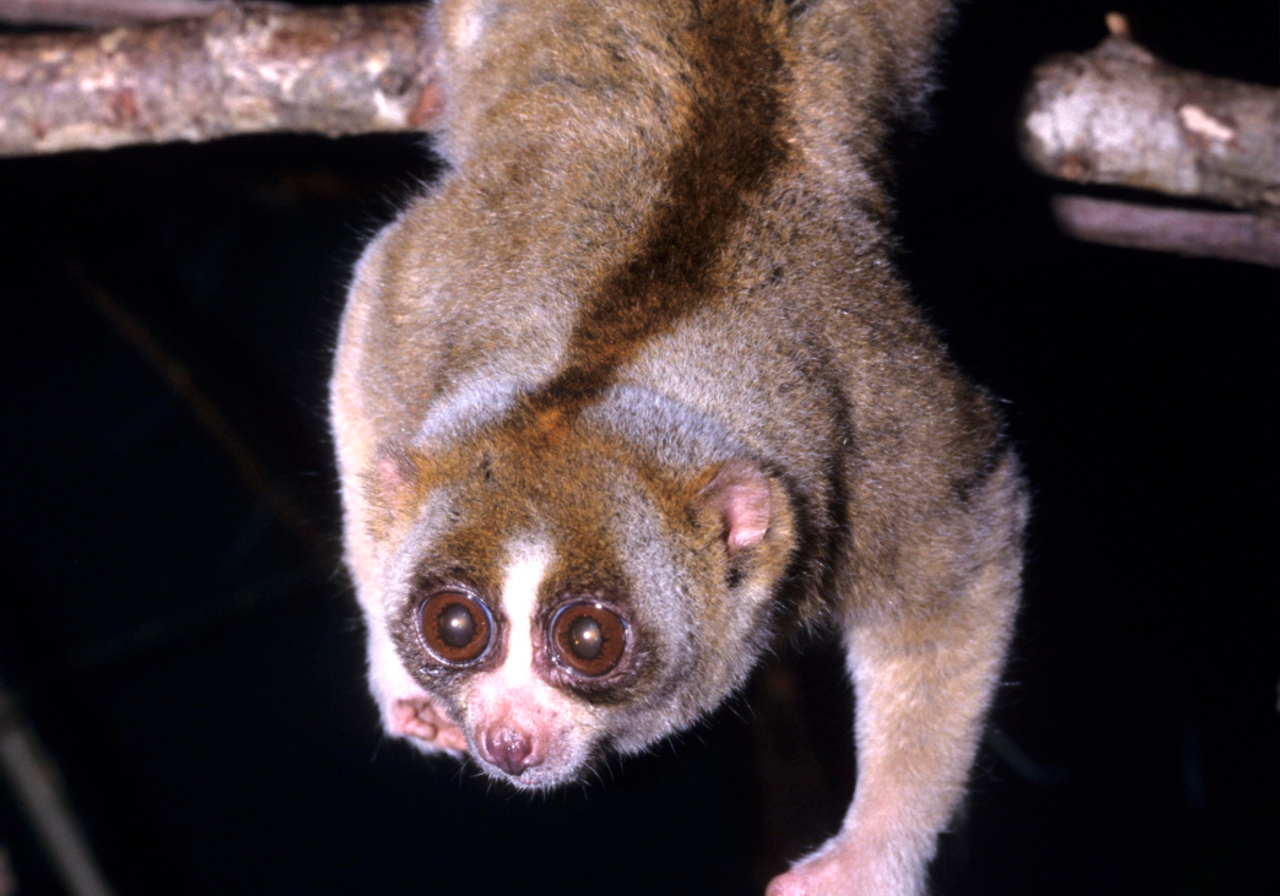
The slow loris (Nycticebus coucang) is a mammal of the family Lorisidae, in the order Primates.
Quick answer
Slow lorises are small, nocturnal primates of South and South-East Asia with huge eyes, a firm grip and a gland inside each elbow that produces a toxin. This profile describes the Sunda slow loris (Nycticebus coucang) of Sumatra, the Malay Peninsula, southern Thailand and Singapore, which is 27–38 cm long and weighs about 600–685 g. It is listed as Endangered on the IUCN Red List (assessed 2015), with a decreasing population. The illegal pet trade is a major threat.
Top questions about the Slow Loris
Slow Loris facts at a glance
- Weight 640 g
- Length 33 cm
- Lifespan 20 years
| Scientific name | Nycticebus coucang (Sunda slow loris) |
|---|---|
| Diet | Tree sap and gum, nectar, fruit and some insects |
| Habitat | Tropical lowland forest, also swamp and hill forest |
| Length | 27–38 cm |
| Weight | About 600–685 g |
| Lifespan | About 20 years in the wild; record 25.8 years in captivity |
| Range | Sumatra, Peninsular Malaysia, southern Thailand and Singapore |
| Conservation status | Endangered (IUCN Red List, assessed 2015) |
| Kingdom | Animalia |
|---|---|
| Phylum | Chordata |
| Class | Mammalia |
| Order | Primates |
| Family | Lorisidae |
| Genus | Nycticebus |
Where it lives
The slow loris (Nycticebus coucang) is native to Sumatra and nearby islands (Indonesia), Peninsular Malaysia, southern Thailand south of the Isthmus of Kra, and Singapore. — recorded across Asia in this guide’s range summary.
For occurrence records, see GBIF species search and sources below.
How big is a slow loris?
An adult slow loris measures 33 cm long — about 19% of the height of an average adult person (1.73 m) — and weighs around 640 g, about 1% of an average adult’s body weight (70 kg).
Length vs an average adult’s height (to scale)
Slow by design
A slow loris moves through the trees on all four limbs, usually keeping three of them gripping a branch at any moment. It makes little noise and rarely changes speed, and it can hang beneath a branch by its feet for long periods. Its hands work like clamps: the second finger is reduced, which gives a powerful pincer grip.
A toxic primate
All slow lorises produce a toxin in a gland on the inside of each elbow. The loris spreads it through its fur with the comb-like teeth of its lower jaw when it grooms. A threatened loris may roll into a ball so that only treated fur faces the predator, or let go and drop from the tree.
What slow lorises eat
Sunda slow lorises are generalists. Roughly a third of the diet is tree sap and gum, another third is nectar and nectar-producing plants, and about a quarter is fruit. Insects, spiders, snails and birds' eggs make up the rest.
Why the pet trade harms them
The IUCN Red List classes the Sunda slow loris as Endangered, with numbers falling. Animal Diversity Web describes the pet trade as a severe threat: traders often remove the teeth to stop the animal biting, which commonly leads to infection and death, and a loris without teeth cannot be returned to the wild. Forest loss adds to the pressure. A slow loris is a wild animal and does not make a suitable pet.
Explore the Slow Loris
Close relatives
- Mountain Gorilla Same order
- Aye-aye Same order
- Japanese Macaque Same order
- Gorilla Same order
Collections
Did you know? Slow Loris facts
- A slow loris can hang beneath a branch by its feet for long periods.
- The IUCN Red List calls Nycticebus coucang the greater slow loris; it is also known as the Sunda slow loris.
Conservation status of the Slow Loris
The slow loris (Nycticebus coucang) is listed as Endangered on the IUCN Red List. Endangered (EN) means a species faces a very high risk of extinction in the wild. Populations are usually declining sharply due to habitat loss, hunting, disease, or climate pressure. It sits one level below Critically Endangered on the IUCN Red List.
Main threats to the slow loris
- Capture for the illegal pet trade
- Forest loss
Slow Loris (Nycticebus coucang) was most recently assessed for the IUCN Red List in 2015. View the full IUCN assessment .
Frequently asked questions about the Slow Loris
Are slow lorises venomous?
They produce a toxin in a gland on the inside of each elbow and spread it through their fur with their teeth when grooming, which helps to deter predators.
Can you keep a slow loris as a pet?
No. Slow lorises are wild, nocturnal animals with a specialised diet, and the Sunda slow loris is Endangered. Animals in the pet trade often have their teeth removed, which commonly causes fatal infection.
Where do slow lorises live?
The Sunda slow loris lives in Sumatra, Peninsular Malaysia, southern Thailand and Singapore. Other slow loris species live elsewhere in South and South-East Asia.
How long do slow lorises live?
Animal Diversity Web gives an average of about 20 years in the wild for the Sunda slow loris. The oldest on record in captivity lived 25.8 years.
Sources & references
This guide is compiled and reviewed against established zoological and conservation references. Key sources for the Slow Loris:
-
IUCN Red List of Threatened Species
Conservation status (Endangered) reflects the IUCN Red List category for Nycticebus coucang, most recently assessed in 2015.
-
iNaturalist — observations & photos
Search citizen-science observations and community IDs for Nycticebus coucang. Useful for range checks and recent sightings — not a substitute for formal Red List status.
-
GBIF — occurrence data
Global Biodiversity Information Facility species search for Nycticebus coucang. Explore published occurrence records used in range research.
- Nekaris, K.A.I., Poindexter, S. & Streicher, U. (2020). Nycticebus coucang. The IUCN Red List of Threatened Species 2020: e.T163017685A17970966. Checked 16 November 2026.
IUCN Red List category Endangered, assessed 2015; population trend decreasing.
- Animal Diversity Web: Nycticebus coucang. University of Michigan Museum of Zoology.
Size, lifespan, range, diet, toxin and pet-trade threat.
-
Global Animal Guide editorial standards
How we research, source, review, and update every guide for accuracy.