Quick answer
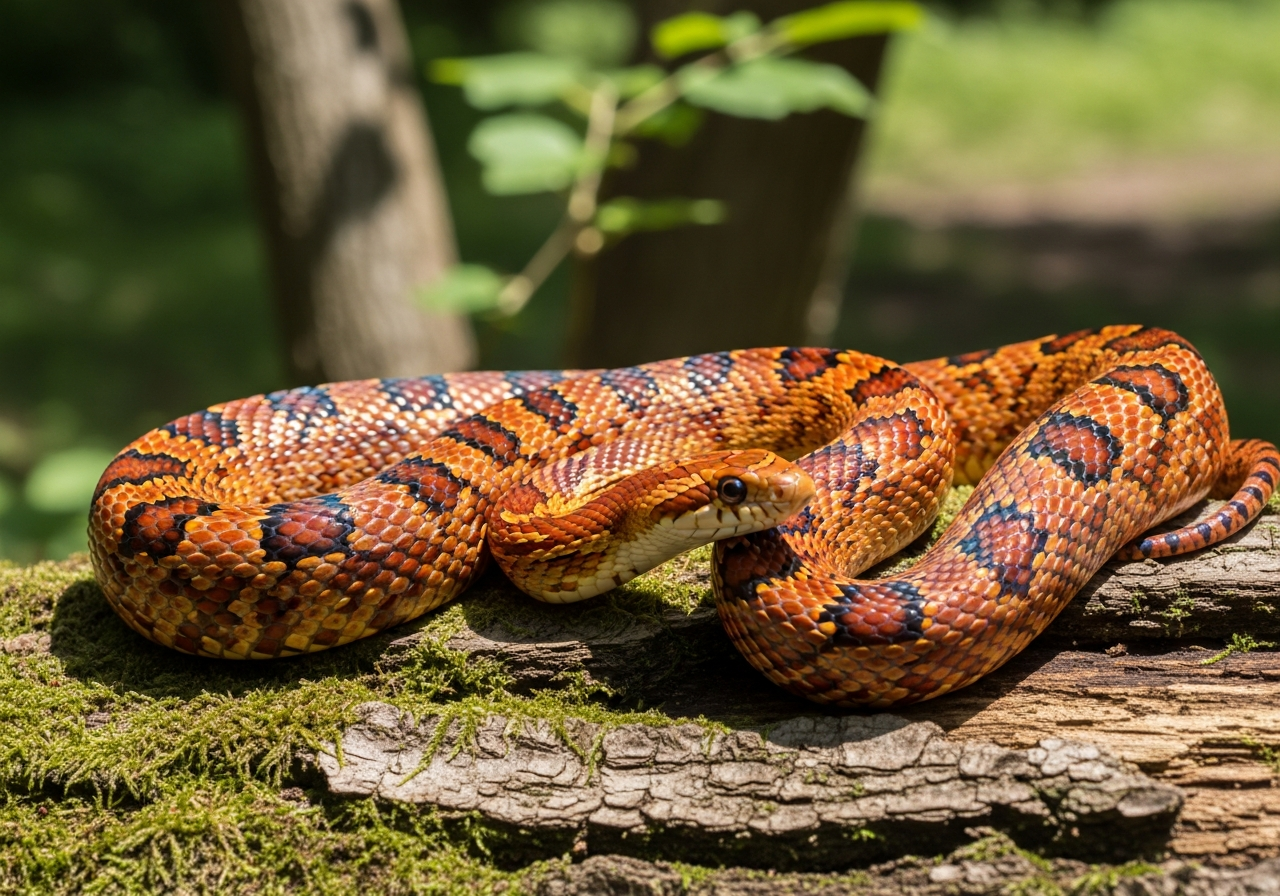
The corn snake (Pantherophis guttatus) is a gentle, colourful North American rat snake and one of the most popular pet snakes in the world. Native to the fields, woodlands and farmland of the southeastern United States, it grows to around 1.4 m (up to about 1.8 m) and is a non-venomous constrictor that hunts rodents. Docile and easy to keep, corn snakes can live 15 to 20 years in captivity and are listed as Least Concern.
Top questions about the Corn Snake
Corn Snake facts at a glance
- Weight 900 g
- Length 1.4 m
- Top speed 5 km/h
- Lifespan 18 years
| Scientific name | Pantherophis guttatus |
|---|---|
| Diet | Carnivore |
| Habitat | Fields, woodlands, and farmland |
| Lifespan | 15–20 years in captivity |
| Length | 0.6–1.8 m (2–6 ft) |
| Weight | About 0.9 kg (2 lb) |
| Conservation status | Least Concern (IUCN) |
| Kingdom | Animalia |
|---|---|
| Phylum | Chordata |
| Class | Reptilia |
| Order | Squamata |
| Family | Colubridae |
| Genus | Pantherophis |
Where it lives
The corn snake (Pantherophis guttatus) is native to Fields, woodlands, and farmland across the southeastern and central United States. — recorded across North America in this guide’s range summary.
For occurrence records, see GBIF species search and sources below.
How big is a corn snake?
An adult corn snake measures 1.4 m long — about 81% of the height of an average adult person (1.73 m) — and weighs around 900 g, about 1% of an average adult’s body weight (70 kg).
Length vs an average adult’s height (to scale)
What is a group of corn snakes called?
Group name (collective noun)
A group of Corn Snakes is called a nest.
Baby name
A baby Corn Snake is called a hatchling. It may also be called a snakelet.
Explore more animal collective nouns and baby animal names .
Appearance and colour
The corn snake is named partly for the maize-like checkerboard pattern on its belly and partly for its habit of hunting around grain stores. Wild individuals are typically orange or reddish-brown with bold, black-edged red or orange blotches down the back. Decades of captive breeding have produced a huge range of colour and pattern variations, known as morphs, from snow-white to lavender. A slender adult reaches about 1.4 m long and weighs around 0.9 kg (2 lb).
A non-venomous constrictor
The corn snake is completely harmless to people, with no venom and only tiny teeth. It kills its prey by constriction, coiling around a rodent and tightening its grip until the animal stops breathing before swallowing it whole. Corn snakes are carnivores that feed mainly on mice, rats and other small rodents, along with the occasional bird or egg. This appetite for rodents makes them welcome around farms and barns, where they help control pests.
Habitat and behaviour
In the wild the corn snake ranges across the southeastern United States, favouring fields, woodlands, farmland and abandoned buildings. It slithers across the ground and is a capable climber, scaling trees and rafters in search of prey and shelter. Mostly active at dawn, dusk and night, it spends much of its time hidden under logs, rocks or debris. When alarmed it may vibrate its tail against dry leaves, mimicking a rattlesnake to bluff predators.
Why it is a popular pet
The corn snake is often recommended as an ideal beginner's snake because it is calm, tolerant of handling and simple to care for. It stays a manageable size, feeds readily on frozen-thawed rodents, and rarely bites. Its wide array of colour morphs also makes it a favourite among keepers and breeders. With good care a pet corn snake can live 15 to 20 years.
Reproduction and life cycle
Corn snakes breed in spring, after emerging from a cooler winter dormancy that helps trigger the cycle. The female lays a clutch of around a dozen eggs in a warm, humid, hidden spot such as rotting wood or leaf litter, then leaves them to develop on their own. The eggs hatch after about two months, and the young snakes are independent from birth. In the wild corn snakes generally live several years, but in captivity they commonly reach 15 to 20 years.
Conservation status
The corn snake is listed as Least Concern and remains common across its native range in the southeastern United States. It is one of the most widely bred snakes in the world, so the pet trade draws overwhelmingly on captive-bred animals rather than wild ones. Habitat loss and road deaths affect some local populations, but the species as a whole is secure. Its adaptability to farmland and disturbed land has helped it persist alongside people.
Dig deeper into the Corn Snake
- Corn Snake: Key Facts
Corn Snakes (Pantherophis guttatus) are reptiles found across North America. The gentle, colorful beginner's pet snake.
- How Big Is A Corn Snake?
Corn Snake size and weight: typical About 0.9 kg (2 lb), dimorphism, and growth.
- How Long Do Corn Snakes Live?
Corn Snake lifespan is typically 15–20 years in captivity. What shortens or extends life, life stages, and status (Least Concern).
- What Do Corn Snakes Eat?
What corn snakes eat: Carnivore, foraging style, and seasonal shifts in Fields, woodlands, and farmland.
- Where Do Corn Snakes Live?
Where corn snakes live: Fields, woodlands, and farmland, native range cues, and human overlap. Status Least Concern.
Explore the Corn Snake
Related Reptiles
Range & geography
Did you know? Corn Snake facts
- The corn snake is a slender, non-venomous North American snake known for its orange-and-red blotched pattern and calm temperament.
- No. Corn snakes are non-venomous constrictors. They are harmless to humans and kill their small prey by squeezing rather than with venom.
- Yes. Corn snakes are among the most recommended beginner snakes because they stay a manageable size, are docile, tolerate handling, and have straightforward care requirements.
- Corn snakes are carnivores that mainly eat rodents such as mice and rats, plus birds and eggs in the wild. Captive corn snakes are usually fed frozen-thawed rodents.
- With good care, corn snakes commonly live 15 to 20 years in captivity, and some individuals live longer, so they are a long-term commitment.
- Conservation: Least Concern (IUCN).
Diet & feeding
Corn Snake feeds primarily as a carnivore. Corn snakes are generally calm and rarely bite, which is a big reason for their popularity as pets. They are good climbers and burrowers and are most active around dawn and dusk. When threatened in the wild, a corn snake may vibrate its tail in dry leaves, mimicking a rattlesn
Adaptations
- Corn snakes are generally calm and rarely bite, which is a big reason for their popularity as pets. They are good climbers and burrowers and are most active around dawn and dusk. When threatened in the wild, a corn snake may vibrate its tail in dry leaves, mimicking a rattlesnake to bluff predators.
- Corn snakes are constrictors that feed mainly on rodents such as mice and rats, along with birds and their eggs. By hunting rodents around barns and fields, they provide valuable natural pest control, which is part of how they got their name. In captivity they are usually fed appropriately sized frozen-thawed rodents.
Behaviour & ecology
- Corn snakes are generally calm and rarely bite, which is a big reason for their popularity as pets. They are good climbers and burrowers and are most active around dawn and dusk. When threatened in the wild, a corn snake may vibrate its tail in dry leaves, mimicking a rattlesnake to bluff predators.
- Corn snakes are constrictors that feed mainly on rodents such as mice and rats, along with birds and their eggs. By hunting rodents around barns and fields, they provide valuable natural pest control, which is part of how they got their name. In captivity they are usually fed appropriately sized frozen-thawed rodents.
- Corn snakes are native to the southeastern and central United States, where they live in fields, woodlands, farmland, and abandoned buildings. They favor places with plenty of cover and a steady supply of rodents. During colder months they shelter in burrows and crevices and become inactive.
Communication
- Scent marking, body posture, and head-bobbing or tail signals communicate threat and dominance.
- Vocalisations are limited in many reptiles but hissing or bellowing occurs in some groups.
Habitat & range
Fields, woodlands, and farmland
Ecological role
Corn Snake acts as a predator that helps regulate prey populations and maintain balance in fields, woodlands, and farmland.
Conservation status of the Corn Snake
The corn snake (Pantherophis guttatus) is listed as Least Concern on the IUCN Red List. Least Concern (LC) is the IUCN's lowest-risk category, assigned to widespread, abundant species that have been evaluated and found not to be threatened. It does not mean a species faces no pressures — only that it is not currently at risk of extinction.
The corn snake (Pantherophis guttatus) is assessed on the IUCN Red List. Look up on the IUCN Red List .
Frequently asked questions about the Corn Snake
Are corn snakes venomous or dangerous?
No. Corn snakes are completely non-venomous and harmless to people. They kill prey by constriction, are very docile, and rarely bite, which is why they are considered one of the safest pet snakes.
How big do corn snakes get?
Corn snakes typically grow to around 1.4 m long, with some reaching about 1.8 m (6 ft), and weigh roughly 0.9 kg (2 lb). They are a slender, moderately sized rat snake.
What do corn snakes eat?
Corn snakes are carnivores that feed mainly on mice, rats and other small rodents, along with the occasional bird or egg. In captivity they are usually fed appropriately sized frozen-thawed rodents.
How long do corn snakes live?
With good care a pet corn snake can live 15 to 20 years. Wild corn snakes generally live shorter lives because of predators and other hazards.
Why are corn snakes good pets for beginners?
Corn snakes are calm, tolerant of handling and simple to care for. They stay a manageable size, feed readily on frozen-thawed rodents, rarely bite, and come in a wide range of attractive colour morphs.
Why is it called a corn snake?
The name comes partly from the maize-like checkerboard pattern on the snake's belly and partly from its habit of hunting rodents around grain and corn stores. It is a type of North American rat snake.
What is a group of corn snakes called?
A group of Corn Snakes is called a nest.
What is a baby corn snake called?
A baby Corn Snake is called a hatchling. It may also be called a snakelet.
Sources & references
This guide is compiled and reviewed against established zoological and conservation references. Key sources for the Corn Snake:
-
IUCN Red List of Threatened Species
Conservation status (Least Concern) reflects the IUCN Red List category for Pantherophis guttatus.
-
iNaturalist — observations & photos
Search citizen-science observations and community IDs for Pantherophis guttatus. Useful for range checks and recent sightings — not a substitute for formal Red List status.
-
GBIF — occurrence data
Global Biodiversity Information Facility species search for Pantherophis guttatus. Explore published occurrence records used in range research.
- IUCN Red List — Pantherophis guttatus.
Conservation status (Least Concern) and population trends.
- Animal Diversity Web — Pantherophis guttatus. University of Michigan Museum of Zoology.
Life history, morphology, and range.
- Wikipedia — Corn Snake.
General taxonomy and overview (cross-check primary sources).
-
Global Animal Guide editorial standards
How we research, source, review, and update every guide for accuracy.