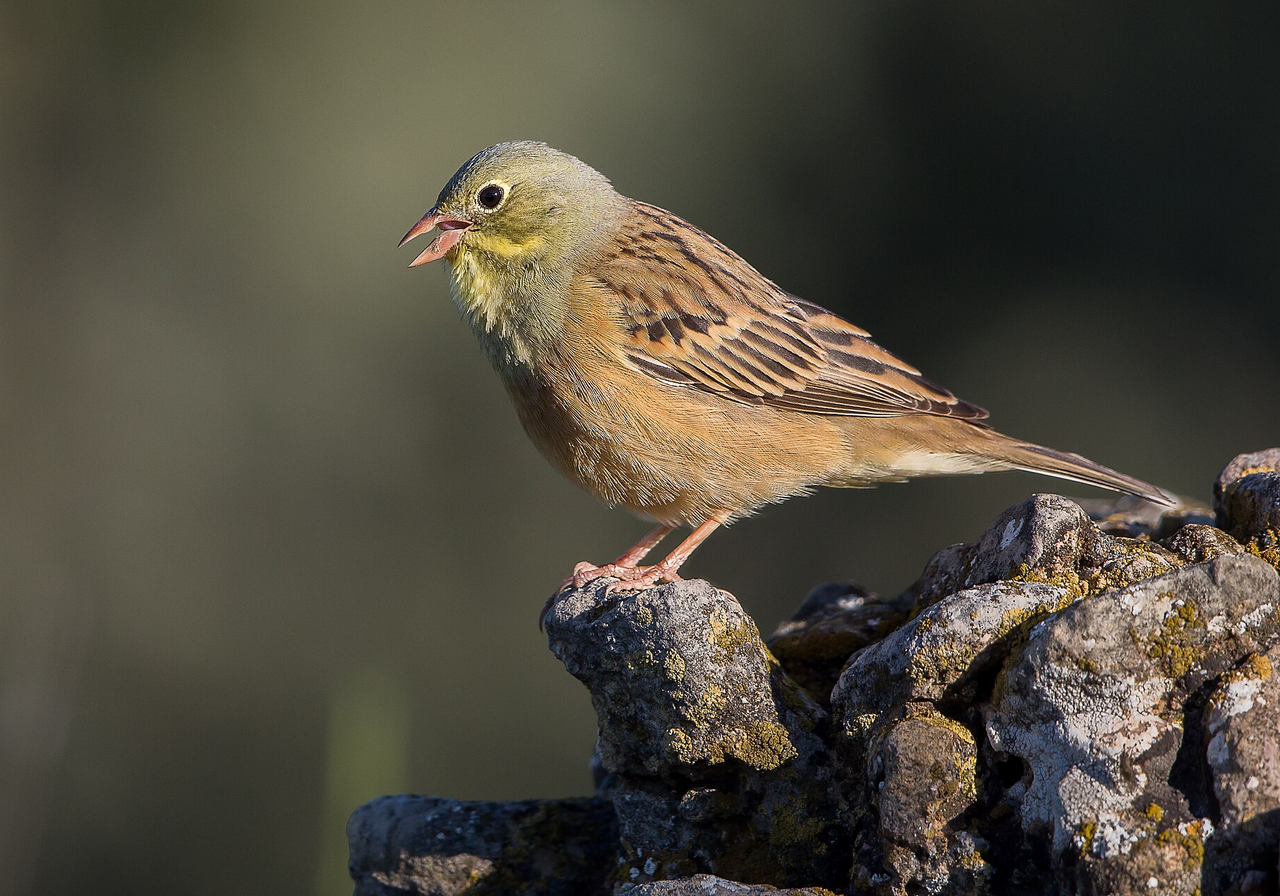
The ortolan bunting (Emberiza hortulana) is a bird of the family Emberizidae, in the order Passeriformes.
Quick answer
The ortolan bunting (Emberiza hortulana) is a small songbird that breeds from Europe to Mongolia and winters in Africa south of the Sahara. It has an olive-grey head, yellow throat and pale eye-ring. It is best known for its use as a delicacy in France, which is now illegal. Globally it is Least Concern, but it is declining and has vanished from much of north-west Europe.
Top questions about the Ortolan Bunting
Ortolan Bunting facts at a glance
- Weight 20 g
- Length 16 cm
| Scientific name | Emberiza hortulana |
|---|---|
| Diet | Seeds; insects when feeding chicks |
| Habitat | Open, warm hillsides with scattered trees, vineyards and farmland |
| Length | About 16–17 cm |
| Weight | About 20 g |
| Migration | Winters in the Sahel, Ethiopia and south-west Arabia |
| Conservation status | Least Concern (IUCN Red List, assessed 2025) |
| Kingdom | Animalia |
|---|---|
| Phylum | Chordata |
| Class | Aves |
| Order | Passeriformes |
| Family | Emberizidae |
| Genus | Emberiza |
Where it lives
The ortolan bunting (Emberiza hortulana) is native to Breeds from Iberia and Scandinavia east to Mongolia and north-west China; winters in the Sahel, Ethiopia, Eritrea and south-west Arabia. — recorded across Europe, Asia, Africa in this guide’s range summary.
For occurrence records, see GBIF species search and sources below.
How big is a ortolan bunting?
An adult ortolan bunting measures 16 cm long — about 9% of the height of an average adult person (1.73 m) — and weighs around 20 g, a small fraction of an average adult’s body weight (70 kg).
Length vs an average adult’s height (to scale)
What is a baby ortolan bunting called?
Baby name
A baby Ortolan Bunting is called a chick.
Explore more animal collective nouns and baby animal names .
Identification
Males have an olive-grey head and breast band, a pale yellow throat and moustache stripe, a narrow pale eye-ring and a pinkish bill. The underparts are warm orange-buff. Females and young birds are duller and streaked. The song is a short, ringing series of notes.
A long-distance migrant
The IOC World Bird List describes a breeding range from Scandinavia and Iberia east across Europe, Turkey and the Caucasus to Kazakhstan, north-west China and Mongolia. In autumn the whole population flies south to winter in upland semi-arid country across the Sahel, Eritrea, Ethiopia and south-west Arabia.
The ortolan dish
In France ortolans were traditionally caught on migration, fattened and eaten whole. BirdLife records the species as used for human food. It is listed on Annex I of the EU Birds Directive and protected under the Bern Convention, so hunting it for the table is illegal across the European Union.
Status
BirdLife International lists the ortolan bunting as Least Concern globally (2025), with 11 to 17 million mature birds, but the trend is decreasing. Within the EU the breeding population fell by more than 25% in a decade and it is assessed as Near Threatened at EU level. It is now functionally extinct across much of north-west Europe, mainly because of changes in farming.
Explore the Ortolan Bunting
Close relatives
- Canary Same order
- House Sparrow Same order
- Superb Lyrebird Same order
- Blue Tit Same order
Did you know? Ortolan Bunting facts
- The whole population migrates to Africa south of the Sahara or south-west Arabia each autumn.
- BirdLife describes it as functionally extinct across much of north-west Europe.
Conservation status of the Ortolan Bunting
The ortolan bunting (Emberiza hortulana) is listed as Least Concern on the IUCN Red List. Least Concern (LC) is the IUCN's lowest-risk category, assigned to widespread, abundant species that have been evaluated and found not to be threatened. It does not mean a species faces no pressures — only that it is not currently at risk of extinction.
Ortolan Bunting (Emberiza hortulana) was most recently assessed for the IUCN Red List in 2025. Look up on the IUCN Red List .
Frequently asked questions about the Ortolan Bunting
Is it illegal to eat ortolan?
Yes, within the European Union. The ortolan bunting is protected under the EU Birds Directive (Annex I), so catching or killing it for food is illegal, including in France.
Is the ortolan bunting endangered?
Not globally: BirdLife lists it as Least Concern because it is still widespread in eastern Europe and Asia. But it is declining and is Near Threatened at EU level.
Where do ortolan buntings live?
They breed from Spain and Scandinavia east to Mongolia and spend the winter in Africa south of the Sahara and in south-west Arabia.
How big is an ortolan bunting?
About 16–17 cm long and roughly 20 g, similar in size to a house sparrow.
What is a baby ortolan bunting called?
A baby Ortolan Bunting is called a chick.
Sources & references
This guide is compiled and reviewed against established zoological and conservation references. Key sources for the Ortolan Bunting:
-
IUCN Red List of Threatened Species
Conservation status (Least Concern) reflects the IUCN Red List category for Emberiza hortulana, most recently assessed in 2025.
-
iNaturalist — observations & photos
Search citizen-science observations and community IDs for Emberiza hortulana. Useful for range checks and recent sightings — not a substitute for formal Red List status.
-
GBIF — occurrence data
Global Biodiversity Information Facility species search for Emberiza hortulana. Explore published occurrence records used in range research.
-
eBird — bird observations
Cornell Lab eBird target search for Ortolan Bunting. Check recent checklists and seasonal abundance where birders report this species.
- BirdLife International (2026). Species factsheet: Ortolan Bunting Emberiza hortulana. BirdLife DataZone. Checked 1 November 2026.
IUCN Red List category Least Concern (assessed 2025), population estimate and trend.
- Tobias, J. A. et al. (2022). AVONET: morphological, ecological and geographical data for all birds. Ecology Letters 25: 581–597. doi:10.1111/ele.13898
Average body mass.
- Gill, F., Donsker, D. & Rasmussen, P. (Eds). IOC World Bird List v15.2.
English and scientific name, classification and range.
-
Global Animal Guide editorial standards
How we research, source, review, and update every guide for accuracy.