Image sourcing: see credits & licences
Quick answer
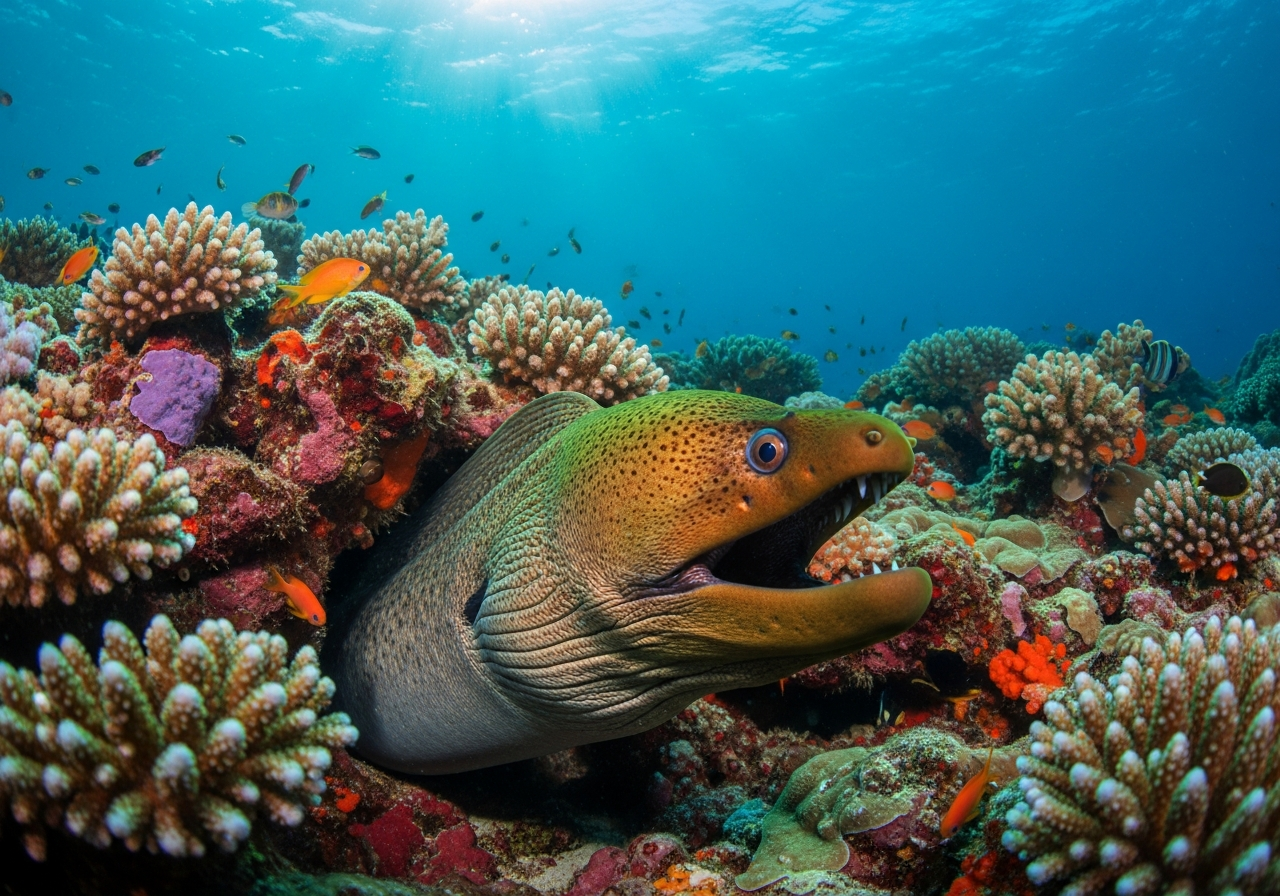
Moray eels are a family of long, snake-like marine fish (Muraenidae) found in coral reefs and rocky crevices, mostly in warm and temperate seas. They swim with an undulating, ribbon-like motion and shelter in holes by day, striking out to catch fish, crustaceans, and octopuses. Large species can reach 3 m (10 ft) and around 15 kg, and many live 10 to 30 years depending on the species.
Top questions about the Moray Eel
Moray Eel facts at a glance
- Weight 15 kg
- Length 1.5 m
- Top speed 12 km/h
- Lifespan 20 years
| Scientific name | Muraenidae |
|---|---|
| Diet | Carnivore (fish, crustaceans, cephalopods) |
| Habitat | Coral reefs and rocky crevices |
| Lifespan | 10–30 years by species |
| Length | Varies; up to 3 m (10 ft) in large species |
| Top speed | Fast strike from cover |
| Conservation status | Varies by species |
| Kingdom | Animalia |
|---|---|
| Phylum | Chordata |
| Class | Actinopterygii |
| Order | Anguilliformes |
| Family | Muraenidae |
Where it lives
The moray eel (Muraenidae) is native to Coral reefs and rocky crevices in tropical and temperate seas worldwide. — recorded across Oceans in this guide’s range summary.
For occurrence records, see GBIF species search and sources below.
How big is a moray eel?
An adult moray eel measures 1.5 m long — about 87% of the height of an average adult person (1.73 m) — and weighs around 15 kg, about 21% of an average adult’s body weight (70 kg).
Length vs an average adult’s height (to scale)
What is a baby moray eel called?
Baby name
A baby Moray Eel is called an elver. It may also be called a leptocephalus.
Explore more animal collective nouns and baby animal names .
Appearance and body plan
Morays have a slender, muscular, snake-like body with no pelvic or pectoral fins, and a long dorsal fin that runs the length of the back. Their scaleless skin is covered in a protective mucus, and many species are patterned to blend into reef crevices. Size varies widely between species, with large ones reaching up to 3 m (10 ft) and weighing around 15 kg. Their constantly open mouth, showing rows of needle-like teeth, is a breathing action rather than a threat.
Habitat and behaviour
Moray eels live in coral reefs, rocky reefs, and crevices, mostly in tropical and subtropical seas, with some species in temperate waters. By day they usually shelter in holes with only the head protruding, and they become more active hunters at night. Although they can strike quickly from cover, they generally swim slowly and stay close to their den. Their apparent gaping is simply how they pump water over their gills to breathe.
Diet and hunting
Morays are carnivores that feed on fish, crustaceans, and cephalopods such as octopuses. They hunt largely by ambush, waiting in a crevice and lunging out with a fast strike when prey passes, relying on a keen sense of smell to locate food in dim conditions. Some species have been observed cooperating with reef fish such as groupers, which flush prey out of hiding for the eel to catch. Their backward-pointing teeth make it very hard for prey to escape once seized.
Reproduction and lifespan
Most morays release eggs and sperm into open water, where fertilised eggs develop into transparent, leaf-shaped larvae that drift with the plankton before settling onto a reef. This larval stage can last for months, helping the young disperse over wide areas. Depending on the species, morays live roughly 10 to 30 years. They grow slowly and can occupy the same crevice for long periods once established.
Dig deeper into the Moray Eel
- How Big Is A Moray Eel?
Moray Eel size and weight: typical about 15 kg, dimorphism, and growth.
- How Long Do Moray Eels Live?
Moray Eel lifespan is typically 10–30 years by species. What shortens or extends life, life stages, and status (Least Concern).
- Moray Eel: Key Facts
Moray Eels (Muraenidae) are fish found across multiple regions. The reef-dwelling eel with hidden jaws.
- What Do Moray Eels Eat?
What moray eels eat: Carnivore (fish, crustaceans, cephalopods), foraging style, and seasonal shifts in Coral reefs and rocky crevices.
- Where Do Moray Eels Live?
Where moray eels live: Coral reefs and rocky crevices, native range cues, and human overlap. Status Least Concern.
Explore the Moray Eel
Related Fishs
Range & geography
Did you know? Moray Eel facts
- Moray eels are a family of elongated, snake-like fish that live in crevices of coral reefs and rocky seabeds in tropical and temperate seas worldwide.
- Moray eels are not aggressive but will bite if threatened, cornered, or fed by hand. Their sharp, backward-curving teeth can cause deep wounds, so divers should avoid reaching into crevices.
- Morays are carnivores that ambush fish, crustaceans, octopuses, and squid, striking from cover and using a second set of throat jaws to pull prey down.
- The constant gaping pumps water over their gills so they can breathe. It looks threatening but is mostly a normal breathing action rather than aggression.
- Size varies widely by species, from small morays under a meter to giants such as the giant moray, which can exceed 3 m (10 ft) in length.
- Conservation: Varies by species.
Diet & feeding
Moray Eel feeds primarily as a carnivore (fish, crustaceans, cephalopods). Moray eels spend most of the day hidden in reef crevices, holes, and rocky cracks, often with only their head showing as they open and close their mouths to pump water over the gills for breathing. This constant gaping makes them look menacing,
Adaptations
- Moray eels spend most of the day hidden in reef crevices, holes, and rocky cracks, often with only their head showing as they open and close their mouths to pump water over the gills for breathing. This constant gaping makes them look menacing, but it is mainly a way to breathe rather than a threat. They have poor eyesight and rely heavily on a keen sense of smell to detect food.
- Morays are carnivores that ambush fish, crustaceans, octopuses, and squid, lunging from cover to seize prey. Many species have a remarkable second set of jaws, called pharyngeal jaws, that shoot forward from the throat to grip and pull prey down the gullet. This adaptation helps them swallow food in their narrow burrows where suction feeding is difficult.
Behaviour & ecology
- Moray eels spend most of the day hidden in reef crevices, holes, and rocky cracks, often with only their head showing as they open and close their mouths to pump water over the gills for breathing. This constant gaping makes them look menacing, but it is mainly a way to breathe rather than a threat. They have poor eyesight and rely heavily on a keen sense of smell to detect food.
- Morays are carnivores that ambush fish, crustaceans, octopuses, and squid, lunging from cover to seize prey. Many species have a remarkable second set of jaws, called pharyngeal jaws, that shoot forward from the throat to grip and pull prey down the gullet. This adaptation helps them swallow food in their narrow burrows where suction feeding is difficult.
- There are many species of moray eel living in tropical and temperate seas around the world, mostly on coral reefs and rocky shores. They occupy a range of depths from shallow lagoons to deeper reef slopes, always favoring places with plenty of hiding spots. Some species also enter brackish water near river mouths.
Communication
- Lateral-line and visual cues coordinate schooling, courtship, or territorial behaviour.
- Some species produce low-frequency sounds or drumming for spawning or defence.
Habitat & range
Coral reefs and rocky crevices
Ecological role
Moray Eel acts as a predator that helps regulate prey populations and maintain balance in coral reefs and rocky crevices.
Conservation status of the Moray Eel
The moray eel (Muraenidae) is listed as Least Concern on the IUCN Red List. Least Concern (LC) is the IUCN's lowest-risk category, assigned to widespread, abundant species that have been evaluated and found not to be threatened. It does not mean a species faces no pressures — only that it is not currently at risk of extinction.
The moray eel (Muraenidae) is assessed on the IUCN Red List. Look up on the IUCN Red List .
Frequently asked questions about the Moray Eel
Are moray eels dangerous to humans?
Moray eels are not naturally aggressive toward people and prefer to stay hidden in their crevices. Bites usually happen when a diver reaches into a hole or tries to feed them, and their sharp, backward-facing teeth can cause a serious wound.
Why do moray eels keep their mouths open?
The constant opening and closing of a moray's mouth is how it pumps water over its gills to breathe, not a sign of aggression. Because they rest in tight crevices, this pumping is more visible than in fish that swim in the open.
How big do moray eels get?
Size varies greatly by species, from under a metre to about 3 m (10 ft) in the largest. Big species can weigh around 15 kg, with a long, muscular body built for life in reef crevices.
What do moray eels eat?
Morays are carnivores that eat fish, crustaceans, and cephalopods such as octopuses. They ambush prey from cover and use a hidden second set of jaws in the throat to pull food back and swallow it.
How long do moray eels live?
Lifespan depends on the species, but many morays live between 10 and 30 years. They grow slowly and may hold the same den site for years once settled.
Do moray eels really have two sets of jaws?
Yes. In addition to their outer jaws, morays have pharyngeal jaws in the throat that shoot forward to grip prey and drag it toward the stomach. This lets them swallow prey inside narrow crevices where suction feeding is not possible.
What is a baby moray eel called?
A baby Moray Eel is called an elver. It may also be called a leptocephalus.
Sources & references
This guide is compiled and reviewed against established zoological and conservation references. Key sources for the Moray Eel:
-
IUCN Red List of Threatened Species
Conservation status (Least Concern) reflects the IUCN Red List category for Muraenidae.
-
iNaturalist — observations & photos
Search citizen-science observations and community IDs for Muraenidae. Useful for range checks and recent sightings — not a substitute for formal Red List status.
-
GBIF — occurrence data
Global Biodiversity Information Facility species search for Muraenidae. Explore published occurrence records used in range research.
- IUCN Red List — Muraenidae.
Conservation status (Least Concern) and population trends.
- Wikipedia — Moray Eel.
General taxonomy and overview (cross-check primary sources).
-
Global Animal Guide editorial standards
How we research, source, review, and update every guide for accuracy.