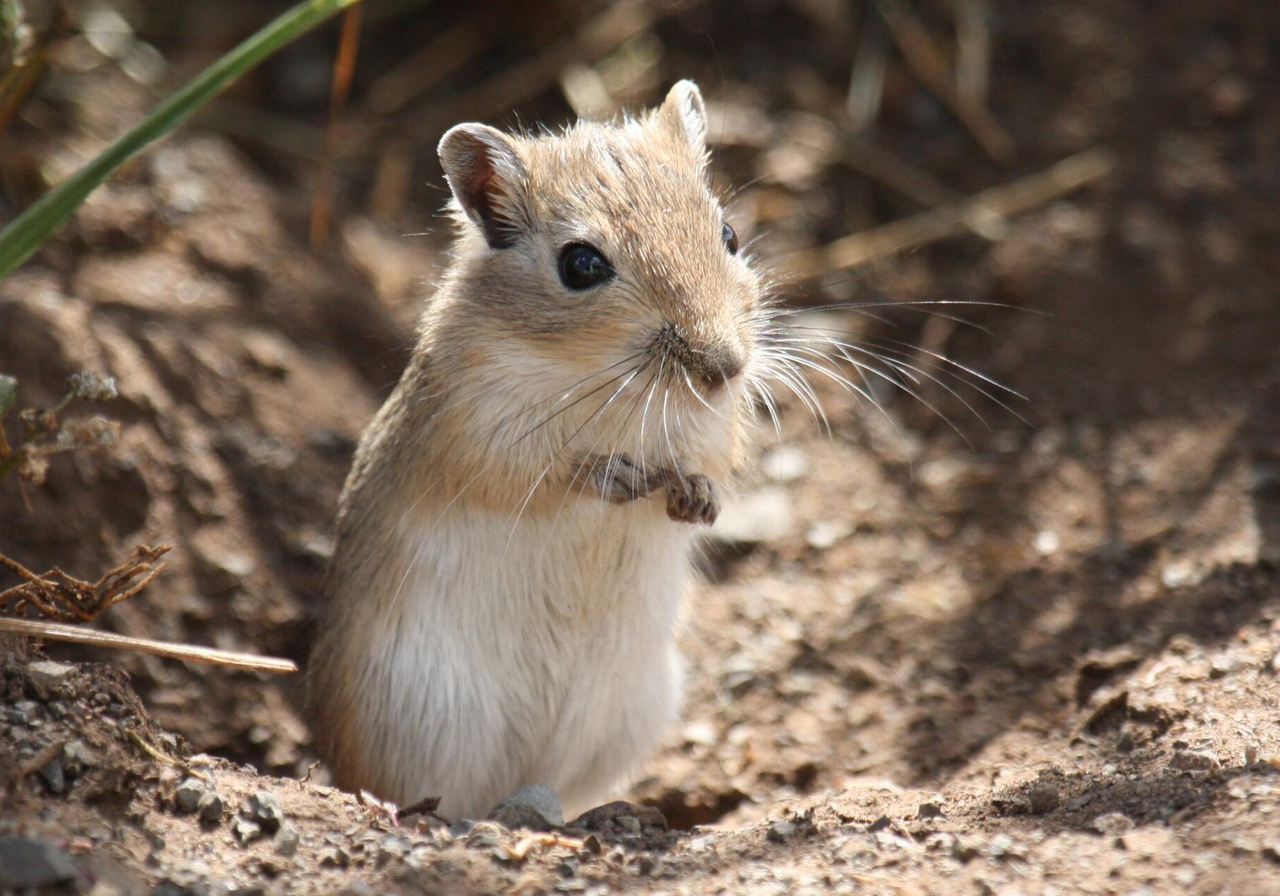
The mongolian gerbil (Meriones unguiculatus) is a mammal of the family Muridae, in the order Rodentia.
Quick answer
The Mongolian gerbil (Meriones unguiculatus), also called the Mongolian jird, is a small burrowing rodent from the dry steppe of Mongolia, northern China and southern Siberia. It weighs 52–133 g, with a body about 12 cm long and a tail of similar length. It lives in family groups and is now a popular pet. It is listed as Least Concern on the IUCN Red List (assessed 2016).
Top questions about the Mongolian Gerbil
Mongolian Gerbil facts at a glance
- Weight 96 g
- Length 12 cm
- Lifespan 2 years
| Scientific name | Meriones unguiculatus |
|---|---|
| Also called | Mongolian jird |
| Diet | Mugwort, saltwort and grasses |
| Habitat | Arid steppe, sandy desert, grassland and scrub |
| Body length | About 12 cm, with a tail up to 12 cm |
| Weight | 52–133 g; 96 g on average |
| Range | Mongolia, northern China and southern Siberia |
| Conservation status | Least Concern (IUCN Red List, assessed 2016) |
| Kingdom | Animalia |
|---|---|
| Phylum | Chordata |
| Class | Mammalia |
| Order | Rodentia |
| Family | Muridae |
| Genus | Meriones |
Where it lives
The mongolian gerbil (Meriones unguiculatus) is native to Dry steppe and semi-desert of Mongolia, northern China (including Inner Mongolia) and adjacent southern Siberia. — recorded across Asia in this guide’s range summary.
For occurrence records, see GBIF species search and sources below.
How big is a mongolian gerbil?
An adult mongolian gerbil measures 12 cm long — about 7% of the height of an average adult person (1.73 m) — and weighs around 96 g, a small fraction of an average adult’s body weight (70 kg).
Length vs an average adult’s height (to scale)
What is a group of mongolian gerbils called?
Group name (collective noun)
A group of Mongolian Gerbils is called a colony.
Baby name
A baby Mongolian Gerbil is called a pup.
Explore more animal collective nouns and baby animal names .
A harsh home
Wild gerbils live where temperatures can range from −40 °C in winter to 50 °C in summer. They dig burrows in soft soil, often beside a plant whose roots help to support the tunnel.
Saving water
Gerbils conserve water and fat extremely well, producing very concentrated urine and dry droppings. They feed mainly on mugwort, with saltwort and grasses.
Family groups
Each family group appears to be led by a dominant male. Territories range from about 325 to 1,550 square metres.
From steppe to pet shop
The Mongolian gerbil is now a popular pet and is widely used in research. In the wild, the IUCN Red List classes it as Least Concern and records it in China, Mongolia and Russia.
Explore the Mongolian Gerbil
Close relatives
- Mouse Same family
- Rat Same family
- North American Beaver Same order
- Hamster Same order
Range & geography
Did you know? Mongolian Gerbil facts
- Wild gerbils often dig their burrows beside a plant so its roots support the tunnel.
- Gerbil territories range from about 325 to 1,550 square metres.
Conservation status of the Mongolian Gerbil
The mongolian gerbil (Meriones unguiculatus) is listed as Least Concern on the IUCN Red List. Least Concern (LC) is the IUCN's lowest-risk category, assigned to widespread, abundant species that have been evaluated and found not to be threatened. It does not mean a species faces no pressures — only that it is not currently at risk of extinction.
Mongolian Gerbil (Meriones unguiculatus) was most recently assessed for the IUCN Red List in 2016. View the full IUCN assessment .
Frequently asked questions about the Mongolian Gerbil
Where do gerbils come from?
Pet gerbils descend from the Mongolian gerbil, a wild rodent of the steppe of Mongolia, northern China and southern Siberia.
What do wild gerbils eat?
Mainly mugwort, along with saltwort and grasses.
How big is a Mongolian gerbil?
The body is about 12 cm long with a tail of up to 12 cm, and adults weigh 52–133 g.
What is a group of mongolian gerbils called?
A group of Mongolian Gerbils is called a colony.
What is a baby mongolian gerbil called?
A baby Mongolian Gerbil is called a pup.
Sources & references
This guide is compiled and reviewed against established zoological and conservation references. Key sources for the Mongolian Gerbil:
-
IUCN Red List of Threatened Species
Conservation status (Least Concern) reflects the IUCN Red List category for Meriones unguiculatus, most recently assessed in 2016.
-
iNaturalist — observations & photos
Search citizen-science observations and community IDs for Meriones unguiculatus. Useful for range checks and recent sightings — not a substitute for formal Red List status.
-
GBIF — occurrence data
Global Biodiversity Information Facility species search for Meriones unguiculatus. Explore published occurrence records used in range research.
- IUCN Red List of Threatened Species: Meriones unguiculatus (assessed 2016). Checked 16 November 2026.
IUCN Red List category Least Concern, assessed 2016; population trend unknown; native range.
- Animal Diversity Web: Meriones unguiculatus. University of Michigan Museum of Zoology.
Size, lifespan, range, diet and behaviour.
-
Global Animal Guide editorial standards
How we research, source, review, and update every guide for accuracy.