Quick answer
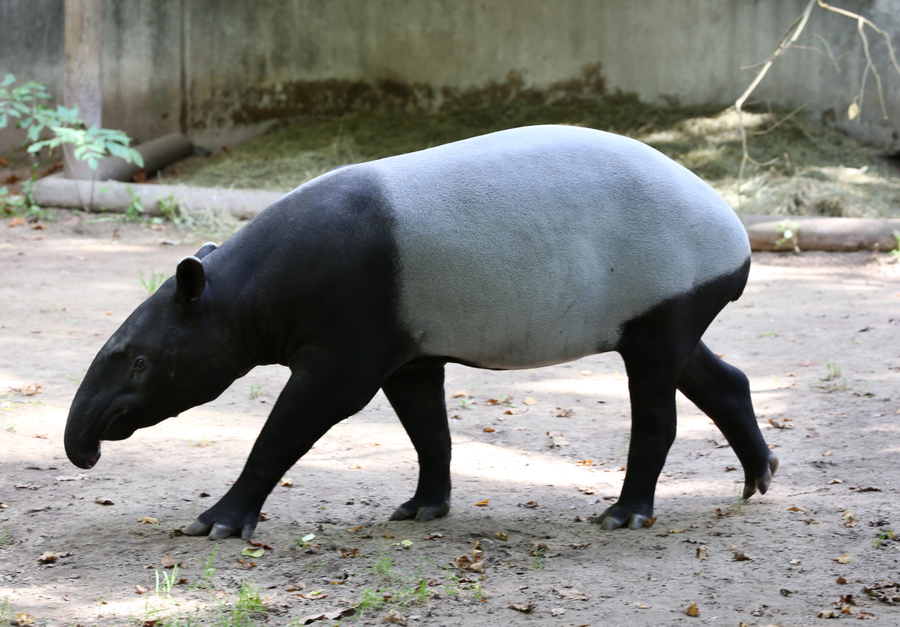
The Malayan tapir (Tapirus indicus) is the largest of the four tapir species and the only one native to Asia, instantly recognised by its black-and-white 'saddleback' coat. Adults weigh 250–540 kg (550–1,190 lb) and live around 30 years, but fewer than about 2,500 mature individuals remain, making it Endangered.
Top questions about the Malayan Tapir
Also available in Español (Tapir malayo)
Malayan Tapir facts at a glance
- Weight 350 kg
- Length 2.2 m
- Top speed 48 km/h
- Lifespan 30 years
| Scientific name | Tapirus indicus |
|---|---|
| Diet | Leaves, shoots, buds, and fruit from hundreds of plant species |
| Habitat | Lowland and hill rainforest of Southeast Asia, always near water |
| Lifespan | Around 25–30 years in the wild and captivity |
| Weight | 250–540 kg (550–1,190 lb) |
| Top speed | Up to 48 km/h (30 mph) over short distances; a strong swimmer |
| Conservation status | Endangered (IUCN) |
| Kingdom | Animalia |
|---|---|
| Phylum | Chordata |
| Class | Mammalia |
| Order | Perissodactyla |
| Family | Tapiridae |
| Genus | Tapirus |
Where it lives
The malayan tapir (Tapirus indicus) is native to Rainforests of southern Myanmar and Thailand, Peninsular Malaysia, and Sumatra. — recorded across Asia in this guide’s range summary.
For occurrence records, see GBIF species search and sources below.
How big is a malayan tapir?
An adult malayan tapir measures 2.2 m long — about 1.3× the height of an average adult person (1.73 m) — and weighs around 350 kg, about 5.0× an average adult’s body weight (70 kg).
Length vs an average adult’s height (to scale)
A two-tone giant
The Malayan tapir's front half and hindquarters are black, divided by a broad white saddle across the back and belly — disruptive camouflage that breaks up its outline in moonlit forest. It is the largest tapir, with a flexible, trunk-like proboscis used to grab foliage, and despite its bulk it moves quietly through dense vegetation.
Shy and solitary
Malayan tapirs live alone, marking territories with urine and keeping in touch through shrill whistles. They are most active at dusk and night, have poor eyesight but keen smell and hearing, and when startled crash downhill toward water — they swim well, dive to feed, and sometimes walk along riverbeds to cool off and shed skin parasites.
Diet and seed dispersal
A dedicated browser, the Malayan tapir eats the leaves, shoots, buds, and fallen fruit of more than a hundred plant species, pulling them in with the prehensile snout. Many seeds survive the trip through its gut and germinate in dung piles far from the parent tree, earning tapirs the nickname 'gardeners of the forest'.
Habitat and range
The species survives in southern Myanmar and Thailand, Peninsular Malaysia, and Sumatra, in lowland dipterocarp and hill forest. It once ranged more widely across mainland Southeast Asia but has been squeezed into fragmented reserves; Peninsular Malaysia now holds the largest share of the remaining population.
Reproduction
After a long gestation of about thirteen months, a single calf is born weighing 6–7 kg. The calf's coat of white spots and stripes on a dark background — like a watermelon — provides camouflage for its first months, fading to the adult pattern at around six to eight months. Mothers breed only every two years or so, slowing population recovery.
Conservation
Listed as Endangered, with an estimated fewer than 2,500 mature individuals left, the Malayan tapir is losing habitat to oil-palm plantations and logging, and is increasingly killed on the roads that cut through Malaysia's forests. Protected areas, wildlife corridors, road-crossing projects, and zoo breeding programmes form the core of conservation efforts.
Explore the Malayan Tapir
Collections
Range & geography
Conservation status of the Malayan Tapir
The malayan tapir (Tapirus indicus) is listed as Endangered on the IUCN Red List. Endangered (EN) means a species faces a very high risk of extinction in the wild. Populations are usually declining sharply due to habitat loss, hunting, disease, or climate pressure. It sits one level below Critically Endangered on the IUCN Red List.
The malayan tapir (Tapirus indicus) is assessed on the IUCN Red List. Look up on the IUCN Red List .
Frequently asked questions about the Malayan Tapir
Why is the Malayan tapir black and white?
The contrasting saddle is disruptive camouflage: in dim forest light the white mid-section breaks the animal's outline, making it hard for predators such as tigers to read its shape.
Are tapirs related to pigs or elephants?
Neither, despite the pig-like body and mini-trunk. Tapirs are odd-toed ungulates whose closest living relatives are horses and rhinoceroses.
Where do Malayan tapirs live?
In the rainforests of Southeast Asia: southern Myanmar and Thailand, Peninsular Malaysia, and the island of Sumatra — always near rivers and swamps.
What do Malayan tapirs eat?
Leaves, young shoots, buds, twigs, and fallen fruit from well over a hundred plant species, gathered with their flexible snout as they walk regular feeding routes.
Why are Malayan tapirs endangered?
Forest clearance for plantations and logging destroys and fragments their habitat, roads through remaining forest cause fatal collisions, and they are occasionally hunted. Slow breeding makes each loss hard to replace.
Sources & references
This guide is compiled and reviewed against established zoological and conservation references. Key sources for the Malayan Tapir:
-
IUCN Red List of Threatened Species
Conservation status (Endangered) reflects the IUCN Red List category for Tapirus indicus.
-
iNaturalist — observations & photos
Search citizen-science observations and community IDs for Tapirus indicus. Useful for range checks and recent sightings — not a substitute for formal Red List status.
-
GBIF — occurrence data
Global Biodiversity Information Facility species search for Tapirus indicus. Explore published occurrence records used in range research.
-
Global Animal Guide editorial standards
How we research, source, review, and update every guide for accuracy.