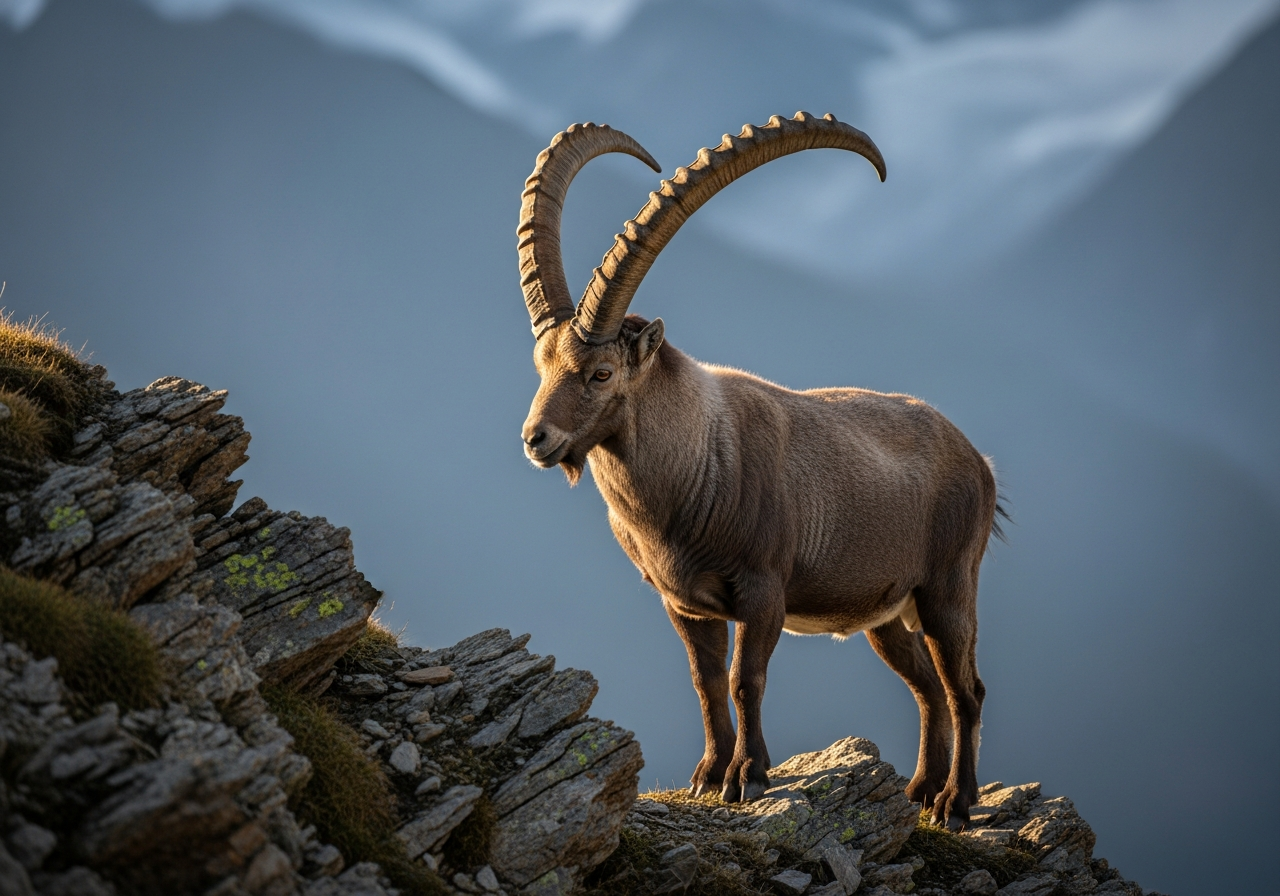
The ibex (Capra ibex) is a mammal of the family Bovidae, in the order Artiodactyla.
Quick answer
An ibex is a wild mountain goat with long, backward-curving ridged horns, built for life on steep cliffs. The Alpine ibex of Europe can climb near-vertical rock faces and dam walls. Males carry the largest horns, and ibex typically live 14 to 16 years in the wild.
Top questions about the Ibex
Ibex facts at a glance
- Weight 100 kg
- Length 1.5 m
- Top speed 50 km/h
- Lifespan 16 years
| Scientific name | Capra ibex |
|---|---|
| Diet | Herbivore |
| Habitat | Steep rocky mountain slopes |
| Lifespan | 14–16 years in the wild |
| Weight | 35–100 kg (77–220 lb) |
| Top speed | Around 50 km/h (31 mph) |
| Conservation status | Least Concern (IUCN) |
| Kingdom | Animalia |
|---|---|
| Phylum | Chordata |
| Class | Mammalia |
| Order | Artiodactyla |
| Family | Bovidae |
| Genus | Capra |
Where it lives
The ibex (Capra ibex) is native to Steep, rocky mountain slopes of the European Alps, with related ibex species across Asia and North Africa. — recorded across Europe in this guide’s range summary.
For occurrence records, see GBIF species search and sources below.
How big is a ibex?
An adult ibex measures 1.5 m long — about 87% of the height of an average adult person (1.73 m) — and weighs around 100 kg, about 1.4× an average adult’s body weight (70 kg).
Length vs an average adult’s height (to scale)
What is a group of ibexes called?
Group name (collective noun)
A group of Ibexes is called a herd.
Baby name
A baby Ibex is called a kid.
Explore more animal collective nouns and baby animal names .
Master of steep terrain
Ibex are extraordinary climbers, using split, rubbery-edged hooves to grip tiny ledges on near-vertical rock. They are famous for scaling steep dam walls in the Alps to lick mineral salts from the stone, balancing in places few other large animals could reach.
Horns and contests
Both sexes have horns, but males grow huge, knobbly, backward-sweeping ones that can exceed a meter in length. During the rut, males rear up and clash horns in dramatic head-to-head fights to win mates, and the rings on their horns can be used to estimate age.
Diet and daily life
Ibex are grazers and browsers that feed on grasses, herbs, and shrubs, moving to lower slopes in winter and high meadows in summer. They are most active in the cool of morning and evening, resting on cliffs during the heat of the day.
Comeback story
The Alpine ibex was hunted almost to extinction in the 1800s, surviving in a single protected population in Italy. Careful reintroduction across the Alps has since restored tens of thousands, making it one of conservation's notable recoveries.
Dig deeper into the Ibex
- How Fast Is An Ibex?
Ibex top speed is about Around 50 km/h (31 mph). Sprint vs endurance and what limits pace.
- How Long Do Ibexs Live?
Ibex lifespan is typically 14–16 years in the wild. What shortens or extends life, life stages, and status (Least Concern).
- What Do Ibexs Eat?
What ibexs eat: Herbivore, foraging style, and seasonal shifts in Steep rocky mountain slopes.
- Where Do Ibexs Live?
Where ibexs live: Steep rocky mountain slopes, native range cues, and human overlap. Status Least Concern.
Explore the Ibex
Close relatives
- Domestic Goat Same genus
- Cow Same family
- Wildebeest Same family
- Saiga Antelope Same family
Range & geography
Did you know? Ibex facts
- An ibex is a wild mountain goat with long, backward-curving ridged horns, built for life on steep cliffs.
- An ibex is a species of wild mountain goat with long, ridged, curving horns, adapted to live on steep rocky slopes in mountain ranges such as the Alps.
- Ibex have cloven hooves with hard outer edges and soft, grippy pads that let them balance on tiny ledges and scale almost vertical rock and dam walls.
- Male ibex grow large, knobbly horns that can be over 1 m (3 ft) long, while females have shorter, slimmer horns.
- The Alpine ibex is now Least Concern after a major recovery from near-extinction, though some other ibex species remain more threatened.
- Conservation: Least Concern (IUCN).
Diet & feeding
Ibex feeds primarily as a herbivore. Ibex are grazers and browsers that feed on grasses, herbs, and shrubs, moving to lower slopes in winter and high meadows in summer. They are most active in the cool of morning and evening, resting on cliffs during the heat of the day.
Adaptations
- Ibex are extraordinary climbers, using split, rubbery-edged hooves to grip tiny ledges on near-vertical rock. They are famous for scaling steep dam walls in the Alps to lick mineral salts from the stone, balancing in places few other large animals could reach.
- Both sexes have horns, but males grow huge, knobbly, backward-sweeping ones that can exceed a meter in length. During the rut, males rear up and clash horns in dramatic head-to-head fights to win mates, and the rings on their horns can be used to estimate age.
Behaviour & ecology
- Ibex are extraordinary climbers, using split, rubbery-edged hooves to grip tiny ledges on near-vertical rock. They are famous for scaling steep dam walls in the Alps to lick mineral salts from the stone, balancing in places few other large animals could reach.
- Both sexes have horns, but males grow huge, knobbly, backward-sweeping ones that can exceed a meter in length. During the rut, males rear up and clash horns in dramatic head-to-head fights to win mates, and the rings on their horns can be used to estimate age.
- Ibex are grazers and browsers that feed on grasses, herbs, and shrubs, moving to lower slopes in winter and high meadows in summer. They are most active in the cool of morning and evening, resting on cliffs during the heat of the day.
Communication
- Ibex uses scent, posture, and vocal signals to mark territory and coordinate social behaviour.
- Communication intensity often peaks during breeding seasons and territorial disputes.
Habitat & range
Steep rocky mountain slopes
Ecological role
Ibex shapes vegetation through grazing or browsing and serves as prey for larger predators where ranges overlap.
Conservation status of the Ibex
The ibex (Capra ibex) is listed as Least Concern on the IUCN Red List. Least Concern (LC) is the IUCN's lowest-risk category, assigned to widespread, abundant species that have been evaluated and found not to be threatened. It does not mean a species faces no pressures — only that it is not currently at risk of extinction.
The ibex (Capra ibex) is assessed on the IUCN Red List. Look up on the IUCN Red List .
Frequently asked questions about the Ibex
What is an ibex?
An ibex is a species of wild mountain goat with long, ridged, curving horns, adapted to live on steep rocky slopes in mountain ranges such as the Alps.
How do ibex climb so well?
Ibex have cloven hooves with hard outer edges and soft, grippy pads that let them balance on tiny ledges and scale almost vertical rock and dam walls.
How big are ibex horns?
Male ibex grow large, knobbly horns that can be over 1 m (3 ft) long, while females have shorter, slimmer horns.
Are ibex endangered?
The Alpine ibex is now Least Concern after a major recovery from near-extinction, though some other ibex species remain more threatened.
What do ibex eat?
Ibex are herbivores that feed on grasses, alpine herbs, and shrubs, moving up and down the mountains with the seasons.
What is a group of ibexes called?
A group of Ibexes is called a herd.
What is a baby ibex called?
A baby Ibex is called a kid.
Sources & references
This guide is compiled and reviewed against established zoological and conservation references. Key sources for the Ibex:
-
IUCN Red List of Threatened Species
Conservation status (Least Concern) reflects the IUCN Red List category for Capra ibex.
-
iNaturalist — observations & photos
Search citizen-science observations and community IDs for Capra ibex. Useful for range checks and recent sightings — not a substitute for formal Red List status.
-
GBIF — occurrence data
Global Biodiversity Information Facility species search for Capra ibex. Explore published occurrence records used in range research.
- IUCN Red List — Capra ibex.
Conservation status (Least Concern) and population trends.
- Animal Diversity Web — Capra ibex. University of Michigan Museum of Zoology.
Life history, morphology, and range.
- Wikipedia — Ibex.
General taxonomy and overview (cross-check primary sources).
-
Global Animal Guide editorial standards
How we research, source, review, and update every guide for accuracy.