Quick answer
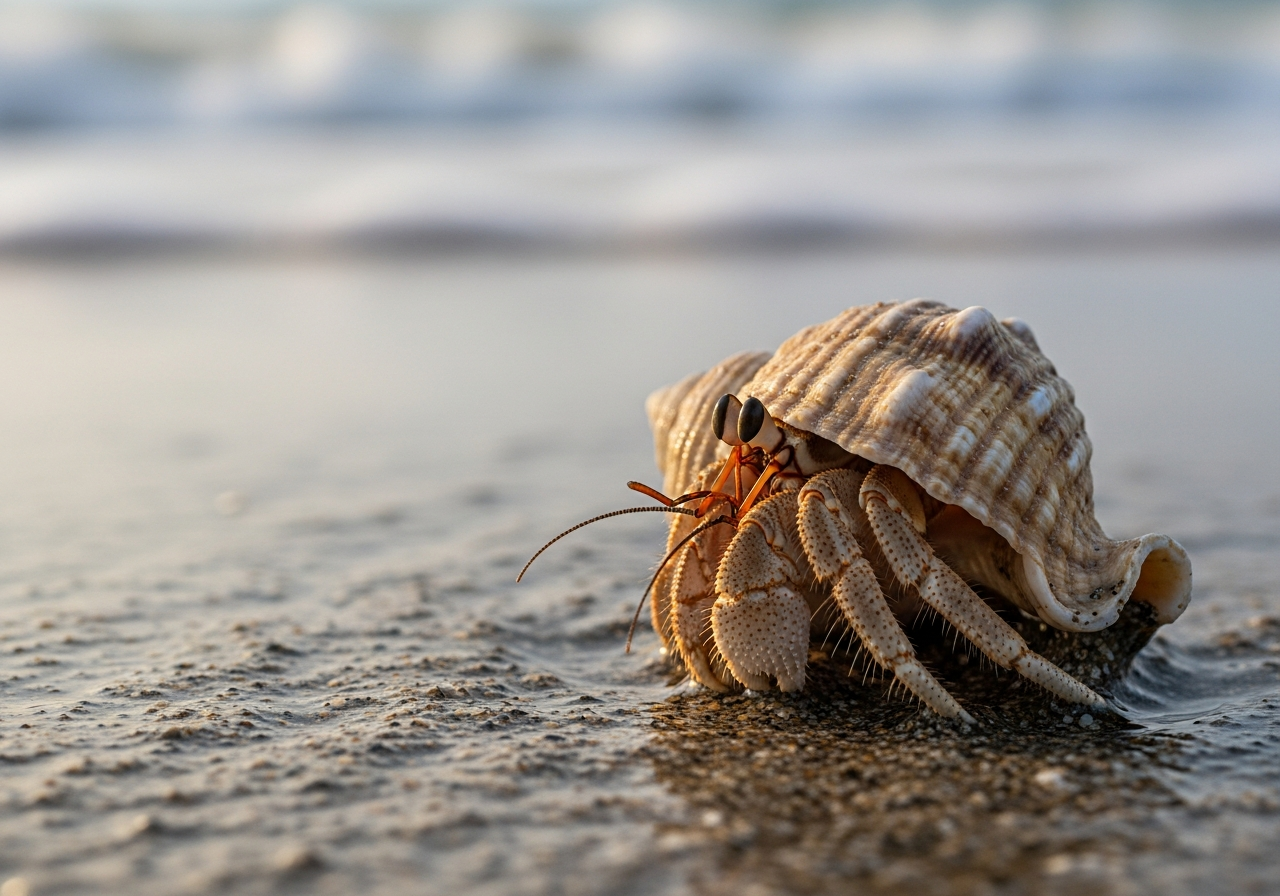
Hermit crabs are crustaceans that protect their soft, spiraled abdomens by living inside empty snail shells. As they grow, they leave their old shell and move into a larger one, sometimes lining up to swap shells in sequence. Found on shorelines and seabeds worldwide, many species live 10 to 30 years, and they are popular, low-cost pets.
Top questions about the Hermit Crab
Hermit Crab facts at a glance
- Weight 100 g
- Length 10 cm
- Top speed 1 km/h
- Lifespan 30 years
| Scientific name | Paguroidea (superfamily) |
|---|---|
| Diet | Omnivore (algae, plankton, scraps, carrion) |
| Habitat | Shorelines, tide pools, and seabeds worldwide |
| Lifespan | 10–30 years (varies by species) |
| Size | From a few millimeters to 30 cm (coconut crab) |
| Top speed | Slow walkers; faster when alarmed |
| Conservation status | Least Concern (IUCN, most species) |
| Kingdom | Animalia |
|---|---|
| Phylum | Arthropoda |
| Class | Malacostraca |
| Order | Decapoda |
| Family | Paguridae |
Where it lives
The hermit crab (Paguroidea) is native to Shorelines, tide pools, and seabeds of warm and temperate oceans worldwide. — recorded across Oceans in this guide’s range summary.
For occurrence records, see GBIF species search and sources below.
How big is a hermit crab?
An adult hermit crab measures 10 cm long — about 6% of the height of an average adult person (1.73 m) — and weighs around 100 g, a small fraction of an average adult’s body weight (70 kg).
Length vs an average adult’s height (to scale)
What is a group of hermit crabs called?
Group name (collective noun)
A group of Hermit Crabs is called a cast.
Baby name
A baby Hermit Crab is called a larva. It may also be called a zoea.
Explore more animal collective nouns and baby animal names .
Borrowed homes
Unlike true crabs, most hermit crabs have a soft, curled abdomen with no hard shell of its own. To protect it, the crab backs into an empty snail shell and carries it everywhere, gripping the inside with specially shaped rear legs. The shell shields the crab from predators and from drying out.
Shell swapping
As a hermit crab grows it outgrows its shell and must find a larger one. When a good empty shell appears, crabs sometimes gather and form a line by size, each moving into the next-biggest shell in a chain swap. Competition for shells can be intense where suitable shells are scarce.
Diet and behavior
Hermit crabs are omnivorous scavengers that feed on algae, plankton, food scraps, and dead animals, helping clean the shoreline. They are mostly active at night and use their antennae and claws to find and handle food. Many species are social and gather in groups, especially around food or fresh shells.
As a pet
Land hermit crabs are common, inexpensive pets that need humid, warm enclosures, a choice of empty shells to grow into, and both fresh and salt water. With good care they can live well over a decade, far longer than many owners expect. They are wild-caught in some regions, so responsible sourcing matters.
Dig deeper into the Hermit Crab
- How Long Do Hermit Crabs Live?
Hermit Crab lifespan is typically 10–30 years (varies by species). What shortens or extends life, life stages, and status (Least Concern).
- What Do Hermit Crabs Eat?
What hermit crabs eat: Omnivore (algae, plankton, scraps, carrion), foraging style, and seasonal shifts in Shorelines, tide pools, and seabeds worldwide.
- Where Do Hermit Crabs Live?
Where hermit crabs live: Shorelines, tide pools, and seabeds worldwide, native range cues, and human overlap. Status Least Concern.
Explore the Hermit Crab
Related Invertebrates
Range & geography
Did you know? Hermit Crab facts
- Hermit crabs are crustaceans that protect their soft, spiraled abdomens by living inside empty snail shells.
- Most hermit crabs have a soft, vulnerable abdomen and no shell of their own, so they move into empty snail shells for protection from predators and from drying out.
- Yes. As they grow, hermit crabs must move into larger empty shells. They sometimes gather and line up by size to swap shells in a chain, each taking the next-biggest one.
- Hermit crabs are omnivorous scavengers. They eat algae, plankton, food scraps, and dead animals, which makes them useful cleaners of the shoreline.
- Hermit crabs can make low-cost, low-maintenance pets, but they need a warm, humid tank, spare shells to grow into, and both fresh and salt water. With proper care they can live for over a decade.
- Conservation: Least Concern (IUCN, most species).
Diet & feeding
Hermit Crab feeds primarily as a omnivore (algae, plankton, scraps, carrion). Hermit crabs are omnivorous scavengers that feed on algae, plankton, food scraps, and dead animals, helping clean the shoreline. They are mostly active at night and use their antennae and claws to find and handle food. Many species are social
Adaptations
- Unlike true crabs, most hermit crabs have a soft, curled abdomen with no hard shell of its own. To protect it, the crab backs into an empty snail shell and carries it everywhere, gripping the inside with specially shaped rear legs. The shell shields the crab from predators and from drying out.
- As a hermit crab grows it outgrows its shell and must find a larger one. When a good empty shell appears, crabs sometimes gather and form a line by size, each moving into the next-biggest shell in a chain swap. Competition for shells can be intense where suitable shells are scarce.
Behaviour & ecology
- Unlike true crabs, most hermit crabs have a soft, curled abdomen with no hard shell of its own. To protect it, the crab backs into an empty snail shell and carries it everywhere, gripping the inside with specially shaped rear legs. The shell shields the crab from predators and from drying out.
- As a hermit crab grows it outgrows its shell and must find a larger one. When a good empty shell appears, crabs sometimes gather and form a line by size, each moving into the next-biggest shell in a chain swap. Competition for shells can be intense where suitable shells are scarce.
- Hermit crabs are omnivorous scavengers that feed on algae, plankton, food scraps, and dead animals, helping clean the shoreline. They are mostly active at night and use their antennae and claws to find and handle food. Many species are social and gather in groups, especially around food or fresh shells.
Communication
- Hermit Crab uses scent, posture, and vocal signals to mark territory and coordinate social behaviour.
- Communication intensity often peaks during breeding seasons and territorial disputes.
Habitat & range
Shorelines, tide pools, and seabeds worldwide
Ecological role
Hermit Crab plays a recognised ecological role in shorelines, tide pools, and seabeds worldwide.
Conservation status of the Hermit Crab
The hermit crab (Paguroidea) is listed as Least Concern on the IUCN Red List. Least Concern (LC) is the IUCN's lowest-risk category, assigned to widespread, abundant species that have been evaluated and found not to be threatened. It does not mean a species faces no pressures — only that it is not currently at risk of extinction.
The hermit crab (Paguroidea) is assessed on the IUCN Red List. Look up on the IUCN Red List .
Frequently asked questions about the Hermit Crab
Why do hermit crabs live in shells?
Most hermit crabs have a soft, vulnerable abdomen and no shell of their own, so they move into empty snail shells for protection from predators and from drying out.
Do hermit crabs change shells?
Yes. As they grow, hermit crabs must move into larger empty shells. They sometimes gather and line up by size to swap shells in a chain, each taking the next-biggest one.
What do hermit crabs eat?
Hermit crabs are omnivorous scavengers. They eat algae, plankton, food scraps, and dead animals, which makes them useful cleaners of the shoreline.
Are hermit crabs good pets?
Hermit crabs can make low-cost, low-maintenance pets, but they need a warm, humid tank, spare shells to grow into, and both fresh and salt water. With proper care they can live for over a decade.
Are hermit crabs actually crabs?
Hermit crabs are crustaceans closely related to true crabs but in a different group. Unlike true crabs, they have a soft, asymmetrical abdomen that they protect inside a borrowed shell.
What is a group of hermit crabs called?
A group of Hermit Crabs is called a cast.
What is a baby hermit crab called?
A baby Hermit Crab is called a larva. It may also be called a zoea.
Sources & references
This guide is compiled and reviewed against established zoological and conservation references. Key sources for the Hermit Crab:
-
IUCN Red List of Threatened Species
Conservation status (Least Concern) reflects the IUCN Red List category for Paguroidea.
-
iNaturalist — observations & photos
Search citizen-science observations and community IDs for Paguroidea. Useful for range checks and recent sightings — not a substitute for formal Red List status.
-
GBIF — occurrence data
Global Biodiversity Information Facility species search for Paguroidea. Explore published occurrence records used in range research.
- IUCN Red List — Paguroidea.
Conservation status (Least Concern) and population trends.
- Wikipedia — Hermit Crab.
General taxonomy and overview (cross-check primary sources).
-
Global Animal Guide editorial standards
How we research, source, review, and update every guide for accuracy.