Quick answer
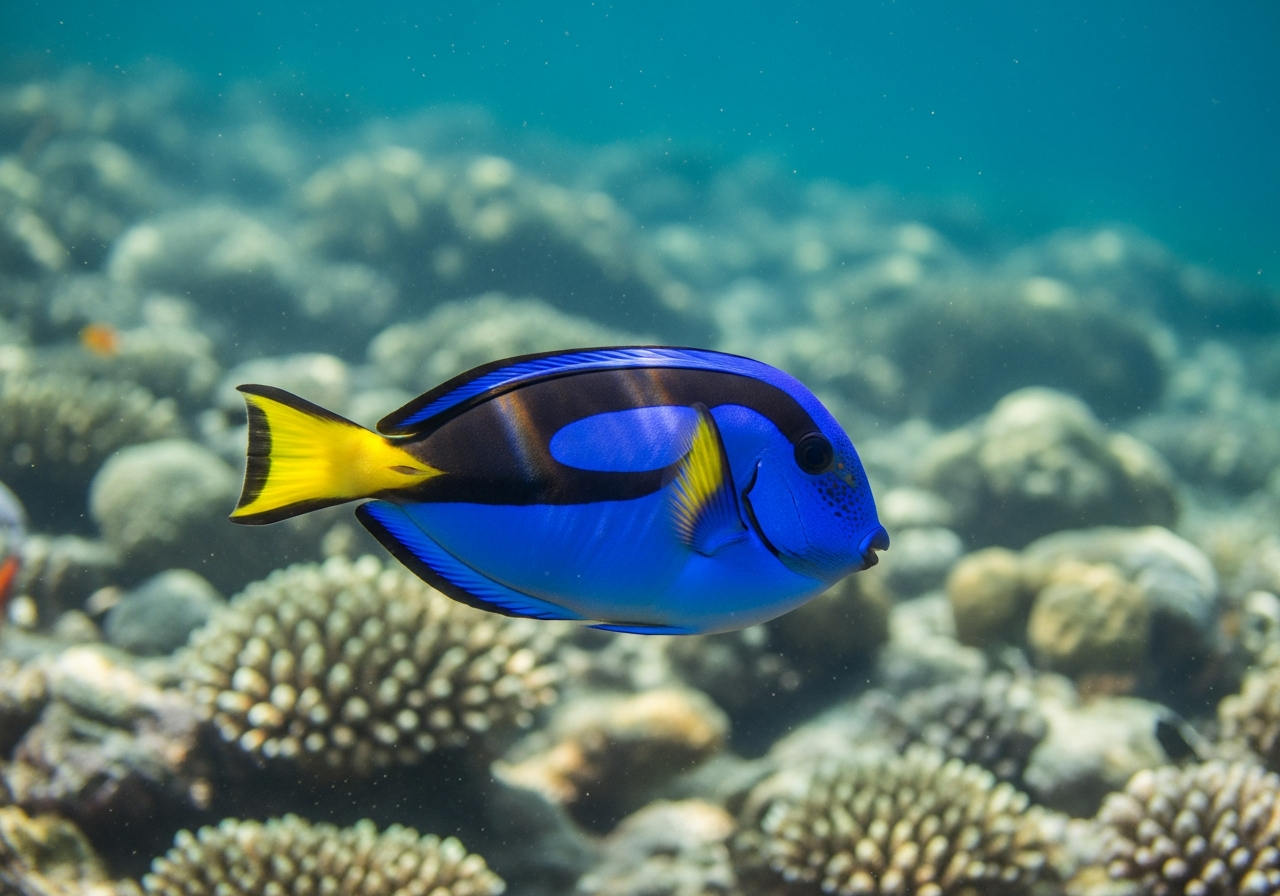
The blue tang (Paracanthurus hepatus) is a vivid royal-blue reef fish with black markings and a bright yellow tail, best known as the character Dory from Finding Nemo. It lives on coral reefs across the Indo-Pacific, where it grazes mainly on algae. Growing to about 30 cm long and weighing up to 0.6 kg, it is a fast, agile swimmer that darts among coral for shelter. Blue tangs can live up to around 20 years.
Top questions about the Blue Tang
Blue Tang facts at a glance
- Weight 600 g
- Length 30 cm
- Top speed 10 km/h
- Lifespan 20 years
| Scientific name | Paracanthurus hepatus |
|---|---|
| Diet | Omnivore (mostly algae) |
| Habitat | Indo-Pacific coral reefs |
| Lifespan | Up to about 20 years |
| Length | Up to about 30 cm (12 in) |
| Top speed | Fast, agile reef swimmer |
| Conservation status | Least Concern (IUCN) |
| Kingdom | Animalia |
|---|---|
| Phylum | Chordata |
| Class | Actinopterygii |
| Order | Acanthuriformes |
| Family | Acanthuridae |
| Genus | Paracanthurus |
Where it lives
The blue tang (Paracanthurus hepatus) is native to Coral reefs across the Indo-Pacific, from East Africa to Japan and the Great Barrier Reef. — recorded across Oceans in this guide’s range summary.
For occurrence records, see GBIF species search and sources below.
How big is a blue tang?
An adult blue tang measures 30 cm long — about 17% of the height of an average adult person (1.73 m) — and weighs around 600 g, about 1% of an average adult’s body weight (70 kg).
Length vs an average adult’s height (to scale)
What is a group of blue tangs called?
Group name (collective noun)
A group of Blue Tangs is called a school. It is also known as a shoal.
Baby name
A baby Blue Tang is called a fry.
Explore more animal collective nouns and baby animal names .
Appearance and colour
The blue tang is one of the most recognisable reef fish, with an oval, flattened body painted in brilliant royal blue, a bold black pattern often described as a painter's palette, and a striking yellow tail. Its colour can shift with mood and time of day, deepening or fading depending on the fish's condition and stress level. Juveniles start out bright yellow and gradually gain the blue adult colouring as they grow. This eye-catching pattern has made the species a favourite in aquariums and a star of the cinema screen.
Diet and feeding
Blue tangs are omnivores that feed mainly on algae, which they nibble from coral and rock throughout the day. By grazing on fast-growing algae they help keep reef surfaces clear, giving corals room to grow. They also take plankton drifting in the water column, and in captivity they will accept a mixed diet of plant and animal foods. Their small mouths and fine teeth are well suited to scraping and picking at the reef.
The tang's defensive spines
The blue tang belongs to the surgeonfish family, named for the sharp, scalpel-like spines set on either side of the base of the tail. These spines normally lie flat in a groove but can be flicked out to slash at a rival or predator, and in this species they may carry a mild venom that adds sting to the wound. When threatened, a blue tang can also play dead, lying on its side and staying motionless until the danger passes. Together these defences help a fairly small fish survive on a crowded, predator-rich reef.
Swimming and behaviour
Blue tangs are fast, agile swimmers, cruising the reef at speeds of up to around 10 km/h (6 mph) and darting into coral crevices at the first sign of danger. They propel themselves mainly with their pectoral fins, which gives them precise control for hovering and turning among the branching coral. Young fish and adults often gather in loose groups that move over the reef together, offering safety in numbers. At night they wedge themselves into cracks in the coral to rest, out of reach of hunting predators.
Reproduction and life cycle
Blue tangs gather to spawn in groups, releasing eggs and sperm into the water where fertilisation takes place. The tiny eggs float with the plankton, and the larvae drift in open water before settling onto a reef and taking on their juvenile colours. On the reef they can live for up to around 20 years, a long life for a fish of their size. Because they are so difficult to breed in captivity, most blue tangs in the aquarium trade are still caught from the wild.
Dig deeper into the Blue Tang
- Blue Tang: Key Facts
Blue Tangs (Paracanthurus hepatus) are fish found across multiple regions. The bright blue reef fish from Finding Nemo.
- How Long Do Blue Tangs Live?
Blue Tang lifespan is typically Up to about 20 years. What shortens or extends life, life stages, and status (Least Concern).
- What Do Blue Tangs Eat?
What blue tangs eat: Omnivore (mostly algae), foraging style, and seasonal shifts in Indo-Pacific coral reefs.
- Where Do Blue Tangs Live?
Where blue tangs live: Indo-Pacific coral reefs, native range cues, and human overlap. Status Least Concern.
Explore the Blue Tang
Related Fishs
Range & geography
Did you know? Blue Tang facts
- The blue tang is a vivid royal-blue reef fish with a yellow tail, best known as Dory from the films Finding Nemo and Finding Dory.
- Yes. The character Dory from Finding Nemo and Finding Dory is a blue tang, also called a royal blue tang or palette surgeonfish.
- Blue tangs feed mainly on algae growing on coral reefs, and they also eat plankton. Their grazing helps keep algae from smothering corals.
- Blue tangs are not venomous, but they have a sharp, scalpel-like spine near the tail that can cut, and their flesh has been linked to ciguatera poisoning if eaten, so they are not a typical food fish.
- Blue tangs grow to about 30 cm (12 in) long. Aquarium specimens can reach a substantial size, so they need a large tank with plenty of swimming room.
- Conservation: Least Concern (IUCN).
Diet & feeding
Blue Tang feeds primarily as a omnivore (mostly algae). The blue tang's brilliant blue body is marked with a bold black pattern and a bright yellow tail. Like all surgeonfish, it has a sharp, blade-like spine on each side of the tail base that it can flick out to slash at attackers or rivals. When threatened, it may al
Adaptations
- The blue tang's brilliant blue body is marked with a bold black pattern and a bright yellow tail. Like all surgeonfish, it has a sharp, blade-like spine on each side of the tail base that it can flick out to slash at attackers or rivals. When threatened, it may also play dead by lying on its side.
- Blue tangs feed mainly on algae growing on the reef, grazing throughout the day. By keeping algae in check, they help corals get the light and space they need to grow, making tangs important to reef health. They also take plankton from the water when it is plentiful.
Behaviour & ecology
- The blue tang's brilliant blue body is marked with a bold black pattern and a bright yellow tail. Like all surgeonfish, it has a sharp, blade-like spine on each side of the tail base that it can flick out to slash at attackers or rivals. When threatened, it may also play dead by lying on its side.
- Blue tangs feed mainly on algae growing on the reef, grazing throughout the day. By keeping algae in check, they help corals get the light and space they need to grow, making tangs important to reef health. They also take plankton from the water when it is plentiful.
- Blue tangs live on coral reefs across the Indo-Pacific, from East Africa to Japan and the Great Barrier Reef. Juveniles often shelter among branching corals, while adults form loose groups in open water above the reef. They rely on the reef both for food and for hiding places from predators.
Communication
- Lateral-line and visual cues coordinate schooling, courtship, or territorial behaviour.
- Some species produce low-frequency sounds or drumming for spawning or defence.
Habitat & range
Indo-Pacific coral reefs
Ecological role
Blue Tang occupies a defined trophic level in aquatic food webs, linking plankton or smaller fish to larger predators.
Conservation status of the Blue Tang
The blue tang (Paracanthurus hepatus) is listed as Least Concern on the IUCN Red List. Least Concern (LC) is the IUCN's lowest-risk category, assigned to widespread, abundant species that have been evaluated and found not to be threatened. It does not mean a species faces no pressures — only that it is not currently at risk of extinction.
The blue tang (Paracanthurus hepatus) is assessed on the IUCN Red List. Look up on the IUCN Red List .
Frequently asked questions about the Blue Tang
Is the blue tang the fish from Finding Nemo?
Yes. The blue tang is the species behind Dory, the forgetful blue fish in Finding Nemo and Finding Dory. Its royal-blue body and yellow tail make it instantly recognisable.
What do blue tangs eat?
Blue tangs are omnivores that feed mainly on algae, which they nibble from coral and rock. They also eat plankton from the water, and their grazing helps keep reef surfaces clear for corals.
How big do blue tangs get?
Blue tangs grow to about 30 cm (12 inches) long and weigh up to around 0.6 kg. They are a medium-sized reef fish with a flattened, oval body.
Are blue tangs dangerous?
They are not aggressive, but they carry sharp, scalpel-like spines at the base of the tail that can deliver a painful, mildly venomous cut. These spines are used in defence, so the fish should be handled with care.
How long do blue tangs live?
Blue tangs can live for up to around 20 years, a long lifespan for a reef fish of their size. They are slow to mature and difficult to breed in captivity.
Where do blue tangs live?
Blue tangs live on coral reefs across the Indo-Pacific, from East Africa to the reefs of the western Pacific. They stay close to branching coral, which offers both food and shelter from predators.
What is a group of blue tangs called?
A group of Blue Tangs is called a school. It is also known as a shoal.
What is a baby blue tang called?
A baby Blue Tang is called a fry.
Sources & references
This guide is compiled and reviewed against established zoological and conservation references. Key sources for the Blue Tang:
-
IUCN Red List of Threatened Species
Conservation status (Least Concern) reflects the IUCN Red List category for Paracanthurus hepatus.
-
iNaturalist — observations & photos
Search citizen-science observations and community IDs for Paracanthurus hepatus. Useful for range checks and recent sightings — not a substitute for formal Red List status.
-
GBIF — occurrence data
Global Biodiversity Information Facility species search for Paracanthurus hepatus. Explore published occurrence records used in range research.
- IUCN Red List — Paracanthurus hepatus.
Conservation status (Least Concern) and population trends.
- Animal Diversity Web — Paracanthurus hepatus. University of Michigan Museum of Zoology.
Life history, morphology, and range.
- Wikipedia — Blue Tang.
General taxonomy and overview (cross-check primary sources).
-
Global Animal Guide editorial standards
How we research, source, review, and update every guide for accuracy.