Quick answer
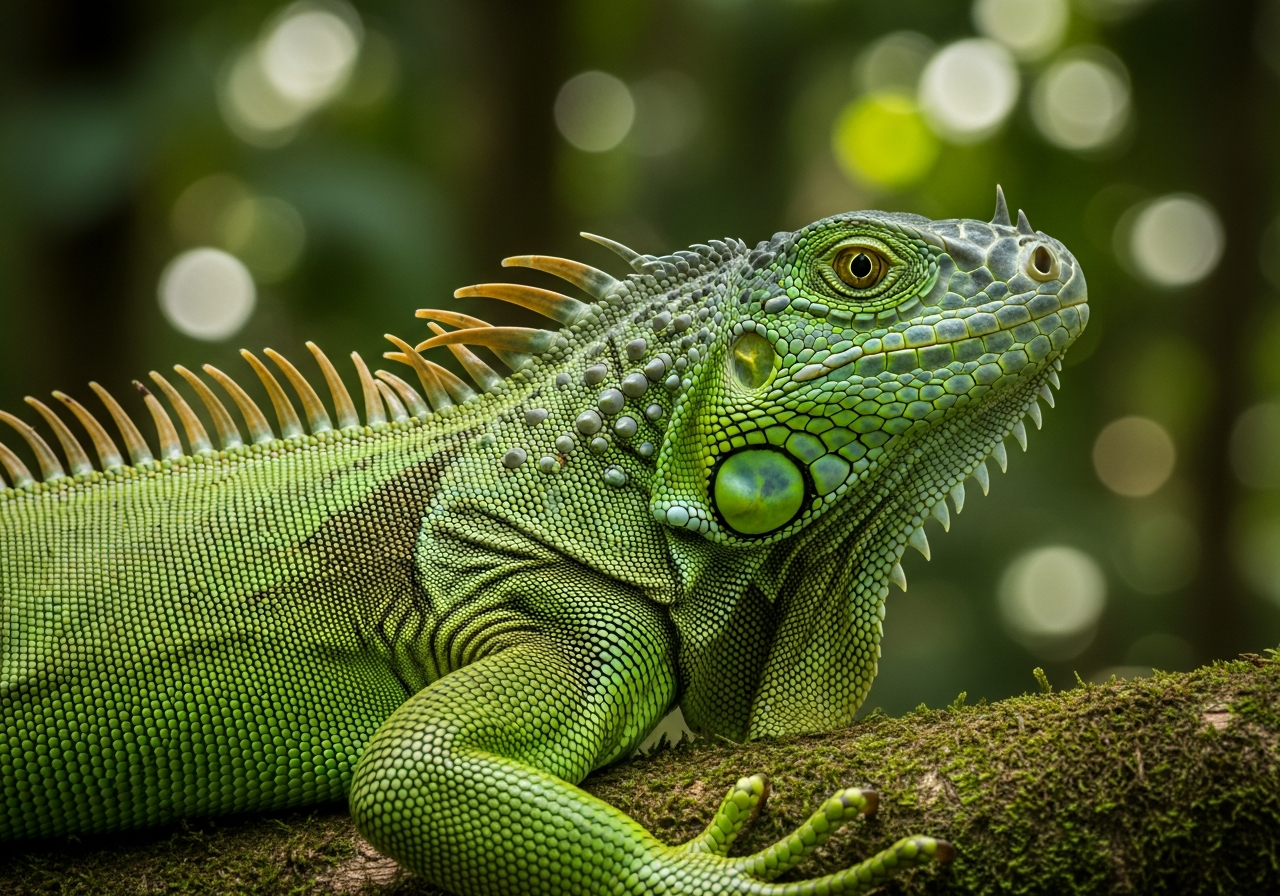
The green iguana is a large, mostly plant-eating lizard native to the rainforests of Central and South America. It spends much of its life in trees, can grow well over 1.5 m (5 ft) including its long tail, and is a popular but demanding pet reptile. Green iguanas are herbivores that often live 10 to 15 years, and longer with good care.
Top questions about the Green Iguana
Green Iguana facts at a glance
- Weight 5 kg
- Length 1.7 m
- Top speed 35 km/h
- Lifespan 15 years
| Scientific name | Iguana iguana |
|---|---|
| Diet | Herbivore |
| Habitat | Tropical rainforest canopy near water |
| Lifespan | 10–15 years, longer in captivity |
| Length | 1.2–1.7 m (4–5.6 ft) including tail |
| Top speed | Up to 35 km/h (22 mph) on land |
| Conservation status | Least Concern (IUCN) |
| Kingdom | Animalia |
|---|---|
| Phylum | Chordata |
| Class | Reptilia |
| Order | Squamata |
| Family | Iguanidae |
| Genus | Iguana |
Where it lives
The green iguana (Iguana iguana) is native to Tropical lowlands from Mexico and Central America through much of northern South America, usually near rivers. — recorded across North America, South America in this guide’s range summary.
For occurrence records, see GBIF species search and sources below.
How big is a green iguana?
An adult green iguana measures 1.7 m long — about 98% of the height of an average adult person (1.73 m) — and weighs around 5.0 kg, about 7% of an average adult’s body weight (70 kg).
Length vs an average adult’s height (to scale)
What is a group of green iguanas called?
Group name (collective noun)
A group of Green Iguanas is called a lounge.
Baby name
A baby Green Iguana is called a hatchling.
Explore more animal collective nouns and baby animal names .
Behavior and life in the trees
Green iguanas are arboreal, spending most of their time high in the rainforest canopy where they bask in the sun and feed on leaves. They are strong climbers and surprisingly good swimmers, often dropping from branches into rivers to escape predators. A row of spines along the back and a large flap of skin under the chin, called a dewlap, help them display to rivals and regulate temperature.
Diet and feeding
Despite their fierce appearance, green iguanas are almost entirely herbivorous. Adults eat leaves, flowers, and fruit, and they rely on warmth to digest this fibrous plant material. In captivity they need a varied diet of leafy greens and vegetables, as too much protein can damage their kidneys.
Habitat and range
Green iguanas are native to a wide band of the Americas, from Mexico and Central America through much of tropical South America, usually near rivers and lakes. They have also been introduced to places such as Florida and several Caribbean and Pacific islands, where they can become invasive. They favor warm, humid lowland forest.
As a pet
Green iguanas are widely sold as pets but are challenging to keep well. They grow large, need spacious enclosures with strong UVB lighting, high humidity, and warm basking areas, and can deliver painful scratches, bites, and tail whips if stressed. Many are surrendered when owners underestimate their size and care needs.
Dig deeper into the Green Iguana
- How Fast Is A Green Iguana?
Green Iguana top speed is up to about 35 km/h (22 mph) on land. Sprint vs endurance and what limits pace.
- How Long Do Green Iguanas Live?
Green Iguana lifespan is typically 10–15 years, longer in captivity. What shortens or extends life, life stages, and status (Least Concern).
- What Do Green Iguanas Eat?
What green iguanas eat: Herbivore, foraging style, and seasonal shifts in Tropical rainforest canopy near water.
- Where Do Green Iguanas Live?
Where green iguanas live: Tropical rainforest canopy near water, native range cues, and human overlap. Status Least Concern.
Explore the Green Iguana
Related Reptiles
Range & geography
Did you know? Green Iguana facts
- The green iguana is a large, mostly plant-eating lizard native to the rainforests of Central and South America.
- Green iguanas are herbivores. They eat leaves, flowers, and fruit in the wild, and in captivity they do best on leafy greens and vegetables with limited fruit and no animal protein.
- Adult green iguanas commonly reach 1.2 to 1.7 m (4 to 5.6 ft) in total length, with the tail making up more than half of that. Large males can be heavy and powerful.
- Green iguanas often live 10 to 15 years, and well-cared-for pets can live 20 years or more. Poor diet and inadequate lighting are common reasons captive iguanas die young.
- They can be rewarding but are not beginner pets. They grow large, need large enclosures with UVB lighting and high humidity, and can be defensive, so they suit experienced keepers willing to commit space and time.
- Conservation: Least Concern (IUCN).
Diet & feeding
Green Iguana feeds primarily as a herbivore. Green iguanas are arboreal, spending most of their time high in the rainforest canopy where they bask in the sun and feed on leaves. They are strong climbers and surprisingly good swimmers, often dropping from branches into rivers to escape predators. A row of spines along t
Adaptations
- Green iguanas are arboreal, spending most of their time high in the rainforest canopy where they bask in the sun and feed on leaves. They are strong climbers and surprisingly good swimmers, often dropping from branches into rivers to escape predators. A row of spines along the back and a large flap of skin under the chin, called a dewlap, help them display to rivals and regulate temperature.
- Despite their fierce appearance, green iguanas are almost entirely herbivorous. Adults eat leaves, flowers, and fruit, and they rely on warmth to digest this fibrous plant material. In captivity they need a varied diet of leafy greens and vegetables, as too much protein can damage their kidneys.
Behaviour & ecology
- Green iguanas are arboreal, spending most of their time high in the rainforest canopy where they bask in the sun and feed on leaves. They are strong climbers and surprisingly good swimmers, often dropping from branches into rivers to escape predators. A row of spines along the back and a large flap of skin under the chin, called a dewlap, help them display to rivals and regulate temperature.
- Despite their fierce appearance, green iguanas are almost entirely herbivorous. Adults eat leaves, flowers, and fruit, and they rely on warmth to digest this fibrous plant material. In captivity they need a varied diet of leafy greens and vegetables, as too much protein can damage their kidneys.
- Green iguanas are native to a wide band of the Americas, from Mexico and Central America through much of tropical South America, usually near rivers and lakes. They have also been introduced to places such as Florida and several Caribbean and Pacific islands, where they can become invasive. They favor warm, humid lowland forest.
Communication
- Scent marking, body posture, and head-bobbing or tail signals communicate threat and dominance.
- Vocalisations are limited in many reptiles but hissing or bellowing occurs in some groups.
Habitat & range
Tropical rainforest canopy near water
Ecological role
Green Iguana shapes vegetation through grazing or browsing and serves as prey for larger predators where ranges overlap.
Conservation status of the Green Iguana
The green iguana (Iguana iguana) is listed as Least Concern on the IUCN Red List. Least Concern (LC) is the IUCN's lowest-risk category, assigned to widespread, abundant species that have been evaluated and found not to be threatened. It does not mean a species faces no pressures — only that it is not currently at risk of extinction.
The green iguana (Iguana iguana) is assessed on the IUCN Red List. Look up on the IUCN Red List .
Frequently asked questions about the Green Iguana
What do green iguanas eat?
Green iguanas are herbivores. They eat leaves, flowers, and fruit in the wild, and in captivity they do best on leafy greens and vegetables with limited fruit and no animal protein.
How big do green iguanas get?
Adult green iguanas commonly reach 1.2 to 1.7 m (4 to 5.6 ft) in total length, with the tail making up more than half of that. Large males can be heavy and powerful.
How long do green iguanas live?
Green iguanas often live 10 to 15 years, and well-cared-for pets can live 20 years or more. Poor diet and inadequate lighting are common reasons captive iguanas die young.
Are green iguanas good pets?
They can be rewarding but are not beginner pets. They grow large, need large enclosures with UVB lighting and high humidity, and can be defensive, so they suit experienced keepers willing to commit space and time.
Are green iguanas dangerous?
Green iguanas are not venomous and avoid people when they can, but a frightened iguana can scratch, bite, and whip with its tail. These defensive moves can cause injury, so they should be handled calmly and carefully.
Can green iguanas swim?
Yes. Green iguanas are strong swimmers and often live near water. They will dive in and use their powerful tails to propel themselves when escaping predators.
What is a group of green iguanas called?
A group of Green Iguanas is called a lounge.
What is a baby green iguana called?
A baby Green Iguana is called a hatchling.
Sources & references
This guide is compiled and reviewed against established zoological and conservation references. Key sources for the Green Iguana:
-
IUCN Red List of Threatened Species
Conservation status (Least Concern) reflects the IUCN Red List category for Iguana iguana.
-
iNaturalist — observations & photos
Search citizen-science observations and community IDs for Iguana iguana. Useful for range checks and recent sightings — not a substitute for formal Red List status.
-
GBIF — occurrence data
Global Biodiversity Information Facility species search for Iguana iguana. Explore published occurrence records used in range research.
- IUCN Red List — Iguana iguana.
Conservation status (Least Concern) and population trends.
- Animal Diversity Web — Iguana iguana. University of Michigan Museum of Zoology.
Life history, morphology, and range.
- Wikipedia — Green Iguana.
General taxonomy and overview (cross-check primary sources).
-
Global Animal Guide editorial standards
How we research, source, review, and update every guide for accuracy.