Quick answer
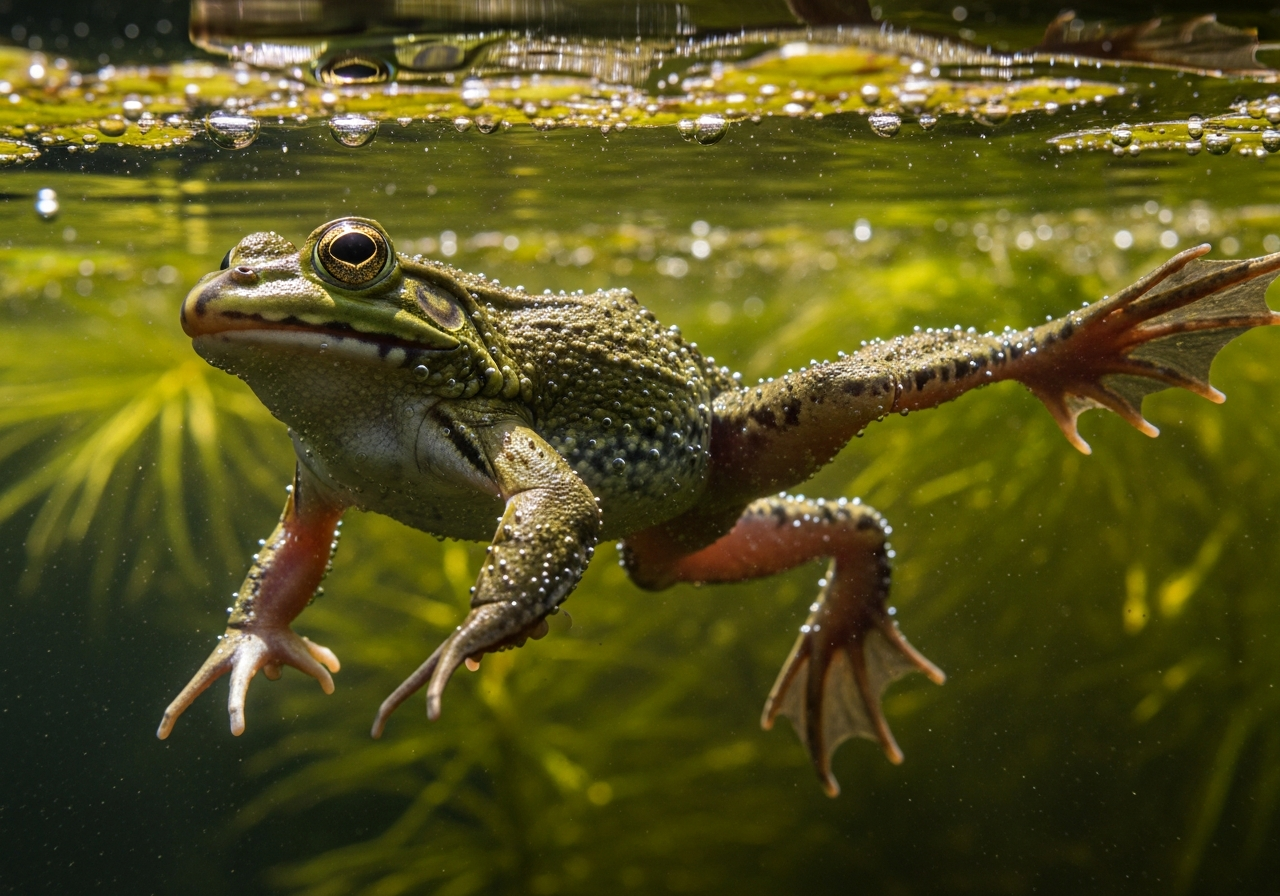
The African clawed frog is a fully aquatic frog from sub-Saharan Africa, named for the small dark claws on its hind feet. It has a flat body, no tongue or visible eardrum, and uses sensitive fingers and a lateral-line system to find food in murky water. Widely used in scientific research and kept as a pet, it can live 15 years or more.
Top questions about the African Clawed Frog
African Clawed Frog facts at a glance
- Weight 60 g
- Length 12 cm
- Top speed 5 km/h
- Lifespan 15 years
| Scientific name | Xenopus laevis |
|---|---|
| Diet | Carnivore (insects, worms, small animals) |
| Habitat | Ponds, lakes, and slow waters |
| Lifespan | 15+ years |
| Length | 5–12 cm (2–4.7 in) body length |
| Weight | Around 60 g (2 oz) |
| Conservation status | Least Concern (IUCN) |
| Kingdom | Animalia |
|---|---|
| Phylum | Chordata |
| Class | Amphibia |
| Order | Anura |
| Family | Pipidae |
| Genus | Xenopus |
Where it lives
The african clawed frog (Xenopus laevis) is native to Ponds, lakes, and slow waters across sub-Saharan Africa; widely introduced elsewhere. — recorded across Africa in this guide’s range summary.
For occurrence records, see GBIF species search and sources below.
How big is a african clawed frog?
An adult african clawed frog measures 12 cm long — about 7% of the height of an average adult person (1.73 m) — and weighs around 60 g, a small fraction of an average adult’s body weight (70 kg).
Length vs an average adult’s height (to scale)
What is a group of african clawed frogs called?
Group name (collective noun)
A group of African Clawed Frogs is called an army.
Baby name
A baby African Clawed Frog is called a tadpole.
Explore more animal collective nouns and baby animal names .
Behavior and adaptations
African clawed frogs spend almost their entire lives underwater, coming to the surface only to breathe. They lack a tongue and teeth, so they shove food into their mouths with their front fingers, and they use a sensitive lateral-line system along their bodies to detect movement in the water. The small black claws on their hind toes give the species its name and help tear apart food.
Diet and feeding
These frogs are scavenging carnivores that eat insects, worms, small fish, crustaceans, and bits of carrion. They detect prey by smell, touch, and water vibrations rather than by sight. Their hearty appetite and tolerance of a wide range of conditions make them easy to keep.
Habitat and range
The African clawed frog is native to ponds, lakes, and slow-moving waters across sub-Saharan Africa. It is extremely hardy and can survive in stagnant or polluted water and even travel short distances over land between pools. Released or escaped frogs have established invasive populations on several continents.
Use in science and conservation
Xenopus laevis is one of the most important laboratory animals, long used in developmental biology, genetics, and, historically, human pregnancy testing. The species is listed as Least Concern and is abundant both in the wild and in captivity. Its main conservation impact is as an invasive species that can spread disease to native amphibians.
Dig deeper into the African Clawed Frog
- How Long Do African Clawed Frogs Live?
African Clawed Frog lifespan is typically 15+ years. What shortens or extends life, life stages, and status (Least Concern).
- What Do African Clawed Frogs Eat?
What african clawed frogs eat: Carnivore (insects, worms, small animals), foraging style, and seasonal shifts in Ponds, lakes, and slow waters.
- Where Do African Clawed Frogs Live?
Where african clawed frogs live: Ponds, lakes, and slow waters, native range cues, and human overlap. Status Least Concern.
Explore the African Clawed Frog
Related Amphibians
Range & geography
Did you know? African Clawed Frog facts
- The African clawed frog is a fully aquatic frog from sub-Saharan Africa, named for the small dark claws on its hind feet.
- It is named for the small, dark, claw-like structures on the toes of its hind feet, which it uses to tear apart food. The 'African' part refers to its native range in sub-Saharan Africa.
- They are carnivores and scavengers that eat insects, worms, small fish, crustaceans, and carrion, pushing food into their mouths with their front fingers since they have no tongue.
- African clawed frogs are long-lived and commonly reach 15 years or more in captivity with good care, which makes them a long-term commitment as pets.
- They are hardy, breed readily, and produce large, easy-to-study eggs, making them a key model animal in developmental biology and genetics. They were also once used in human pregnancy tests.
- Conservation: Least Concern (IUCN).
Diet & feeding
African Clawed Frog feeds primarily as a carnivore (insects, worms, small animals). African clawed frogs spend almost their entire lives underwater, coming to the surface only to breathe. They lack a tongue and teeth, so they shove food into their mouths with their front fingers, and they use a sensitive lateral-line s
Adaptations
- African clawed frogs spend almost their entire lives underwater, coming to the surface only to breathe. They lack a tongue and teeth, so they shove food into their mouths with their front fingers, and they use a sensitive lateral-line system along their bodies to detect movement in the water. The small black claws on their hind toes give the species its name and help tear apart food.
- These frogs are scavenging carnivores that eat insects, worms, small fish, crustaceans, and bits of carrion. They detect prey by smell, touch, and water vibrations rather than by sight. Their hearty appetite and tolerance of a wide range of conditions make them easy to keep.
Behaviour & ecology
- African clawed frogs spend almost their entire lives underwater, coming to the surface only to breathe. They lack a tongue and teeth, so they shove food into their mouths with their front fingers, and they use a sensitive lateral-line system along their bodies to detect movement in the water. The small black claws on their hind toes give the species its name and help tear apart food.
- These frogs are scavenging carnivores that eat insects, worms, small fish, crustaceans, and bits of carrion. They detect prey by smell, touch, and water vibrations rather than by sight. Their hearty appetite and tolerance of a wide range of conditions make them easy to keep.
- The African clawed frog is native to ponds, lakes, and slow-moving waters across sub-Saharan Africa. It is extremely hardy and can survive in stagnant or polluted water and even travel short distances over land between pools. Released or escaped frogs have established invasive populations on several continents.
Communication
- African Clawed Frog uses scent, posture, and vocal signals to mark territory and coordinate social behaviour.
- Communication intensity often peaks during breeding seasons and territorial disputes.
Habitat & range
Ponds, lakes, and slow waters
Ecological role
African Clawed Frog acts as a predator that helps regulate prey populations and maintain balance in ponds, lakes, and slow waters.
Conservation status of the African Clawed Frog
The african clawed frog (Xenopus laevis) is listed as Least Concern on the IUCN Red List. Least Concern (LC) is the IUCN's lowest-risk category, assigned to widespread, abundant species that have been evaluated and found not to be threatened. It does not mean a species faces no pressures — only that it is not currently at risk of extinction.
The african clawed frog (Xenopus laevis) is assessed on the IUCN Red List. Look up on the IUCN Red List .
Frequently asked questions about the African Clawed Frog
Why is it called the African clawed frog?
It is named for the small, dark, claw-like structures on the toes of its hind feet, which it uses to tear apart food. The 'African' part refers to its native range in sub-Saharan Africa.
What do African clawed frogs eat?
They are carnivores and scavengers that eat insects, worms, small fish, crustaceans, and carrion, pushing food into their mouths with their front fingers since they have no tongue.
How long do African clawed frogs live?
African clawed frogs are long-lived and commonly reach 15 years or more in captivity with good care, which makes them a long-term commitment as pets.
Why are African clawed frogs used in research?
They are hardy, breed readily, and produce large, easy-to-study eggs, making them a key model animal in developmental biology and genetics. They were also once used in human pregnancy tests.
Are African clawed frogs invasive?
Yes, outside their native range. Released and escaped frogs have established wild populations on several continents, where they can outcompete native species and help spread amphibian diseases.
Do African clawed frogs need land in their tank?
No. They are fully aquatic and spend their whole lives in water, surfacing only to breathe, so a pet setup needs deep water rather than a land area.
What is a group of african clawed frogs called?
A group of African Clawed Frogs is called an army.
What is a baby african clawed frog called?
A baby African Clawed Frog is called a tadpole.
Sources & references
This guide is compiled and reviewed against established zoological and conservation references. Key sources for the African Clawed Frog:
-
IUCN Red List of Threatened Species
Conservation status (Least Concern) reflects the IUCN Red List category for Xenopus laevis.
-
iNaturalist — observations & photos
Search citizen-science observations and community IDs for Xenopus laevis. Useful for range checks and recent sightings — not a substitute for formal Red List status.
-
GBIF — occurrence data
Global Biodiversity Information Facility species search for Xenopus laevis. Explore published occurrence records used in range research.
- IUCN Red List — Xenopus laevis.
Conservation status (Least Concern) and population trends.
- Animal Diversity Web — Xenopus laevis. University of Michigan Museum of Zoology.
Life history, morphology, and range.
- Wikipedia — African Clawed Frog.
General taxonomy and overview (cross-check primary sources).
-
Global Animal Guide editorial standards
How we research, source, review, and update every guide for accuracy.