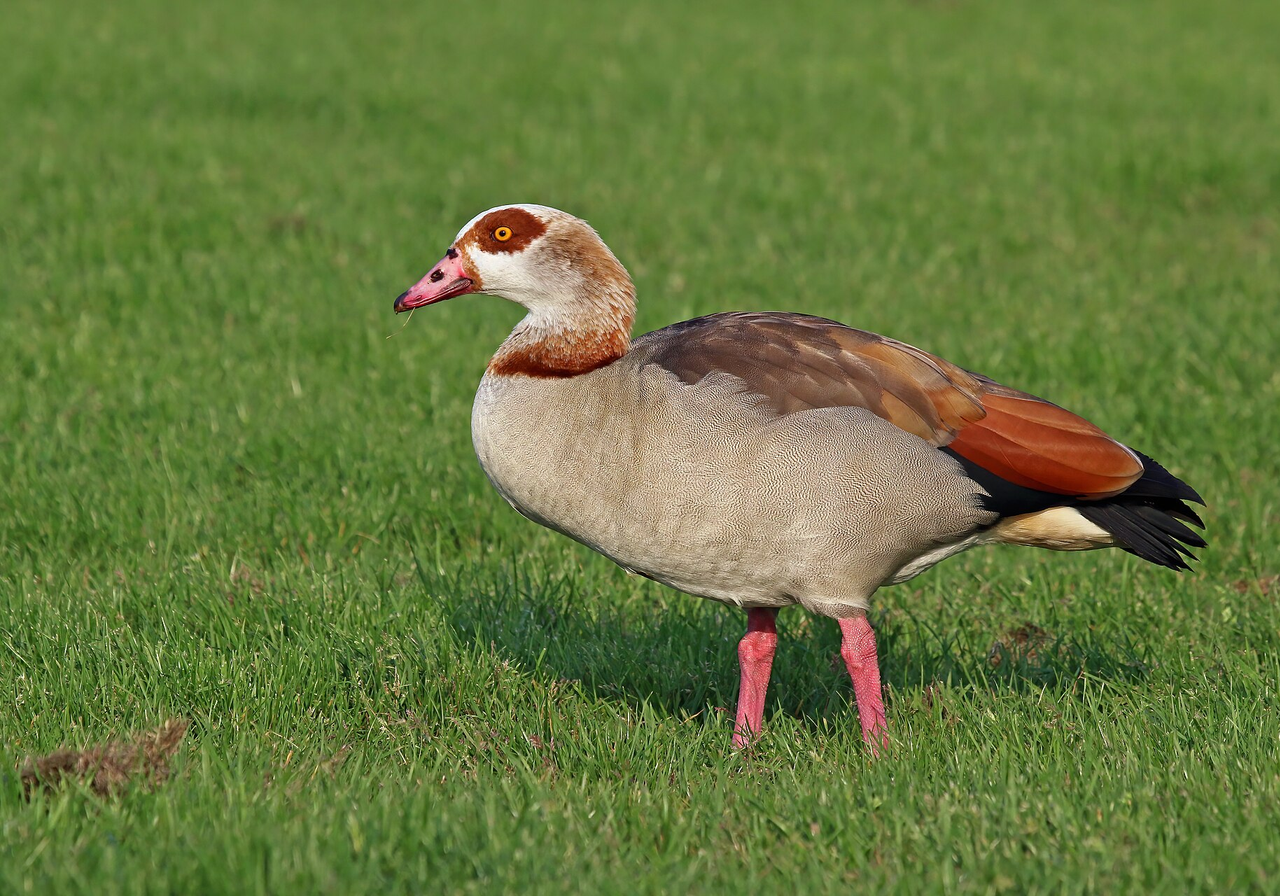
The Egyptian goose (Alopochen aegyptiaca) is a bird of the family Anatidae, in the order Anseriformes.
Quick answer
The Egyptian goose (Alopochen aegyptiaca) is a large waterbird of Africa south of the Sahara and the Nile Valley, with a chocolate-brown patch around each eye and in the centre of the breast, pink legs and big white wing patches. Despite its name it is more closely related to shelducks than to true geese. Introduced birds now live wild across western Europe. It is listed as Least Concern.
Top questions about the Egyptian Goose
Egyptian Goose facts at a glance
- Weight 1.9 kg
- Length 73 cm
| Scientific name | Alopochen aegyptiaca |
|---|---|
| Diet | Grass, seeds, leaves and crops; some invertebrates |
| Habitat | Rivers, lakes, wetlands, farmland and parks |
| Height | 63–73 cm |
| Weight | 1.5–2.3 kg |
| Oldest ringed bird | 15 years 1 month (BTO) |
| Conservation status | Least Concern (IUCN Red List, assessed 2018) |
| Kingdom | Animalia |
|---|---|
| Phylum | Chordata |
| Class | Aves |
| Order | Anseriformes |
| Family | Anatidae |
| Genus | Alopochen |
Where it lives
The egyptian goose (Alopochen aegyptiaca) is native to Africa south of the Sahara and the Nile Valley. Introduced populations live in Britain, the Netherlands, Belgium and Germany. — recorded across Africa in this guide’s range summary.
For occurrence records, see GBIF species search and sources below.
How big is a egyptian goose?
An adult egyptian goose measures 73 cm long — about 42% of the height of an average adult person (1.73 m) — and weighs around 1.9 kg, about 3% of an average adult’s body weight (70 kg).
Length vs an average adult’s height (to scale)
What is a group of egyptian gooses called?
Group name (collective noun)
A group of Egyptian Gooses is called a gaggle. It is also known as a skein.
Baby name
A baby Egyptian Goose is called a gosling.
Explore more animal collective nouns and baby animal names .
Identification
Egyptian geese are pale buff-brown with a darker back, a brown patch around each eye, a brown spot in the middle of the breast, pink bill and legs, and large white wing patches that show in flight. Young birds lack the eye and breast patches.
Not a true goose
The species belongs to the shelduck group of waterfowl rather than the true geese. Pairs are noisy and aggressive in the breeding season and often nest in tree holes, on buildings or in old nests of other birds.
Sacred in ancient Egypt
The ancient Egyptians kept the bird and depicted it in tomb paintings and hieroglyphs. Today it is widespread from the Nile Valley across Africa south of the Sahara to South Africa.
Status and spread
BirdLife International lists the Egyptian goose as Least Concern (2018). Escaped ornamental birds have established large populations in Britain, the Netherlands, Belgium and Germany, and the European Union lists it as an invasive alien species of Union concern.
Explore the Egyptian Goose
Close relatives
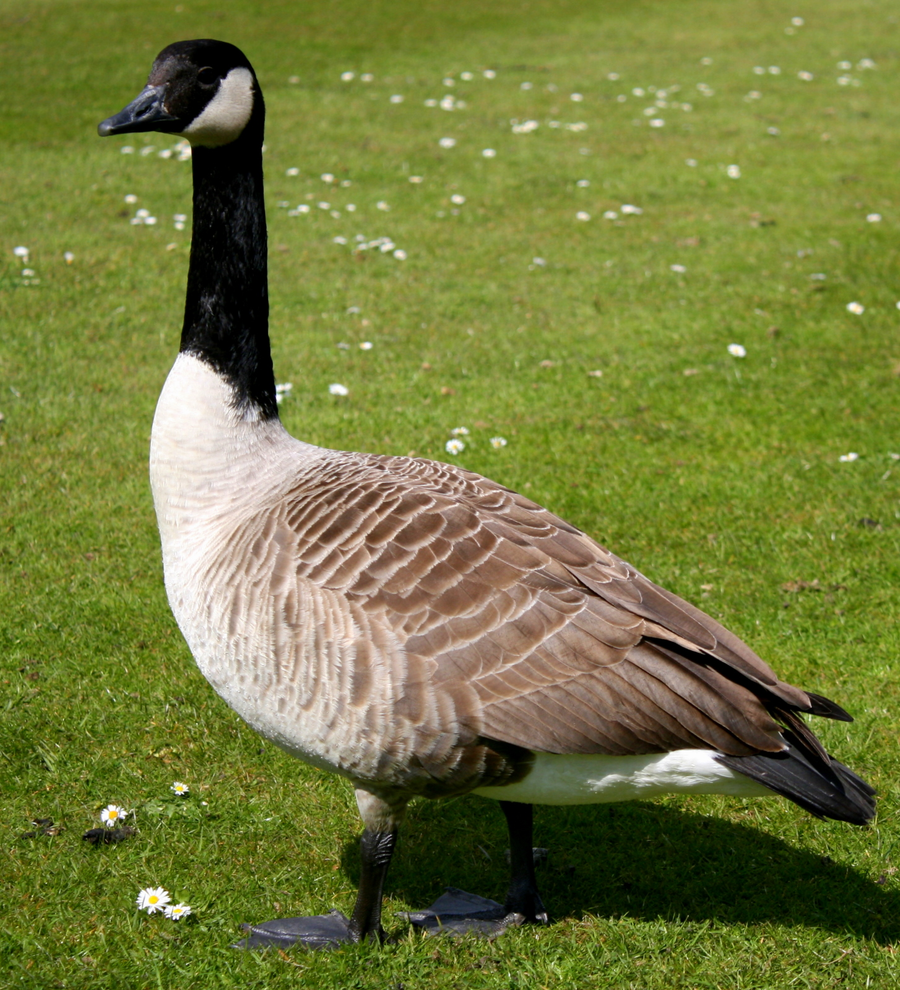
- Canada Goose Same family
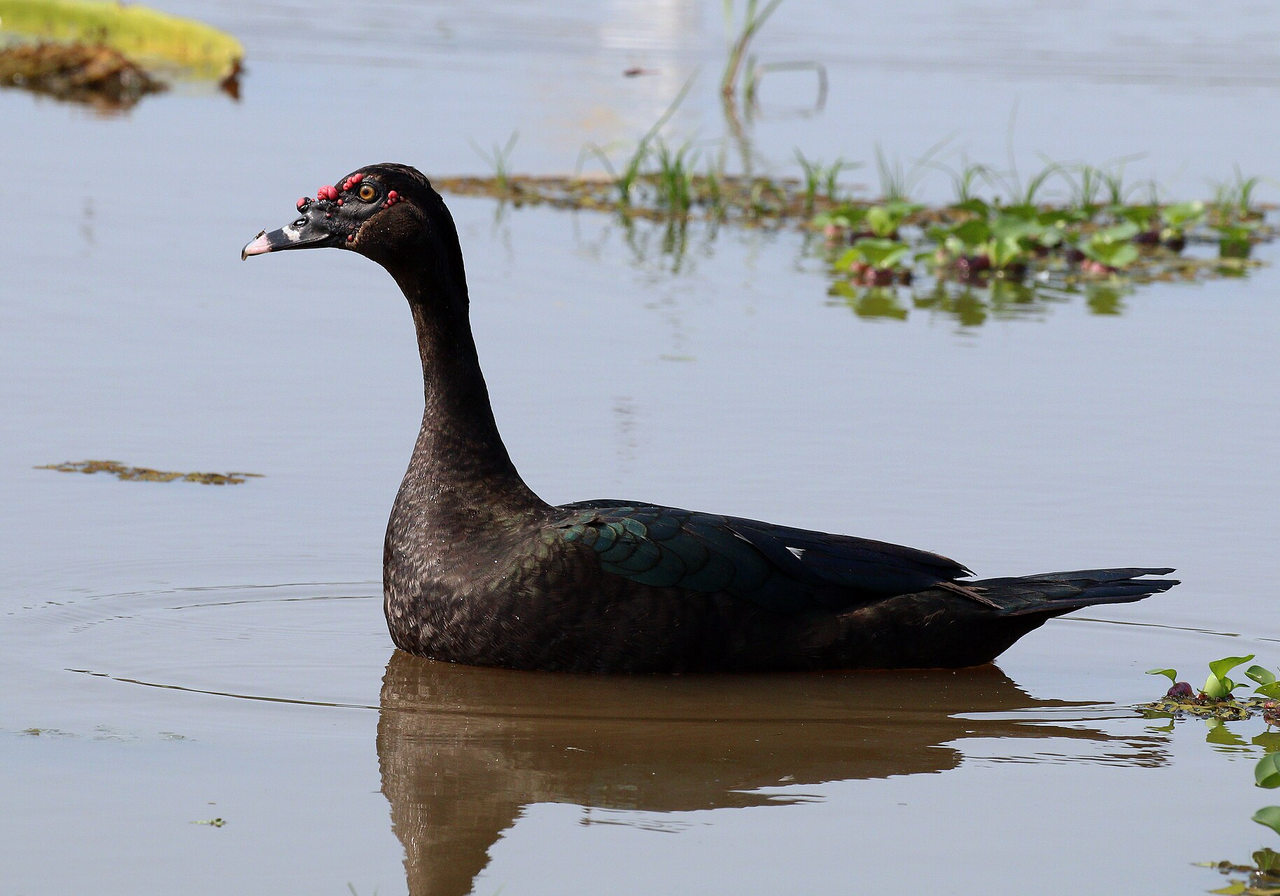
- Muscovy Duck Same family
- Black Swan Same family
- Mandarin Duck Same family
Range & geography
Did you know? Egyptian Goose facts
- Egyptian geese often nest in tree holes or on buildings.
- They appear in ancient Egyptian tomb paintings.
Conservation status of the Egyptian Goose
The Egyptian goose (Alopochen aegyptiaca) is listed as Least Concern on the IUCN Red List. Least Concern (LC) is the IUCN's lowest-risk category, assigned to widespread, abundant species that have been evaluated and found not to be threatened. It does not mean a species faces no pressures — only that it is not currently at risk of extinction.
Egyptian Goose (Alopochen aegyptiaca) was most recently assessed for the IUCN Red List in 2018. Look up on the IUCN Red List .
Frequently asked questions about the Egyptian Goose
Is the Egyptian goose a goose?
Not strictly. It is more closely related to shelducks than to true geese, despite its name.
Is the Egyptian goose invasive?
In Europe, yes. Introduced populations have grown quickly, and the European Union lists it as an invasive alien species of Union concern.
Where do Egyptian geese come from?
From Africa south of the Sahara and the Nile Valley.
How long do Egyptian geese live?
The oldest ringed Egyptian goose in the BTO's records lived 15 years.
What is a group of egyptian gooses called?
A group of Egyptian Gooses is called a gaggle. It is also known as a skein.
What is a baby egyptian goose called?
A baby Egyptian Goose is called a gosling.
Sources & references
This guide is compiled and reviewed against established zoological and conservation references. Key sources for the Egyptian Goose:
-
IUCN Red List of Threatened Species
Conservation status (Least Concern) reflects the IUCN Red List category for Alopochen aegyptiaca, most recently assessed in 2018.
-
iNaturalist — observations & photos
Search citizen-science observations and community IDs for Alopochen aegyptiaca. Useful for range checks and recent sightings — not a substitute for formal Red List status.
-
GBIF — occurrence data
Global Biodiversity Information Facility species search for Alopochen aegyptiaca. Explore published occurrence records used in range research.
-
eBird — bird observations
Cornell Lab eBird target search for Egyptian Goose. Check recent checklists and seasonal abundance where birders report this species.
- BirdLife International (2026). Species factsheet: Egyptian Goose Alopochen aegyptiaca. BirdLife DataZone. Checked 1 November 2026.
IUCN Red List category Least Concern (assessed 2018), population estimate and trend.
- Animal Diversity Web: Alopochen aegyptiaca. University of Michigan Museum of Zoology.
Size, lifespan and behaviour.
- BTO BirdFacts: Egyptian Goose. British Trust for Ornithology.
Typical lifespan, oldest ringed bird and UK body weight.
- Tobias, J. A. et al. (2022). AVONET: morphological, ecological and geographical data for all birds. Ecology Letters 25: 581–597. doi:10.1111/ele.13898
Average body mass.
- Gill, F., Donsker, D. & Rasmussen, P. (Eds). IOC World Bird List v15.2.
English and scientific name, classification and range.
-
Global Animal Guide editorial standards
How we research, source, review, and update every guide for accuracy.