Quick answer
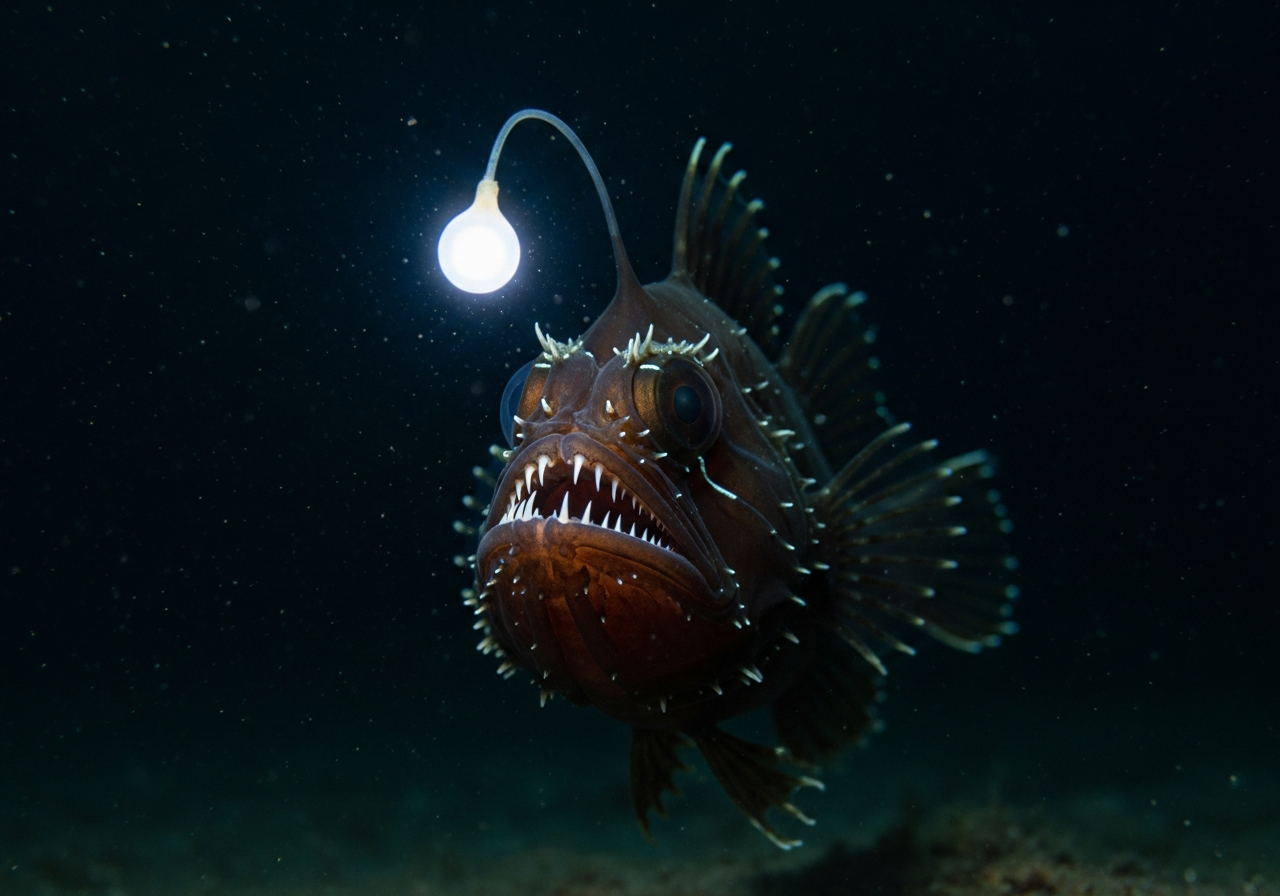
The anglerfish is a deep-sea fish named for the glowing, fishing-rod-like lure that grows from its head and attracts prey in the darkness. The familiar deep-sea females have huge mouths and needle-like teeth, and their light comes from glowing bacteria living in the lure. In some species the tiny male permanently fuses to the female's body, becoming a lifelong source of sperm.
Top questions about the Anglerfish
Anglerfish facts at a glance
- Weight 25 kg
- Length 60 cm
- Top speed 4 km/h
- Lifespan 25 years
| Scientific name | Lophiiformes (order) |
|---|---|
| Diet | Carnivore |
| Habitat | Deep ocean, often below 1,000 m |
| Lifespan | Estimated 10–30 years |
| Length | A few cm up to 1 m by species |
| Top speed | Slow; an ambush predator |
| Conservation status | Least Concern (most species) |
| Kingdom | Animalia |
|---|---|
| Phylum | Chordata |
| Class | Actinopterygii |
| Order | Lophiiformes |
Where it lives
The anglerfish (Lophiiformes) is native to Deep oceans worldwide, with many species living far below the sunlit surface waters. — recorded across Oceans in this guide’s range summary.
For occurrence records, see GBIF species search and sources below.
How big is a anglerfish?
An adult anglerfish measures 60 cm long — about 35% of the height of an average adult person (1.73 m) — and weighs around 25 kg, about 36% of an average adult’s body weight (70 kg).
Length vs an average adult’s height (to scale)
What is a baby anglerfish called?
Baby name
A baby Anglerfish is called a larva. It may also be called a fry.
Explore more animal collective nouns and baby animal names .
The glowing lure
Deep-sea anglerfish have a modified spine that extends over the mouth and ends in a fleshy, glowing tip. The light is produced by symbiotic bacteria living inside the lure, an example of bioluminescence. By wiggling this lure in the dark, the anglerfish draws curious prey close to its waiting jaws.
Built for the deep
Many anglerfish live in the cold, dark, high-pressure waters of the deep sea, where food is scarce. They have enormous mouths, expandable stomachs, and long, inward-curving teeth that let them swallow prey nearly as large as themselves. Slow metabolisms help them survive long gaps between meals.
Extreme reproduction
In several deep-sea species, males are tiny compared with the much larger females. A male finds a female using smell, bites onto her body, and in some species permanently fuses to her, sharing her bloodstream and becoming little more than an attached source of sperm. This ensures a mate is always available in the vast, empty deep.
Habitat and range
Anglerfish are found in oceans worldwide, with many of the famous lured species living far below the sunlit zone. Some relatives, such as the shallow-water monkfish, live on the seafloor and are caught for food. Because deep-sea species are so remote, most are not considered threatened.
Dig deeper into the Anglerfish
- How Big Is An Anglerfish?
Anglerfish size and weight: typical about 25 kg, dimorphism, and growth.
- How Long Do Anglerfish Live?
Anglerfish lifespan is typically Estimated 10–30 years. What shortens or extends life, life stages, and status (Least Concern).
- What Do Anglerfish Eat?
What anglerfish eat: Carnivore, foraging style, and seasonal shifts in Deep ocean, often below 1,000 m.
- Where Do Anglerfish Live?
Where anglerfish live: Deep ocean, often below 1,000 m, native range cues, and human overlap. Status Least Concern.
Explore the Anglerfish
Related Fishs
Collections
Range & geography
Did you know? Anglerfish facts
- The anglerfish is a deep-sea fish named for the glowing, fishing-rod-like lure that grows from its head and attracts prey in the darkness.
- An anglerfish glows because of bioluminescent bacteria living in the lure on its head. The light attracts prey in the dark deep sea, drawing it close enough for the anglerfish to snap up.
- The lure is a built-in fishing rod. By dangling and wiggling the glowing tip, the anglerfish entices curious prey toward its mouth, then ambushes it with a quick gulp.
- In some deep-sea species, yes. The much smaller male bites onto the female and can permanently fuse to her body, sharing her blood supply and serving as a lifelong source of sperm.
- Many anglerfish live in the deep ocean, often well below 1,000 m where sunlight cannot reach, although some relatives live on the seafloor in shallower coastal waters.
- Conservation: Least Concern (most species).
Diet & feeding
Anglerfish feeds primarily as a carnivore. Deep-sea anglerfish have a modified spine that extends over the mouth and ends in a fleshy, glowing tip. The light is produced by symbiotic bacteria living inside the lure, an example of bioluminescence. By wiggling this lure in the dark, the anglerfish draws curious prey clos
Adaptations
- Deep-sea anglerfish have a modified spine that extends over the mouth and ends in a fleshy, glowing tip. The light is produced by symbiotic bacteria living inside the lure, an example of bioluminescence. By wiggling this lure in the dark, the anglerfish draws curious prey close to its waiting jaws.
- Many anglerfish live in the cold, dark, high-pressure waters of the deep sea, where food is scarce. They have enormous mouths, expandable stomachs, and long, inward-curving teeth that let them swallow prey nearly as large as themselves. Slow metabolisms help them survive long gaps between meals.
Behaviour & ecology
- Deep-sea anglerfish have a modified spine that extends over the mouth and ends in a fleshy, glowing tip. The light is produced by symbiotic bacteria living inside the lure, an example of bioluminescence. By wiggling this lure in the dark, the anglerfish draws curious prey close to its waiting jaws.
- Many anglerfish live in the cold, dark, high-pressure waters of the deep sea, where food is scarce. They have enormous mouths, expandable stomachs, and long, inward-curving teeth that let them swallow prey nearly as large as themselves. Slow metabolisms help them survive long gaps between meals.
- In several deep-sea species, males are tiny compared with the much larger females. A male finds a female using smell, bites onto her body, and in some species permanently fuses to her, sharing her bloodstream and becoming little more than an attached source of sperm. This ensures a mate is always available in the vast, empty deep.
Communication
- Lateral-line and visual cues coordinate schooling, courtship, or territorial behaviour.
- Some species produce low-frequency sounds or drumming for spawning or defence.
Habitat & range
Deep ocean, often below 1,000 m
Ecological role
Anglerfish acts as a predator that helps regulate prey populations and maintain balance in deep ocean, often below 1,000 m.
Conservation status of the Anglerfish
The anglerfish (Lophiiformes) is listed as Least Concern on the IUCN Red List. Least Concern (LC) is the IUCN's lowest-risk category, assigned to widespread, abundant species that have been evaluated and found not to be threatened. It does not mean a species faces no pressures — only that it is not currently at risk of extinction.
The anglerfish (Lophiiformes) is assessed on the IUCN Red List. Look up on the IUCN Red List .
Frequently asked questions about the Anglerfish
Why does an anglerfish glow?
An anglerfish glows because of bioluminescent bacteria living in the lure on its head. The light attracts prey in the dark deep sea, drawing it close enough for the anglerfish to snap up.
What does the anglerfish use its lure for?
The lure is a built-in fishing rod. By dangling and wiggling the glowing tip, the anglerfish entices curious prey toward its mouth, then ambushes it with a quick gulp.
Do male and female anglerfish fuse together?
In some deep-sea species, yes. The much smaller male bites onto the female and can permanently fuse to her body, sharing her blood supply and serving as a lifelong source of sperm.
Where do anglerfish live?
Many anglerfish live in the deep ocean, often well below 1,000 m where sunlight cannot reach, although some relatives live on the seafloor in shallower coastal waters.
What do anglerfish eat?
Anglerfish are carnivores that eat fish and invertebrates. Their large mouths and expandable stomachs let them swallow prey nearly as big as themselves, an advantage where food is scarce.
What is a baby anglerfish called?
A baby Anglerfish is called a larva. It may also be called a fry.
Sources & references
This guide is compiled and reviewed against established zoological and conservation references. Key sources for the Anglerfish:
-
IUCN Red List of Threatened Species
Conservation status (Least Concern) reflects the IUCN Red List category for Lophiiformes.
-
iNaturalist — observations & photos
Search citizen-science observations and community IDs for Lophiiformes. Useful for range checks and recent sightings — not a substitute for formal Red List status.
-
GBIF — occurrence data
Global Biodiversity Information Facility species search for Lophiiformes. Explore published occurrence records used in range research.
- IUCN Red List — Lophiiformes.
Conservation status (Least Concern) and population trends.
- Wikipedia — Anglerfish.
General taxonomy and overview (cross-check primary sources).
-
Global Animal Guide editorial standards
How we research, source, review, and update every guide for accuracy.