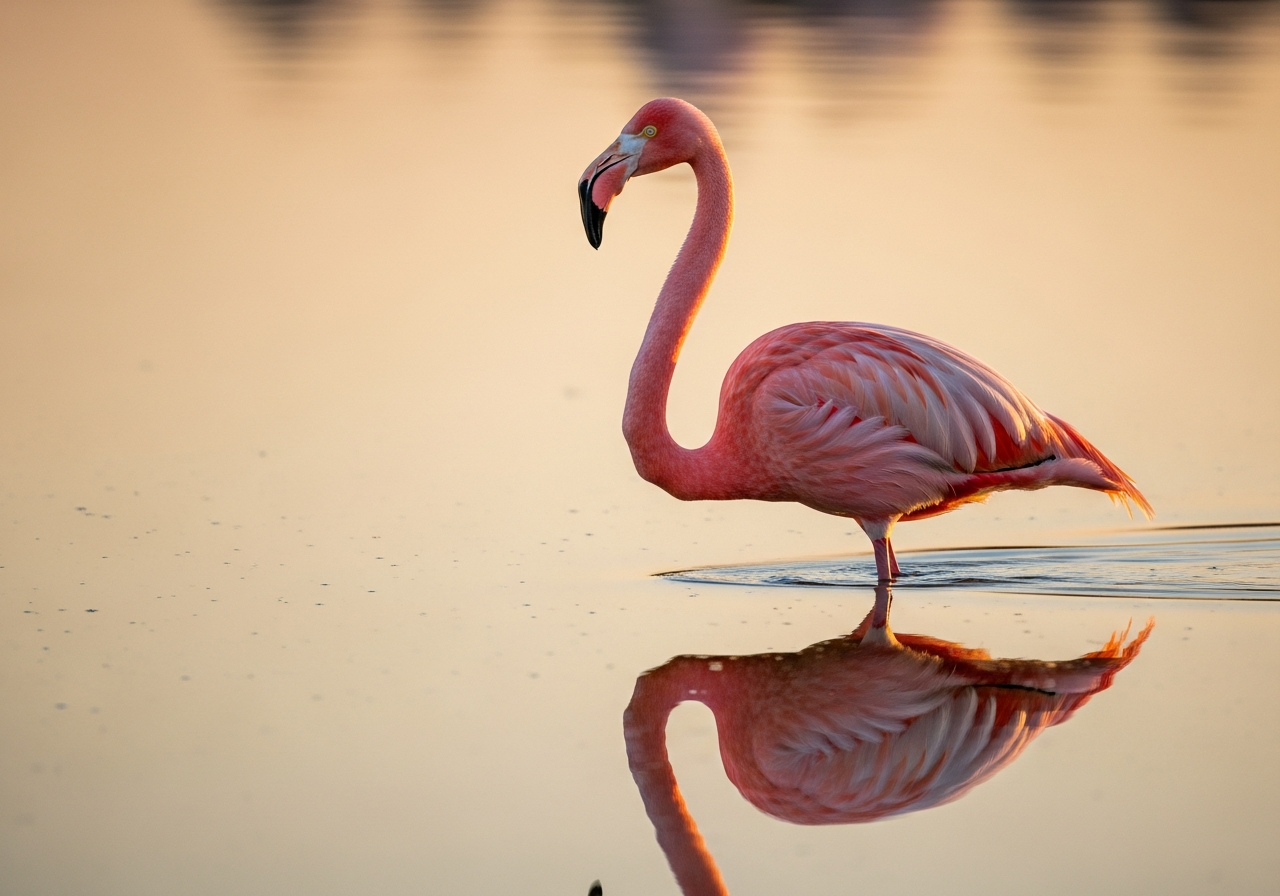
The American flamingo (Phoenicopterus ruber) is a bird of the family Phoenicopteridae, in the order Phoenicopteriformes.
Quick answer
The American flamingo (Phoenicopterus ruber) is a tall pink wading bird of the Caribbean, the coasts of the Yucatán Peninsula and northern South America, with a separate population in the Galápagos. It weighs about 3 kg on average and feeds with its head upside down, filtering small animals from shallow salty water. Its pink colour comes from carotenoid pigments in its food. It is listed as Least Concern on the IUCN Red List (assessed 2020), with an increasing population.
Top questions about the American Flamingo
American Flamingo facts at a glance
- Weight 3 kg
- Lifespan 25 years
| Scientific name | Phoenicopterus ruber |
|---|---|
| Also called | Caribbean flamingo |
| Diet | Small crustaceans and other tiny organisms filtered from shallow water |
| Habitat | Shallow coastal lagoons, mud flats and very salty estuaries |
| Range | The Caribbean, the Yucatán Peninsula coast and northern South America; also the Galápagos |
| Weight | About 3.0 kg on average |
| Lifespan | About 25 years on average in the wild; up to 44 years |
| Mature population | 150,000–205,000 (IUCN Red List) |
| Conservation status | Least Concern (IUCN Red List, assessed 2020) |
| Kingdom | Animalia |
|---|---|
| Phylum | Chordata |
| Class | Aves |
| Order | Phoenicopteriformes |
| Family | Phoenicopteridae |
| Genus | Phoenicopterus |
Where it lives
The american flamingo (Phoenicopterus ruber) is native to Coasts and islands of the Caribbean, the Yucatán Peninsula and northern South America, with a separate population in the Galápagos Islands. — recorded across North America, South America in this guide’s range summary.
For occurrence records, see GBIF species search and sources below.
What is a group of american flamingos called?
Group name (collective noun)
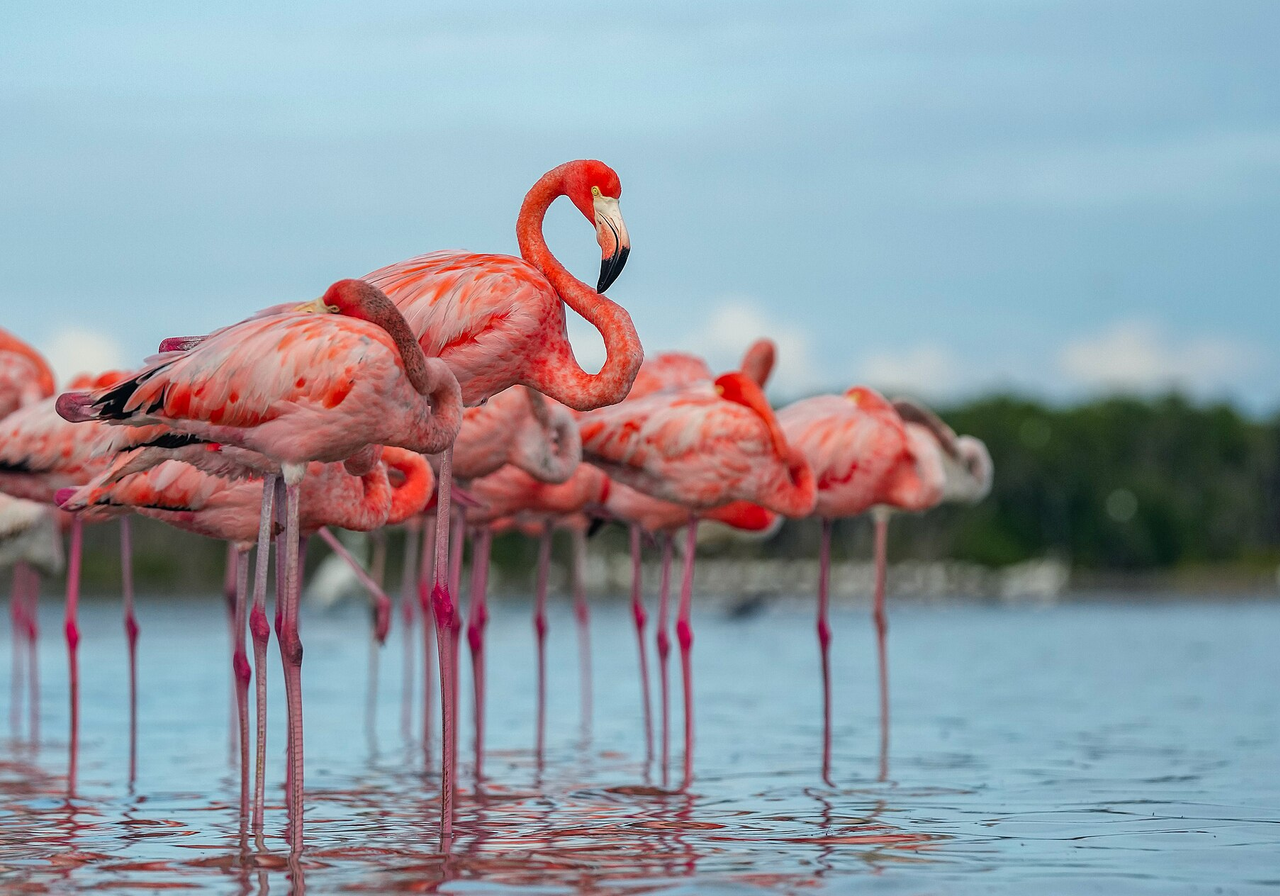
A group of American Flamingos is called a flamboyance. It is also known as a stand or a colony.
Baby name
A baby American Flamingo is called a chick.
Explore more animal collective nouns and baby animal names .
Eating upside down
A flamingo stirs up mud with its feet, then dips its head so the bill is upside down in the water. Rows of plates inside the bill work as a sieve: the bird pumps water out and keeps the tiny animals it has caught. The lower half of the bill is the larger one, the reverse of most birds.
Why it is pink
Chicks hatch grey. Pink feathers grow in as the young bird takes in carotenoid pigments from the crustaceans it eats, and birds that do not get these pigments turn pale. Adults are mostly pink, with black flight feathers that show only when the wings open.
Life in a crowd
American flamingos live, feed and breed in flocks that can number thousands. Each pair builds a mound of mud about 30 cm high, lays a single egg on top and shares incubation. Both parents feed the chick on crop milk, a secretion from the throat that is red because of the pigments in their diet.
Status
The IUCN Red List classes the American flamingo as Least Concern, with an increasing population of 150,000–205,000 mature birds. Some authorities have treated it as a subspecies of the greater flamingo of Africa, southern Europe and Asia; the IUCN Red List and the IOC World Bird List treat it as a separate species.
Explore the American Flamingo
Close relatives
- Flamingo Same genus
- Chicken Same class
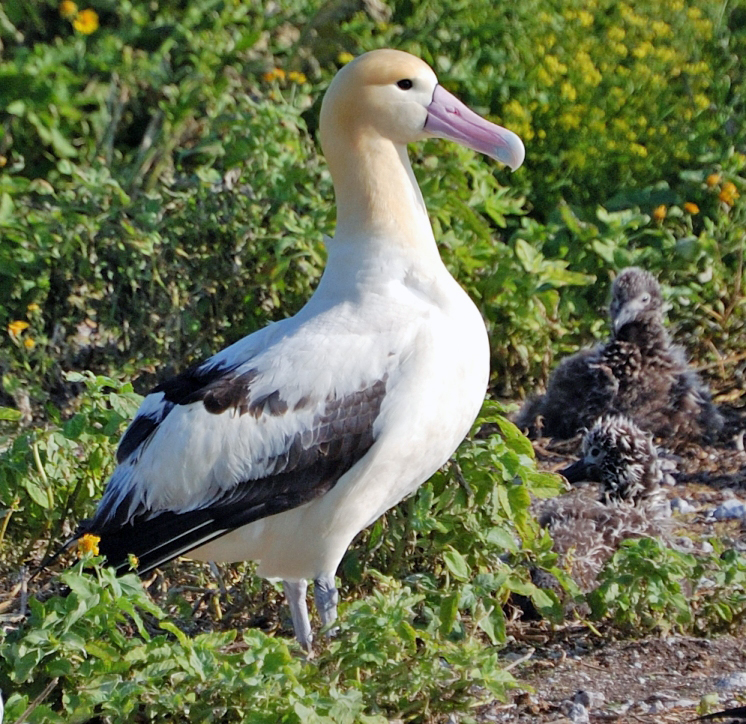
- Wandering Albatross Same class
- Southern Cassowary Same class
Range & geography
Did you know? American Flamingo facts
- A flamingo's lower bill is bigger than the upper one, the reverse of most birds.
- Flamingo crop milk is red, coloured by the same pigments that turn the feathers pink.
Conservation status of the American Flamingo
The American flamingo (Phoenicopterus ruber) is listed as Least Concern on the IUCN Red List. Least Concern (LC) is the IUCN's lowest-risk category, assigned to widespread, abundant species that have been evaluated and found not to be threatened. It does not mean a species faces no pressures — only that it is not currently at risk of extinction.
American Flamingo (Phoenicopterus ruber) was most recently assessed for the IUCN Red List in 2020. View the full IUCN assessment .
Frequently asked questions about the American Flamingo
Why are American flamingos pink?
Their feathers take up carotenoid pigments from the crustaceans they eat. Chicks are grey, and adults that do not get these pigments become pale.
Is the American flamingo the same as the greater flamingo?
No. They are closely related and some authorities have lumped them, but the IUCN Red List and the IOC World Bird List treat the American flamingo (Phoenicopterus ruber) and the greater flamingo (Phoenicopterus roseus) as separate species.
Where do American flamingos live?
Around the Caribbean, along the coasts of the Yucatán Peninsula and northern South America, and in the Galápagos Islands.
Are American flamingos endangered?
No. The IUCN Red List classes them as Least Concern (assessed 2020), with an increasing population of 150,000–205,000 mature birds.
What is a group of american flamingos called?
A group of American Flamingos is called a flamboyance. It is also known as a stand or a colony.
What is a baby american flamingo called?
A baby American Flamingo is called a chick.
Sources & references
This guide is compiled and reviewed against established zoological and conservation references. Key sources for the American Flamingo:
-
IUCN Red List of Threatened Species
Conservation status (Least Concern) reflects the IUCN Red List category for Phoenicopterus ruber, most recently assessed in 2020.
-
iNaturalist — observations & photos
Search citizen-science observations and community IDs for Phoenicopterus ruber. Useful for range checks and recent sightings — not a substitute for formal Red List status.
-
GBIF — occurrence data
Global Biodiversity Information Facility species search for Phoenicopterus ruber. Explore published occurrence records used in range research.
-
eBird — bird observations
Cornell Lab eBird target search for American Flamingo. Check recent checklists and seasonal abundance where birders report this species.
- IUCN Red List of Threatened Species: Phoenicopterus ruber (BirdLife International, assessed 2020). Checked 17 November 2026.
IUCN Red List category Least Concern, last assessed 30 October 2020; population trend increasing; 150,000–205,000 mature individuals.
- Animal Diversity Web: Phoenicopterus ruber. University of Michigan Museum of Zoology.
Feeding, plumage colour, nesting, crop milk and lifespan.
- Tobias, J. A. et al. (2022). AVONET: morphological, ecological and geographical data for all birds. Ecology Letters 25: 581–597. doi:10.1111/ele.13898
Average body mass.
- Gill, F., Donsker, D. & Rasmussen, P. (Eds). IOC World Bird List v15.2.
English and scientific name, classification and range.
-
Global Animal Guide editorial standards
How we research, source, review, and update every guide for accuracy.