Marsupials vs Placentals: What's the Difference?
Marsupials give birth early and often finish development in a pouch; placentals have longer pregnancies. Kangaroos, koalas, opossums vs most familiar mammals.
Global Animal Guide · July 10, 2026
Quick answer
Marsupials and placentals are two major living mammal lineages. Marsupials typically have short pregnancies and raise tiny newborns, often in a pouch. Placentals nourish embryos longer via a complex placenta before birth. Monotremes (platypus, echidnas) are a third lineage that lays eggs.
Last updated: July 2026.
The real difference is where development happens
The popular answer — “marsupials have pouches” — is the least reliable way to tell the two groups apart. The genuine distinction is when a mammal is born relative to how finished it is, and which organ does the heavy lifting of feeding the embryo.
Placental mammals invest in a long, sophisticated pregnancy. A complex placenta interlocks maternal and foetal blood supplies, delivering oxygen and nutrients and removing waste for weeks or months. The newborn that emerges may be nearly self-sufficient — a wildebeest calf runs with the herd within an hour — or it may be blind and helpless like a red fox kit. Either way, the major organ systems were built inside the uterus.
Marsupials shift almost all of that investment to lactation. A marsupial embryo develops on a simpler, short-lived placenta — usually a yolk-sac structure without deep, long-term invasion of the uterine wall — and is born at what looks like a foetal stage. A newborn red kangaroo is roughly the size of a jellybean, pink, blind, and with hind limbs that are barely buds. It is not, however, helpless: its forelimbs and shoulder girdle are precociously developed, and it climbs unaided through its mother’s fur to the teat. What follows is a long lactation in which milk composition changes stage by stage, effectively doing the job a placenta would have done.
Why the pouch is a red herring
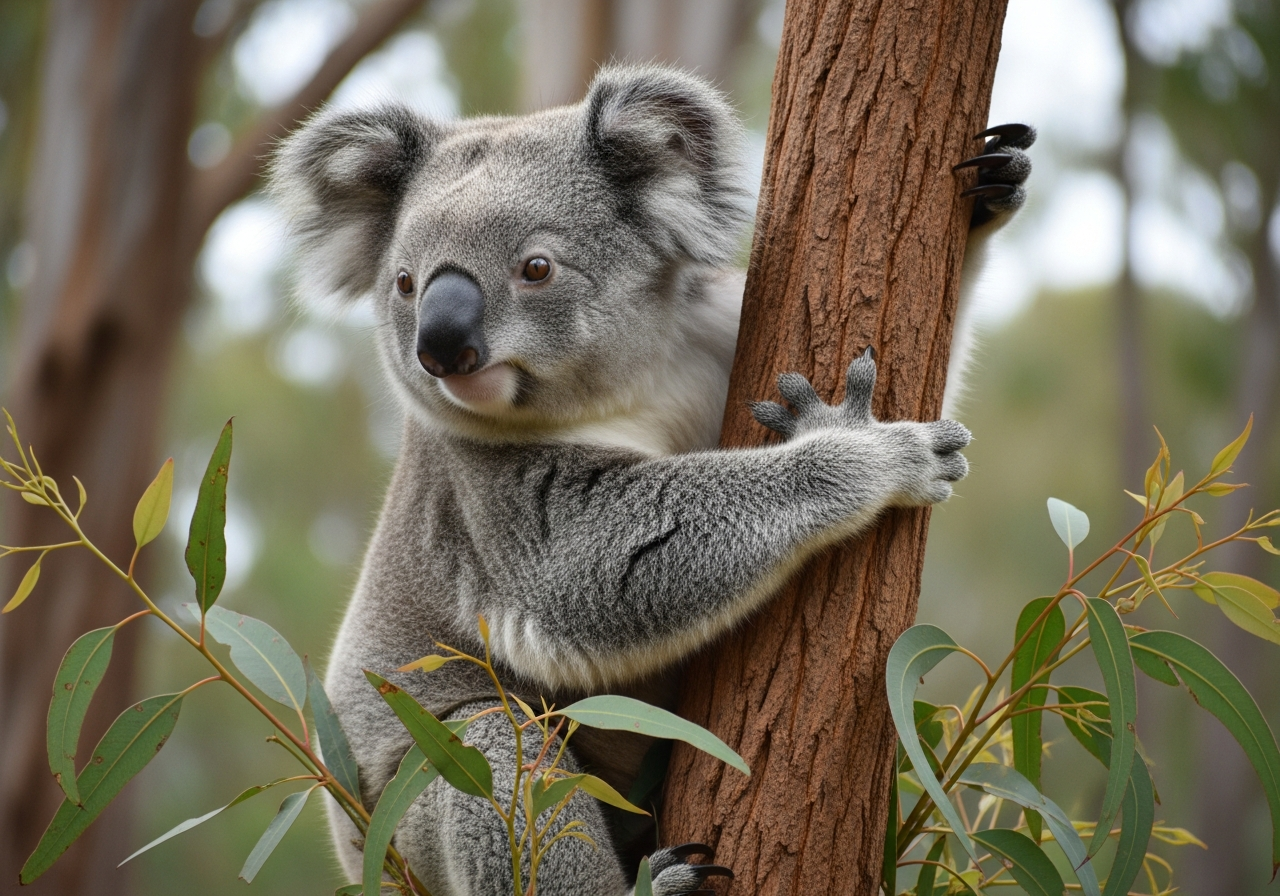
Pouches vary enormously, and plenty of marsupials barely have one. Some small dasyurids and shrew-opossums have only a shallow fold of skin, or ridges either side of the teats, with the young simply hanging on. Many American opossums have no true enclosed pouch at all. Where pouches do exist, they open in different directions: forward in the red kangaroo, rearward in the wombat and the koala, which keeps soil out of the pouch of a burrowing animal and, in the koala’s case, positions the young near the cloaca — a genuinely useful arrangement, because a young koala eats a specialised maternal pap that seeds its gut with the microbes needed to detoxify eucalyptus leaves.
Convergent structures muddy things further. The platypus and echidna are monotremes, not marsupials, yet an echidna incubates its egg and hatchling in a temporary pouch-like fold. Pouches are a solution, not a lineage marker.
Two lineages, one ancient split
Marsupials and placentals are both therian mammals — they share a common ancestor and diverged deep in the Mesozoic, well before the extinction that ended the non-avian dinosaurs. Neither group is “primitive” relative to the other; both have had exactly the same amount of time to evolve.
Their present-day distribution is a story of geography rather than superiority. Marsupial diversity is concentrated in Australia and New Guinea, with a substantial secondary radiation in South America, and it reached Australia via Antarctica when the southern continents were joined. Australia’s long isolation left marsupials to fill roles that placentals occupy elsewhere — which is why the continent’s mammal fauna reads like a parallel draft of the same design brief.
Convergent evolution: the parallel drafts
Put the two groups side by side and the resemblances are startling, because similar ecological problems produce similar solutions.
The sugar glider glides on a membrane stretched between wrist and ankle, hunts insects and sap at night, and looks remarkably like the placental flying squirrel — yet the two are separated by well over a hundred million years of independent evolution. The numbat tackles termites with a long sticky tongue and reduced, peg-like teeth, arriving at much the same toolkit as the placental giant anteater and the aardvark. The tasmanian devil occupies a scavenging, bone-cracking niche broadly comparable to that of a small hyena. The extinct thylacine looked so like a canid that its common name — Tasmanian tiger or marsupial wolf — was really a comment on how convincingly evolution had copied a gray wolf.
The copies are never exact, and the gaps are informative. No marsupial has evolved true powered flight, as bats did; none has returned fully to the ocean as whales and dolphins did. One likely constraint is that marsupial newborns must crawl to the teat, which demands functional forelimbs and shoulders early — locking the front limbs into a shape that is hard to redesign into a wing or a flipper.
Trade-offs: which strategy is better?
Neither, which is the point. Each carries a different bet about risk.
Marsupial reproduction is cheap to abort. Because the mother’s early investment is small, a female can jettison a pouch young in drought or when pursued and start again quickly with little sunk cost. Kangaroos take this to an extreme with embryonic diapause: a female may simultaneously carry a paused embryo, suckle a pouch young, and feed an older joey at heel — running three offspring at different stages and producing two milks of different composition from adjacent teats at once. In the boom-and-bust rainfall of arid Australia, that responsiveness is worth a great deal.
Placental reproduction is a bigger, less reversible commitment, but it delivers a more finished, more capable neonate and permits enormous body sizes and specialised body plans — from the blue whale to the elephant. The cost is that losing a late pregnancy is expensive, and the pregnancy itself demands sophisticated immunological tolerance of foetal tissue.
What actually decided the outcome
Placentals vastly outnumber marsupials today — thousands of species against a few hundred. That gap looks like a verdict, but history and geography did most of the work. Where placentals arrived in marsupial strongholds, the results were mixed rather than uniform: the dingo is implicated in the mainland decline of the thylacine, while introduced foxes and cats have been devastating for small marsupials such as the bilby and numbat — but that is predation and novel disease, not a fair contest between reproductive systems. Conversely, the opossum has thrived and expanded its range across a continent full of placentals.
Quick comparison
| Trait | Marsupials | Placentals |
|---|---|---|
| Pregnancy | Short | Longer |
| Newborn | Extremely altricial | More developed (varies) |
| Milk | Long lactation | Variable |
| Main nourishment | Milk, after a very early birth | Placenta, before birth |
| Where young finish developing | Attached to a teat, often in a pouch | In the uterus |
| Examples | Kangaroo, koala, Tasmanian devil | Dog, whale, bat, human |
Related reading
Sources
Frequently asked questions
Is a kangaroo a marsupial?
Yes — kangaroos are marsupials.
Are there marsupials outside Australia?
Yes — opossums in the Americas; Australia/New Guinea hold most diversity.
Do all marsupials have pouches?
No — some have temporary folds or carry young without a full pouch.
Which group has more species?
Placentals — by far.