Quick answer
Whale sharks live in warm tropical and subtropical seas, including coastal aggregation sites. About 75% of remaining animals are inferred in the Indo-Pacific. They are fish, not whales. IUCN: Endangered. Figures checked 13 August 2026.
Warm seas — which water?
Tropical and subtropical open water and coasts, with long movements between feeding pulses. “Warm open and coastal oceans” without the Indo-Pacific share was the thin version of this page. They do not live on polar ice.
What microhabitats do they use?
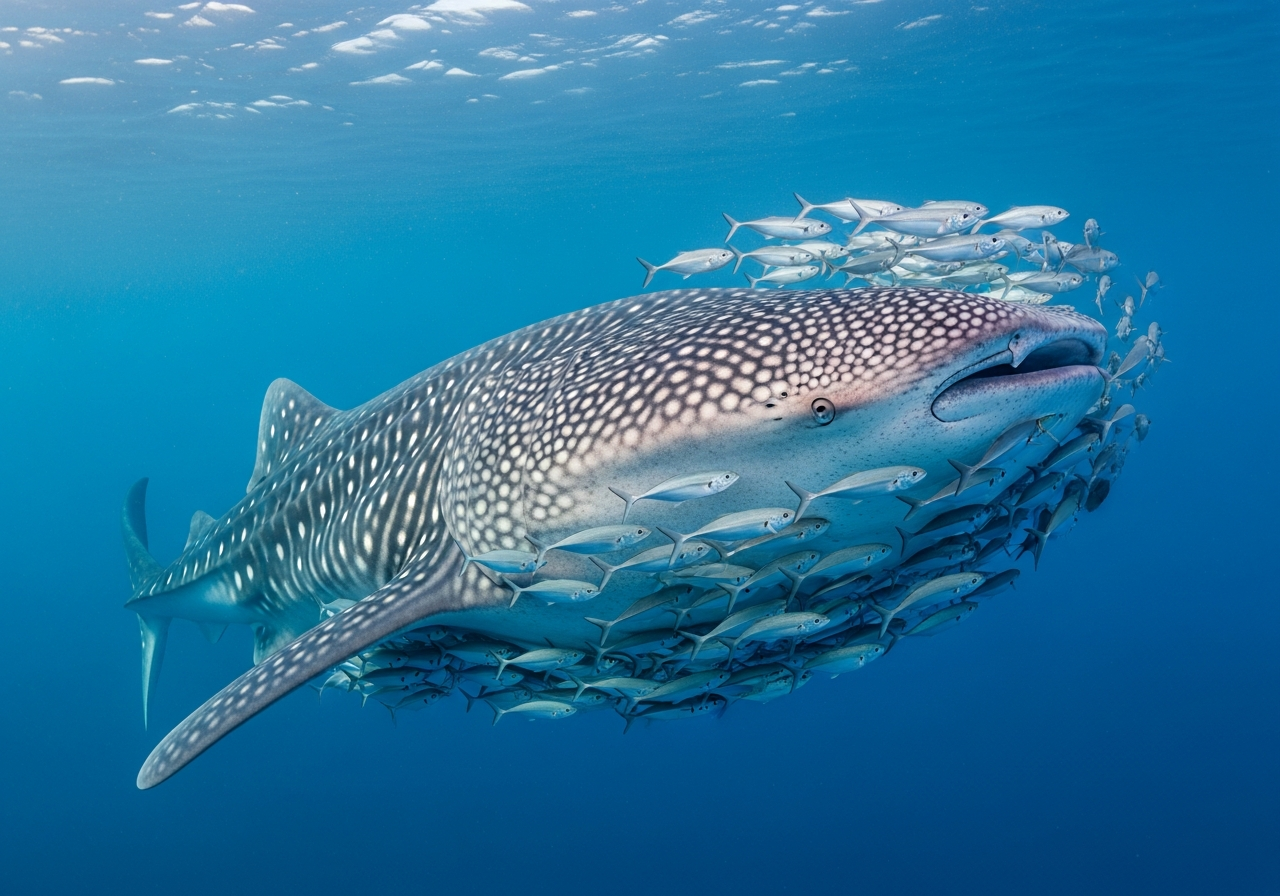
Surface slicks of plankton or spawn, drop-offs, and known aggregation sites. A snorkel queue is a map of food, not proof they “prefer” tourists. Many counted animals at those sites are juvenile males.
How do people shrink the map?
Fishing the aggregations, bycatch in nets, and vessel strikes. This is not a farms-and-suburbs story. A wide warm-water map is not an all-clear when the Indo-Pacific inferred decline is about 63% over three generations.
What does Endangered geography require?
Protected feeding sites, slower boats, and no chum. Watch in the water at a distance; never feed. There is no honest global headcount to treat as a recovered range.
Does size expand the map?
A 12 m fish can cross basins. Spot patterns identify individuals; they do not reconnect a fished hotspot to an unfished one. Slow cruise is not a shield against a propeller.
Does plankton set the pins?
Yes. They go where tiny prey blooms. WARN’s donate page funds wildlife-protection partners — not whale-shark tourism.
Sources
Whale Shark FAQs
Where do whale sharks live?
Warm tropical and subtropical seas, both open water and coastal feeding hotspots, with long migrations between aggregation sites. They are fish, not whales, and not a polar species. About 75% of remaining animals are inferred in the Indo-Pacific. IUCN: Endangered (2016).
Do they live in the same places as blue whales?
Sometimes the same ocean basin, never as the same animal. Blue whales are baleen mammals tracking krill, including cold feeding grounds. Whale sharks stay in warm tropical and subtropical water. Mixing the pins mixes the threats — and the Endangered listing with a whale recovery story.
Have they lost range?
The listing is a decline inside a still-wide map: inferred ≥50% globally over 75 years, about 63% in the Indo-Pacific. A packed snorkel site is not an Atlantic all-clear. There is no honest global headcount to hang on the map.
What actually protects whale shark range?
Unfished aggregations, slower boats, and no feeding at coastal hotspots. A packed snorkel site is not an Atlantic all-clear. World Animal Rescue Network’s donate page funds wildlife-protection partners — not whale-shark tourism. They are fish, not whales.
Who this page is for. This page is native range and habitat, not a sighting hotline.