Image sourcing: see credits & licences
Quick answer
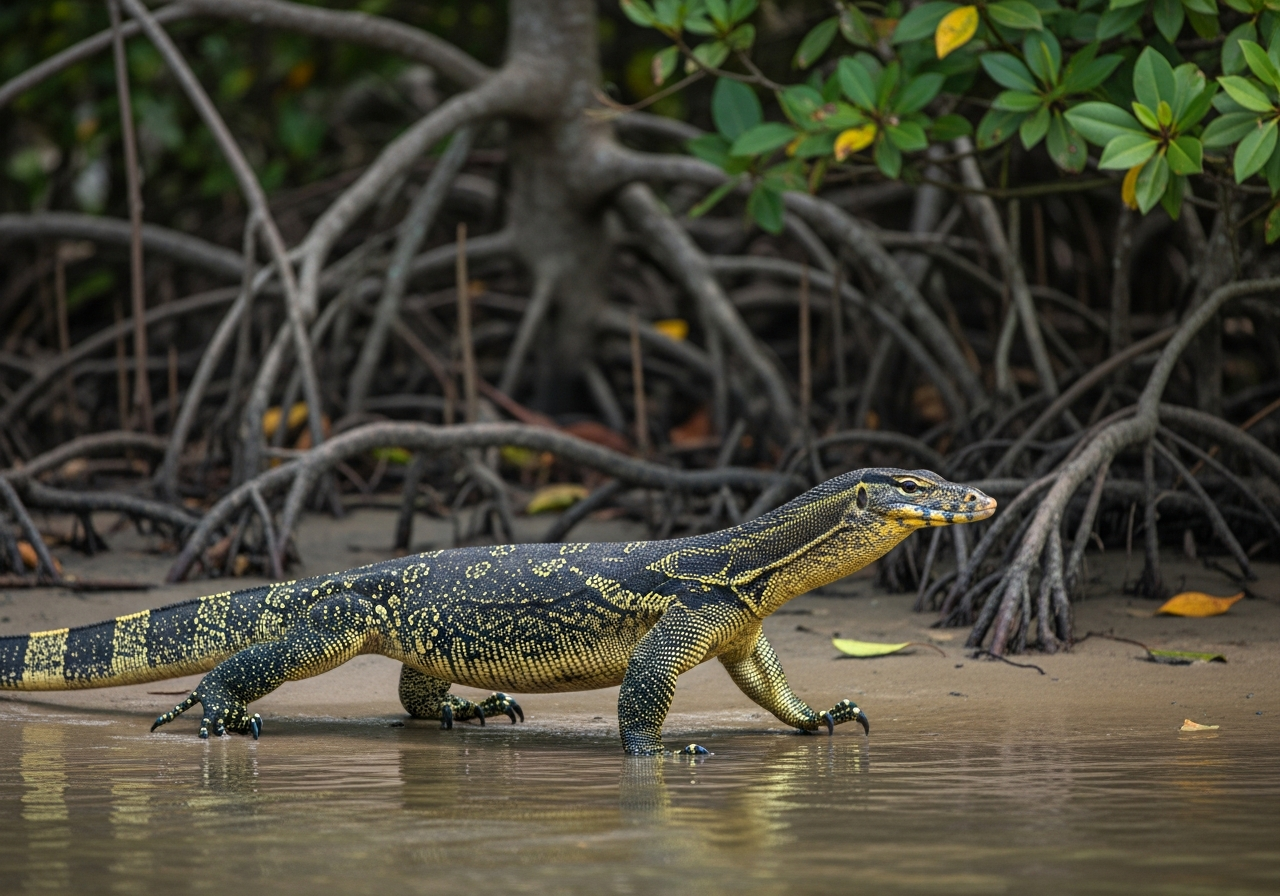
The Asian water monitor (Varanus salvator) is one of the largest lizards in the world, reaching up to 3 m (10 ft) long and around 25 kg (55 lb). It lives across South and Southeast Asia in wetlands, rivers, mangroves, and coastal areas, where it walks powerfully on land and swims with ease using its muscular tail. A carnivore and scavenger, it eats almost anything it can catch and can live 10 to 20 years.
Top questions about the Asian Water Monitor
Asian Water Monitor facts at a glance
- Weight 20 kg
- Length 2 m
- Top speed 30 km/h
- Lifespan 15 years
| Scientific name | Varanus salvator |
|---|---|
| Diet | Carnivore (also scavenges) |
| Habitat | Wetlands, rivers, mangroves, and coasts |
| Lifespan | 10–20 years |
| Length | Up to 3 m (10 ft) |
| Weight | Up to 25 kg (55 lb) |
| Conservation status | Least Concern (IUCN) |
| Kingdom | Animalia |
|---|---|
| Phylum | Chordata |
| Class | Reptilia |
| Order | Squamata |
| Family | Varanidae |
| Genus | Varanus |
Where it lives
The asian water monitor (Varanus salvator) is native to Wetlands, rivers, mangroves, and coasts across South and Southeast Asia. — recorded across Asia in this guide’s range summary.
For occurrence records, see GBIF species search and sources below.
How big is a asian water monitor?
An adult asian water monitor measures 2 m long — about 1.2× the height of an average adult person (1.73 m) — and weighs around 20 kg, about 29% of an average adult’s body weight (70 kg).
Length vs an average adult’s height (to scale)
What is a group of asian water monitors called?
Group name (collective noun)
A group of Asian Water Monitors is called a lounge.
Baby name
A baby Asian Water Monitor is called a hatchling.
Explore more animal collective nouns and baby animal names .
Size and build
The water monitor is second only to the Komodo dragon among the world's heaviest lizards. Large adults stretch up to 3 m (10 ft) from snout to tail tip and weigh as much as 25 kg (55 lb), with the tail alone making up more than half the total length. The body is long and muscular, covered in dark scales flecked with yellow spots and bands. Strong limbs and sharp, curved claws make it an excellent climber and digger as well as a swimmer.
At home in the water
As its name suggests, this monitor is closely tied to water and is rarely found far from it. Its flattened, oar-like tail drives it through rivers, swamps, and coastal shallows, and it can stay submerged for many minutes while hunting or hiding. On land it walks with a steady, side-to-side gait and can put on a surprising burst of speed of around 30 km/h when pressed. It readily crosses stretches of sea between islands, which is one reason it is so widespread.
Diet and scavenging
Water monitors are opportunistic carnivores that eat an enormous range of prey. Fish, frogs, crabs, birds, rodents, snakes, turtles, and eggs are all on the menu, and they will raid nests and dig up buried food. They are also important scavengers, feeding readily on carrion and human refuse, which draws them into towns and villages. A keen sense of smell, aided by a forked tongue, helps them track food from a distance.
Living alongside people
Few large predators tolerate human company as well as the water monitor. It thrives in canals, rice paddies, fishing ports, and even city parks across Southeast Asia, where scraps and rodents are plentiful. Generally shy, it prefers to slip into the water or flee rather than confront a person. This adaptability has allowed it to remain common in landscapes where many other big reptiles have vanished.
Reproduction
Females lay clutches of up to around 40 eggs, often depositing them inside termite mounds or in holes dug into riverbanks and rotting logs. The termite mound provides steady warmth and humidity, and the insects reseal the chamber around the eggs. Incubation takes several months, after which the hatchlings emerge fully independent and immediately take to the water. Young monitors are brightly patterned and spend much of their early life in trees, out of reach of ground predators.
Conservation status
The Asian water monitor is listed as Least Concern by the IUCN and remains widespread and adaptable across its range. Even so, it is hunted in large numbers for its skin, which supplies the leather trade, and for meat and the pet market. Local populations can be depleted where hunting is intense, but its tolerance of disturbed and urban habitats has kept the species as a whole secure. Wetland protection helps sustain the healthiest populations.
Dig deeper into the Asian Water Monitor
- How Fast Is An Asian Water Monitor?
Asian Water Monitor top speed is about about 30 km/h. Sprint vs endurance and what limits pace.
- How Long Do Asian Water Monitors Live?
Asian Water Monitor lifespan is typically 10–20 years. What shortens or extends life, life stages, and status (Least Concern).
- Asian Water Monitor: Key Facts
Asian Water Monitors (Varanus salvator) are reptiles found across Asia. One of the largest lizards in the world.
- What Do Asian Water Monitors Eat?
What asian water monitors eat: Carnivore (also scavenges), foraging style, and seasonal shifts in Wetlands, rivers, mangroves, and coasts.
- Where Do Asian Water Monitors Live?
Where asian water monitors live: Wetlands, rivers, mangroves, and coasts, native range cues, and human overlap. Status Least Concern.
Explore the Asian Water Monitor
Related Reptiles
Range & geography
Did you know? Asian Water Monitor facts
- The Asian water monitor is one of the largest lizards on Earth, reaching up to 3 m (10 ft) and 25 kg (55 lb), and is a strong swimmer found across South and Southeast Asia.
- Asian water monitors are among the largest lizards in the world, reaching up to about 3 m (10 ft) long and 25 kg (55 lb), though most are smaller.
- They are opportunistic carnivores and scavengers that eat fish, frogs, crabs, birds, eggs, rodents, and carrion, and they readily feed at rubbish dumps.
- They generally avoid people, but a large cornered monitor can bite, scratch, and whip with its tail. Bites can become infected, so they should be given space and not handled.
- Yes. Asian water monitors are excellent swimmers that use their powerful, flattened tails to move through water and often dive to escape threats or find food.
- Conservation: Least Concern (IUCN).
Diet & feeding
Asian Water Monitor feeds primarily as a carnivore (also scavenges). These monitors are opportunistic carnivores and scavengers that eat fish, frogs, crabs, birds, eggs, rodents, and carrion. A forked tongue and keen sense of smell help them track food, and they readily feed at rubbish dumps and along rivers. Their wil
Adaptations
- Asian water monitors are semi-aquatic and never live far from water, into which they dive to escape danger or to hunt. They are excellent swimmers, using a powerful, flattened tail, and are also capable climbers and runners. Remarkably tolerant of people, they thrive in farmland, ports, and even busy cities where food is easy to find.
- These monitors are opportunistic carnivores and scavengers that eat fish, frogs, crabs, birds, eggs, rodents, and carrion. A forked tongue and keen sense of smell help them track food, and they readily feed at rubbish dumps and along rivers. Their willingness to eat almost anything is a key reason for their success.
Behaviour & ecology
- Asian water monitors are semi-aquatic and never live far from water, into which they dive to escape danger or to hunt. They are excellent swimmers, using a powerful, flattened tail, and are also capable climbers and runners. Remarkably tolerant of people, they thrive in farmland, ports, and even busy cities where food is easy to find.
- These monitors are opportunistic carnivores and scavengers that eat fish, frogs, crabs, birds, eggs, rodents, and carrion. A forked tongue and keen sense of smell help them track food, and they readily feed at rubbish dumps and along rivers. Their willingness to eat almost anything is a key reason for their success.
- The Asian water monitor ranges across South and Southeast Asia, from Sri Lanka and eastern India through Indonesia and the Philippines. It favors wetlands, riverbanks, mangroves, swamps, and coasts with access to water. It is one of the most widespread large lizards in its region.
Communication
- Scent marking, body posture, and head-bobbing or tail signals communicate threat and dominance.
- Vocalisations are limited in many reptiles but hissing or bellowing occurs in some groups.
Habitat & range
Wetlands, rivers, mangroves, and coasts
Ecological role
Asian Water Monitor acts as a predator that helps regulate prey populations and maintain balance in wetlands, rivers, mangroves, and coasts.
Conservation status of the Asian Water Monitor
The asian water monitor (Varanus salvator) is listed as Least Concern on the IUCN Red List. Least Concern (LC) is the IUCN's lowest-risk category, assigned to widespread, abundant species that have been evaluated and found not to be threatened. It does not mean a species faces no pressures — only that it is not currently at risk of extinction.
The asian water monitor (Varanus salvator) is assessed on the IUCN Red List. Look up on the IUCN Red List .
Frequently asked questions about the Asian Water Monitor
How big do Asian water monitors get?
Asian water monitors can reach up to 3 m (10 ft) in total length and weigh as much as 25 kg (55 lb). Much of that length is tail. This makes them one of the largest lizard species in the world, second only to the Komodo dragon by weight.
Can water monitors swim?
Yes, they are superb swimmers. A flattened, paddle-like tail powers them through rivers, swamps, and coastal water, and they can stay submerged for several minutes. They even swim between islands across open sea, which has helped them spread across Southeast Asia.
What do water monitors eat?
Water monitors are opportunistic carnivores. They eat fish, frogs, crabs, birds, rodents, snakes, turtles, and eggs, and they scavenge carrion and human refuse. A strong sense of smell helps them find both live prey and buried or hidden food.
Are water monitors dangerous to humans?
They are large and powerful but generally shy, and they usually flee into water rather than attack. Bites are rare and normally happen only when the animal is cornered or handled, though a big monitor can inflict a painful wound with its teeth and claws.
Where do Asian water monitors live?
They live across South and Southeast Asia in wetlands, rivers, mangroves, and coastal areas. They are highly adaptable and also thrive in human landscapes such as canals, rice paddies, fishing ports, and city parks.
How long do water monitors live?
Asian water monitors typically live between 10 and 20 years. Their long lifespan and adaptable, opportunistic lifestyle help them persist even in areas heavily altered by people.
What is a group of asian water monitors called?
A group of Asian Water Monitors is called a lounge.
What is a baby asian water monitor called?
A baby Asian Water Monitor is called a hatchling.
Sources & references
This guide is compiled and reviewed against established zoological and conservation references. Key sources for the Asian Water Monitor:
-
IUCN Red List of Threatened Species
Conservation status (Least Concern) reflects the IUCN Red List category for Varanus salvator.
-
iNaturalist — observations & photos
Search citizen-science observations and community IDs for Varanus salvator. Useful for range checks and recent sightings — not a substitute for formal Red List status.
-
GBIF — occurrence data
Global Biodiversity Information Facility species search for Varanus salvator. Explore published occurrence records used in range research.
- IUCN Red List — Varanus salvator.
Conservation status (Least Concern) and population trends.
- Animal Diversity Web — Varanus salvator. University of Michigan Museum of Zoology.
Life history, morphology, and range.
- Wikipedia — Asian Water Monitor.
General taxonomy and overview (cross-check primary sources).
-
Global Animal Guide editorial standards
How we research, source, review, and update every guide for accuracy.