Image sourcing: see credits & licences
The vaquita (Phocoena sinus) is a mammal of the family Phocoenidae, in the order Artiodactyla.
Quick answer
The vaquita is the world's smallest and most endangered porpoise, found only in the northern Gulf of California in Mexico. It is recognized by dark rings around the eyes and lips. With only around ten individuals left, it is the most endangered marine mammal on Earth, threatened mainly by illegal gillnets.
Top questions about the Vaquita
Vaquita facts at a glance
- Weight 50 kg
- Length 1.5 m
- Top speed 35 km/h
- Lifespan 20 years
| Scientific name | Phocoena sinus |
|---|---|
| Diet | Carnivore (fish and squid) |
| Habitat | Shallow northern Gulf of California |
| Lifespan | Around 20 years |
| Weight | 30–55 kg (66–121 lb) |
| Top speed | A fast, shy swimmer |
| Conservation status | Critically Endangered (IUCN) |
| Kingdom | Animalia |
|---|---|
| Phylum | Chordata |
| Class | Mammalia |
| Order | Artiodactyla |
| Family | Phocoenidae |
| Genus | Phocoena |
Where it lives
The vaquita (Phocoena sinus) is native to Only the shallow northern end of the Gulf of California in Mexico, the smallest range of any marine mammal. — recorded across North America, Oceans in this guide’s range summary.
For occurrence records, see GBIF species search and sources below.
How big is a vaquita?
An adult vaquita measures 1.5 m long — about 87% of the height of an average adult person (1.73 m) — and weighs around 50 kg, about 71% of an average adult’s body weight (70 kg).
Length vs an average adult’s height (to scale)
What is a group of vaquitas called?
Group name (collective noun)
A group of Vaquitas is called a pod.
Baby name
A baby Vaquita is called a calf.
Explore more animal collective nouns and baby animal names .
The smallest porpoise
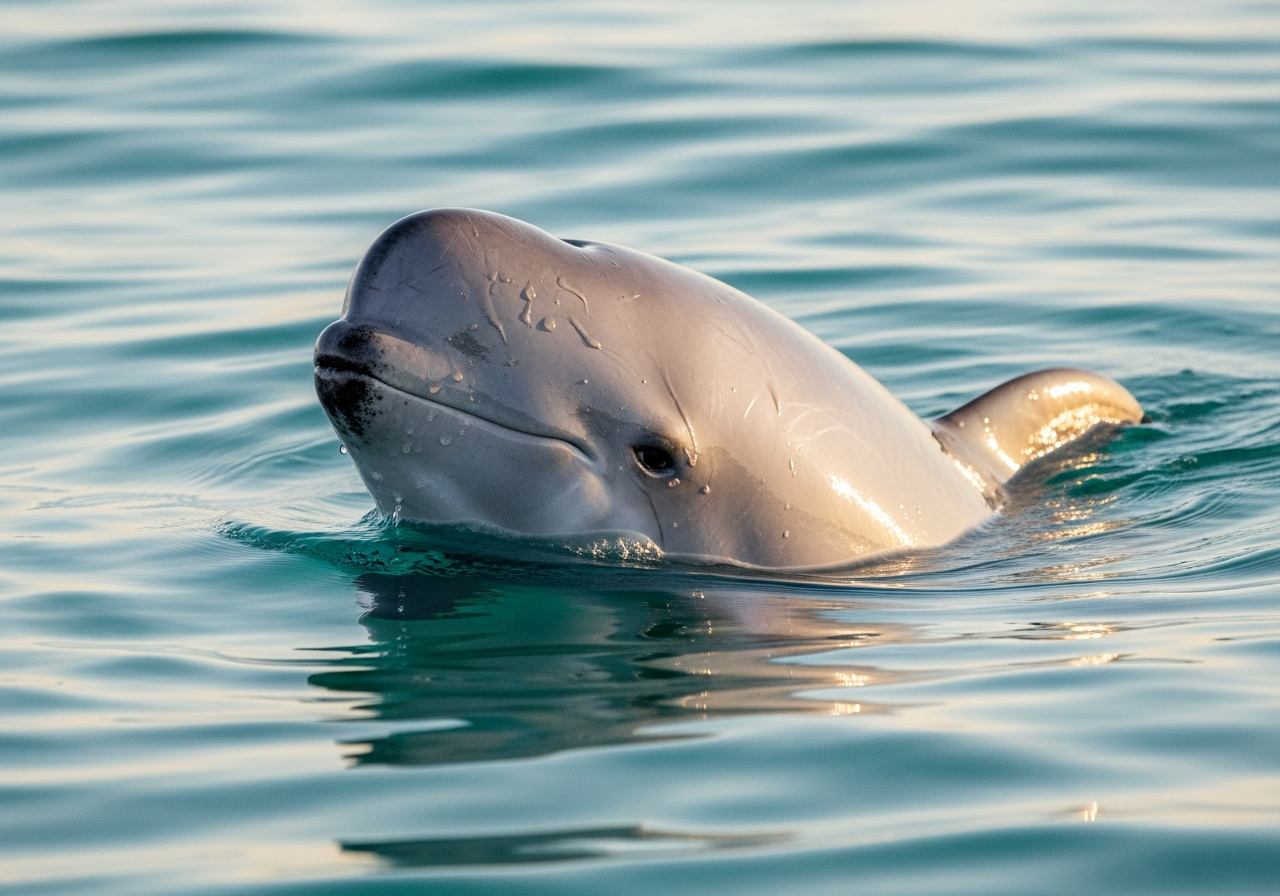
The vaquita is the tiniest member of the porpoise family, reaching only about 1.5 m (5 ft). Dark patches around the eyes and a dark line from the mouth give it a distinctive, almost smiling face. It is shy, surfaces briefly, and avoids boats, so it is rarely seen.
A tiny, shrinking range
Vaquitas live in just one place on Earth: the shallow, murky waters at the northern end of the Gulf of California, between Baja California and mainland Mexico. No other marine mammal has such a small natural range.
On the edge of extinction
The vaquita is the most endangered marine mammal in the world. Surveys suggest only around ten individuals may remain. The main threat is drowning in illegal gillnets set for fish and especially for the totoaba, whose swim bladder is trafficked for high prices.
A race to save them
Conservationists, the Mexican government, and international groups are working to remove gillnets and patrol the vaquita's last refuge. Encouragingly, the surviving vaquitas still appear healthy and are reproducing, so removing nets from their habitat offers a slim but real chance of recovery.
Dig deeper into the Vaquita
- Are Vaquitas Endangered?
Vaquitas are IUCN Critically Endangered (2022). 2025 surveys saw on the order of 7–10 individuals in the study area — not a gulf-wide census. Totoaba gillnets remain the threat.
- How Long Do Vaquitas Live?
Vaquita lifespan is a planning range of about 20 years; gillnets cut that short. Species IUCN Critically Endangered. Captive rescue failed in 2017.
- What Do Vaquitas Eat?
Vaquitas eat small fish and squid in the northern Gulf of California. Gillnets set for totoaba, not empty prey, are the extinction driver. Never feed them.
- Where Do Vaquitas Live?
Vaquitas live only in the shallow northern Gulf of California. IUCN Critically Endangered. A 2025 study-area count is not a range expansion.
Explore the Vaquita
Compare
Close relatives
- Giraffe Same order
- Pygmy Hippopotamus Same order
- Blue Whale Same order
- Cow Same order
Collections
Range & geography
Did you know? Vaquita facts
- The vaquita is the world's smallest and most endangered porpoise, found only in the northern Gulf of California in Mexico.
- Recent surveys suggest only around ten vaquitas remain, making it the most endangered marine mammal in the world.
- Vaquitas live only in the shallow northern end of the Gulf of California in Mexico, the smallest range of any marine mammal.
- Vaquitas drown in illegal gillnets, especially those set for the totoaba fish, whose swim bladder is trafficked. Bycatch in these nets is the single biggest threat.
- Vaquitas are carnivores that feed on small fish, squid, and crustaceans in the shallow waters of the upper Gulf of California.
- Conservation: Critically Endangered (IUCN).
Diet & feeding
Vaquita feeds primarily as a carnivore (fish and squid). The vaquita is the most endangered marine mammal in the world. Surveys suggest only around ten individuals may remain. The main threat is drowning in illegal gillnets set for fish and especially for the totoaba, whose swim bladder is trafficked for high prices.
Adaptations
- The vaquita is the tiniest member of the porpoise family, reaching only about 1.5 m (5 ft). Dark patches around the eyes and a dark line from the mouth give it a distinctive, almost smiling face. It is shy, surfaces briefly, and avoids boats, so it is rarely seen.
- Vaquitas live in just one place on Earth: the shallow, murky waters at the northern end of the Gulf of California, between Baja California and mainland Mexico. No other marine mammal has such a small natural range.
Behaviour & ecology
- The vaquita is the tiniest member of the porpoise family, reaching only about 1.5 m (5 ft). Dark patches around the eyes and a dark line from the mouth give it a distinctive, almost smiling face. It is shy, surfaces briefly, and avoids boats, so it is rarely seen.
- Vaquitas live in just one place on Earth: the shallow, murky waters at the northern end of the Gulf of California, between Baja California and mainland Mexico. No other marine mammal has such a small natural range.
- The vaquita is the most endangered marine mammal in the world. Surveys suggest only around ten individuals may remain. The main threat is drowning in illegal gillnets set for fish and especially for the totoaba, whose swim bladder is trafficked for high prices.
Communication
- Vaquita uses scent, posture, and vocal signals to mark territory and coordinate social behaviour.
- Communication intensity often peaks during breeding seasons and territorial disputes.
Habitat & range
Shallow northern Gulf of California
Ecological role
Vaquita acts as a predator that helps regulate prey populations and maintain balance in shallow northern gulf of california.
Conservation status of the Vaquita
The vaquita (Phocoena sinus) is listed as Critically Endangered on the IUCN Red List. Critically Endangered (CR) is the highest-risk category the IUCN Red List assigns to a wild species before Extinct in the Wild. It means a species faces an extremely high probability of extinction — usually because its population has collapsed, its range has shrunk drastically, or very few mature individuals remain. Species at this level typically depend on active conservation to survive.
Main threats to the vaquita
- Gillnet bycatch
- The illegal totoaba fishery
- An extremely small remaining population
Vaquita (Phocoena sinus) was most recently assessed for the IUCN Red List in 2022. View the full IUCN assessment .
Frequently asked questions about the Vaquita
How many vaquitas are left?
Recent surveys suggest only around ten vaquitas remain, making it the most endangered marine mammal in the world.
Where do vaquitas live?
Vaquitas live only in the shallow northern end of the Gulf of California in Mexico, the smallest range of any marine mammal.
Why are vaquitas endangered?
Vaquitas drown in illegal gillnets, especially those set for the totoaba fish, whose swim bladder is trafficked. Bycatch in these nets is the single biggest threat.
What do vaquitas eat?
Vaquitas are carnivores that feed on small fish, squid, and crustaceans in the shallow waters of the upper Gulf of California.
Can the vaquita still be saved?
Possibly. The remaining vaquitas appear healthy and are still breeding, so removing gillnets from their habitat gives them a small but genuine chance of recovery.
What is a group of vaquitas called?
A group of Vaquitas is called a pod.
What is a baby vaquita called?
A baby Vaquita is called a calf.
Sources & references
This guide is compiled and reviewed against established zoological and conservation references. Key sources for the Vaquita:
-
IUCN Red List of Threatened Species
Conservation status (Critically Endangered) reflects the IUCN Red List category for Phocoena sinus, most recently assessed in 2022.
-
iNaturalist — observations & photos
Search citizen-science observations and community IDs for Phocoena sinus. Useful for range checks and recent sightings — not a substitute for formal Red List status.
-
GBIF — occurrence data
Global Biodiversity Information Facility species search for Phocoena sinus. Explore published occurrence records used in range research.
- IUCN Red List — Phocoena sinus.
Conservation status (Critically Endangered) and population trends.
- Animal Diversity Web — Phocoena sinus. University of Michigan Museum of Zoology.
Life history, morphology, and range.
- Wikipedia — Vaquita.
General taxonomy and overview (cross-check primary sources).
-
Global Animal Guide editorial standards
How we research, source, review, and update every guide for accuracy.