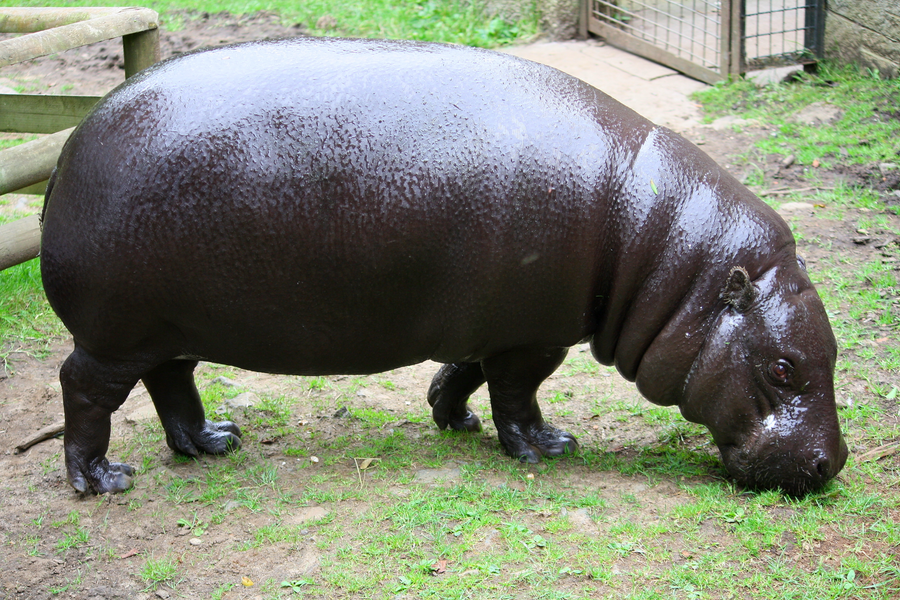
The pygmy hippopotamus (Choeropsis liberiensis) is a mammal of the hippopotamus family, Hippopotamidae, in the order Artiodactyla.
Quick answer
The pygmy hippopotamus (Choeropsis liberiensis) is a small, forest-dwelling cousin of the common hippo found only in West Africa — mostly Liberia. Adults weigh 180–275 kg (400–600 lb) and live around 30–35 years; fewer than about 2,500 mature individuals are thought to remain, making it Endangered.
Top questions about the Pygmy Hippopotamus
Also available in Español (Hipopótamo pigmeo)
Pygmy Hippopotamus facts at a glance
- Weight 240 kg
- Length 1.6 m
- Top speed 30 km/h
- Lifespan 35 years
| Scientific name | Choeropsis liberiensis |
|---|---|
| Diet | Leaves, ferns, fallen fruit, and other forest plants |
| Habitat | Lowland rainforest rivers and swamps of Liberia and neighbouring West African countries |
| Lifespan | 30–35 years in the wild; over 40 years in captivity |
| Weight | 180–275 kg (400–600 lb) — about a tenth of a common hippo |
| Top speed | Around 30 km/h (19 mph) in short bursts on land |
| Conservation status | Endangered (IUCN) |
| Kingdom | Animalia |
|---|---|
| Phylum | Chordata |
| Class | Mammalia |
| Order | Artiodactyla |
| Family | Hippopotamidae |
| Genus | Choeropsis |
Where it lives
The pygmy hippopotamus (Choeropsis liberiensis) is native to Lowland rainforest of West Africa, chiefly Liberia, with smaller populations in Sierra Leone, Guinea, and Côte d'Ivoire. — recorded across Africa in this guide’s range summary.
For occurrence records, see GBIF species search and sources below.
How big is a pygmy hippopotamus?
An adult pygmy hippopotamus measures 1.6 m long — about 92% of the height of an average adult person (1.73 m) — and weighs around 240 kg, about 3.4× an average adult’s body weight (70 kg).
Length vs an average adult’s height (to scale)
A pocket-sized hippo
Standing 75–100 cm at the shoulder and up to about 1.75 m long, the pygmy hippo is a fraction of its river-hippo cousin — roughly an eighth of the weight. Its skin is smoother, its feet less webbed, and its eyes sit more on the sides of the head, all adaptations to a life spent mostly on land in dense forest.
Life in the forest
Unlike the gregarious common hippo, pygmy hippos are solitary or live in pairs and spend the day resting hidden in swamps, rivers, or wallows. At night they forage along a network of well-worn forest trails, staying close to water into which they retreat if threatened.
Diet
Pygmy hippos browse rather than graze, feeding on ferns, broad-leaved plants, shoots, and fallen fruit in the forest understorey. Like other hippos they have a multi-chambered stomach that ferments plant material, though they do not ruminate.
Sweating pink
Like the common hippo, the pygmy hippo secretes a pinkish fluid often called 'blood sweat' — in reality a natural moisturiser containing hipposudoric acid that acts as both sunscreen and antibiotic, protecting skin in the humid forest.
Reproduction
A single calf of 4.5–6 kg is born after a gestation of about six to seven months. The mother hides her calf in thick vegetation while she forages, returning to suckle it; calves can nurse on land or underwater and stay with their mother for several years.
Conservation
The pygmy hippo is listed as Endangered, with an estimated fewer than 2,500 mature individuals scattered across Liberia, Sierra Leone, Guinea, and Côte d'Ivoire. Deforestation for logging and farms, plus hunting for bushmeat, are the main threats, and civil conflict long hampered surveys. The species breeds well in zoos, which now manage a coordinated captive population.
Explore the Pygmy Hippopotamus
Close relatives
- Hippopotamus Same family
- Giraffe Same order
- Blue Whale Same order
- Cow Same order
Collections
Range & geography
Conservation status of the Pygmy Hippopotamus
The pygmy hippopotamus (Choeropsis liberiensis) is listed as Endangered on the IUCN Red List. Endangered (EN) means a species faces a very high risk of extinction in the wild. Populations are usually declining sharply due to habitat loss, hunting, disease, or climate pressure. It sits one level below Critically Endangered on the IUCN Red List.
The pygmy hippopotamus (Choeropsis liberiensis) is assessed on the IUCN Red List. Look up on the IUCN Red List .
Frequently asked questions about the Pygmy Hippopotamus
How big is a pygmy hippo compared to a regular hippo?
At 180–275 kg it weighs roughly a tenth as much as a common hippopotamus, standing about waist-high to a person — still a solid, barrel-shaped animal, but far better suited to moving through forest.
Where do pygmy hippos live?
Only in West Africa: chiefly Liberia, with smaller populations in Sierra Leone, Guinea, and Côte d'Ivoire, always in lowland rainforest near rivers and swamps.
Why are pygmy hippos endangered?
Rainforest loss to logging and agriculture fragments their habitat, and they are hunted for bushmeat. Fewer than about 2,500 mature individuals are thought to survive.
Do pygmy hippos sweat blood?
No — the pink sheen on their skin is a natural oily secretion containing hipposudoric acid, which moisturises, protects from the sun, and fights infection. It is neither blood nor sweat.
Can pygmy hippos swim?
Yes, but they are far less aquatic than common hippos. They rest in shallow water and can close their nostrils and ears underwater, yet they feed and travel mostly on land along forest trails.
Sources & references
This guide is compiled and reviewed against established zoological and conservation references. Key sources for the Pygmy Hippopotamus:
-
IUCN Red List of Threatened Species
Conservation status (Endangered) reflects the IUCN Red List category for Choeropsis liberiensis.
-
iNaturalist — observations & photos
Search citizen-science observations and community IDs for Choeropsis liberiensis. Useful for range checks and recent sightings — not a substitute for formal Red List status.
-
GBIF — occurrence data
Global Biodiversity Information Facility species search for Choeropsis liberiensis. Explore published occurrence records used in range research.
-
Global Animal Guide editorial standards
How we research, source, review, and update every guide for accuracy.