Red Deer
Cervus elaphus
Quick answer
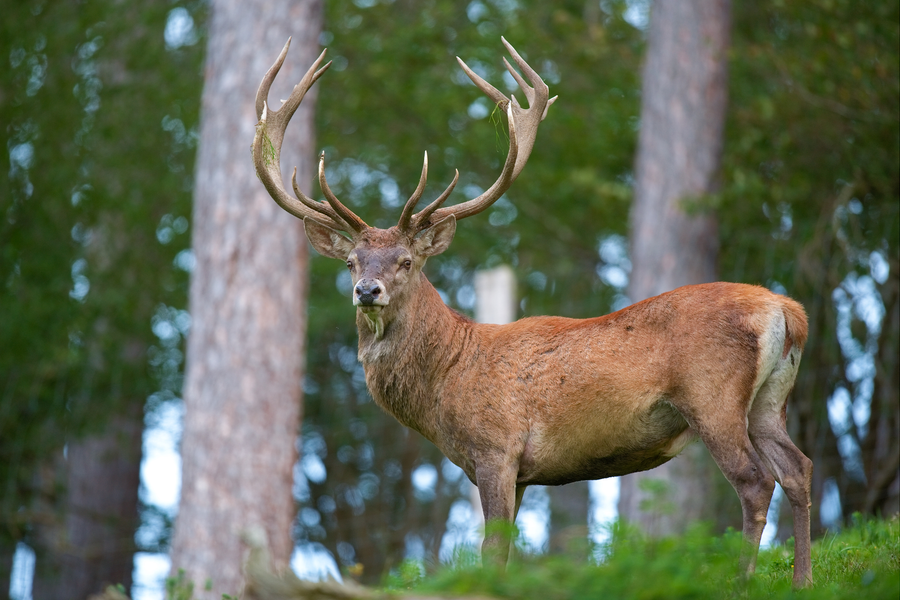
The red deer is one of the largest deer species, with stags weighing up to 240 kg (530 lb) and carrying impressive antlers used in autumn roaring contests. Native across Europe, western Asia, and North Africa, it also includes the North American elk (wapiti) as a subspecies complex.
Red Deer facts at a glance
| Scientific name | Cervus elaphus |
|---|---|
| Diet | Herbivore — grasses, heather, bark, and browse |
| Habitat | Woodlands, moorland, and grasslands across Eurasia |
| Lifespan | 10–15 years in the wild (stags often shorter due to rut stress) |
| Weight | Stags 90–240 kg; hinds 63–120 kg |
| Top speed | Up to 70 km/h (43 mph) in flight |
| Conservation status | Least Concern (IUCN) |
| Kingdom | Animalia |
|---|---|
| Phylum | Chordata |
| Class | Mammalia |
| Order | Artiodactyla |
| Family | Cervidae |
| Genus | Cervus |
Where it lives
Native across Europe, western Asia, and North Africa; introduced to New Zealand, Argentina, Chile, Australia, and North America where elk (wapiti) are a closely related form.
What is a group of red deer called?
Group name (collective noun)
A group of Red Deer is called a herd.
Baby name
A baby Red Deer is called a calf.
Explore more animal collective nouns and baby animal names .
The rut and roaring
Each autumn stags gather harems and roar — deep bellows that advertise fitness and warn rivals. Antler clashes determine dominance, though many disputes are settled by parallel walking and roaring without contact. After the rut, stags shed antlers and regrow them through spring.
Antler growth cycle
Antlers are the fastest-growing bone in mammals, covered in velvet while developing and hardened before the rut. Size reflects age, nutrition, and genetics. In managed parks, exceptional stags carry more than 20 points on each antler.
Herds and habitat
Hinds and calves form herds year-round while mature stags are often solitary outside the breeding season. Red deer occupy Scottish highlands, European forests, and Mediterranean maquis. Introduced populations exist in Argentina, New Zealand, and Australia.
Conservation and management
Globally Least Concern, red deer are managed through hunting and culling in much of their range to balance forestry and agriculture. Scottish and Alpine populations are icons of highland tourism. Hybridisation with sika deer occurs where species overlap.
Dig deeper into the Red Deer
- How Fast Is A Red Deer
Dig deeper into red deer — how fast is a red deer.
- How Long do Red Deer Live?
Dig deeper into red deer — how long do red deer live.
- Red Deer Facts 5
Dig deeper into red deer — red deer facts 5.
- What do Red Deer Eat
Dig deeper into red deer — what do red deer eat.
- Where do Red Deer Live?
Dig deeper into red deer — where do red deer live.
Explore the Red Deer
Did you know? Red Deer facts
- The red deer is one of the largest deer species, with stags weighing up to 240 kg (530 lb) and carrying impressive antlers used in autumn roaring contests.
- North American elk (wapiti) are classified as Cervus canadensis, closely related to Eurasian red deer (Cervus elaphus). They look similar but elk are generally larger with different bugling calls.
- Mature stags carry antlers with multiple tines; exceptional trophies exceed 60 cm beam length with 12 or more points per side in well-fed populations.
- Native across Europe, Iran, and North Africa; introduced to the Americas, Australasia, and South Africa. Scottish red deer are among the most famous populations.
- Stags during the rut and hinds with calves can charge if approached too closely. Park signs typically advise keeping distance during the autumn breeding season.
- Conservation: Least Concern (IUCN).
Diet & feeding
Red Deer feeds primarily as a herbivore — grasses, heather, bark, and browse.
Adaptations
- Each autumn stags gather harems and roar — deep bellows that advertise fitness and warn rivals. Antler clashes determine dominance, though many disputes are settled by parallel walking and roaring without contact. After the rut, stags shed antlers and regrow them through spring.
- Antlers are the fastest-growing bone in mammals, covered in velvet while developing and hardened before the rut. Size reflects age, nutrition, and genetics. In managed parks, exceptional stags carry more than 20 points on each antler.
Behaviour & ecology
- Each autumn stags gather harems and roar — deep bellows that advertise fitness and warn rivals. Antler clashes determine dominance, though many disputes are settled by parallel walking and roaring without contact. After the rut, stags shed antlers and regrow them through spring.
- Antlers are the fastest-growing bone in mammals, covered in velvet while developing and hardened before the rut. Size reflects age, nutrition, and genetics. In managed parks, exceptional stags carry more than 20 points on each antler.
- Hinds and calves form herds year-round while mature stags are often solitary outside the breeding season. Red deer occupy Scottish highlands, European forests, and Mediterranean maquis. Introduced populations exist in Argentina, New Zealand, and Australia.
Communication
- Red Deer uses scent, posture, and vocal signals to mark territory and coordinate social behaviour.
- Communication intensity often peaks during breeding seasons and territorial disputes.
Habitat & range
Woodlands, moorland, and grasslands across Eurasia
Ecological role
Red Deer shapes vegetation through grazing or browsing and serves as prey for larger predators where ranges overlap.
Frequently asked questions about the Red Deer
Red deer vs elk — are they the same?
North American elk (wapiti) are classified as Cervus canadensis, closely related to Eurasian red deer (Cervus elaphus). They look similar but elk are generally larger with different bugling calls.
How big do red deer antlers get?
Mature stags carry antlers with multiple tines; exceptional trophies exceed 60 cm beam length with 12 or more points per side in well-fed populations.
Where do red deer live?
Native across Europe, Iran, and North Africa; introduced to the Americas, Australasia, and South Africa. Scottish red deer are among the most famous populations.
Are red deer dangerous?
Stags during the rut and hinds with calves can charge if approached too closely. Park signs typically advise keeping distance during the autumn breeding season.
What do red deer eat?
Grasses, sedges, heather, tree bark, and shoots — diet shifts seasonally between grazing and browsing.
What is a group of red deer called?
A group of Red Deer is called a herd.
What is a baby red deer called?
A baby Red Deer is called a calf.
Sources & references
This guide is compiled and reviewed against established zoological and conservation references. Key sources for the Red Deer:
-
IUCN Red List of Threatened Species
Conservation status (Least Concern) reflects the IUCN Red List category for Cervus elaphus.
- IUCN Red List — Cervus elaphus.
Conservation status (Least Concern) and population trends.
- Animal Diversity Web — Cervus elaphus. University of Michigan Museum of Zoology.
Life history, morphology, and range.
- Wikipedia — Red Deer.
General taxonomy and overview (cross-check primary sources).
-
Global Animal Guide editorial standards
How we research, source, review, and update every guide for accuracy.