Image sourcing: see credits & licences
Quick answer
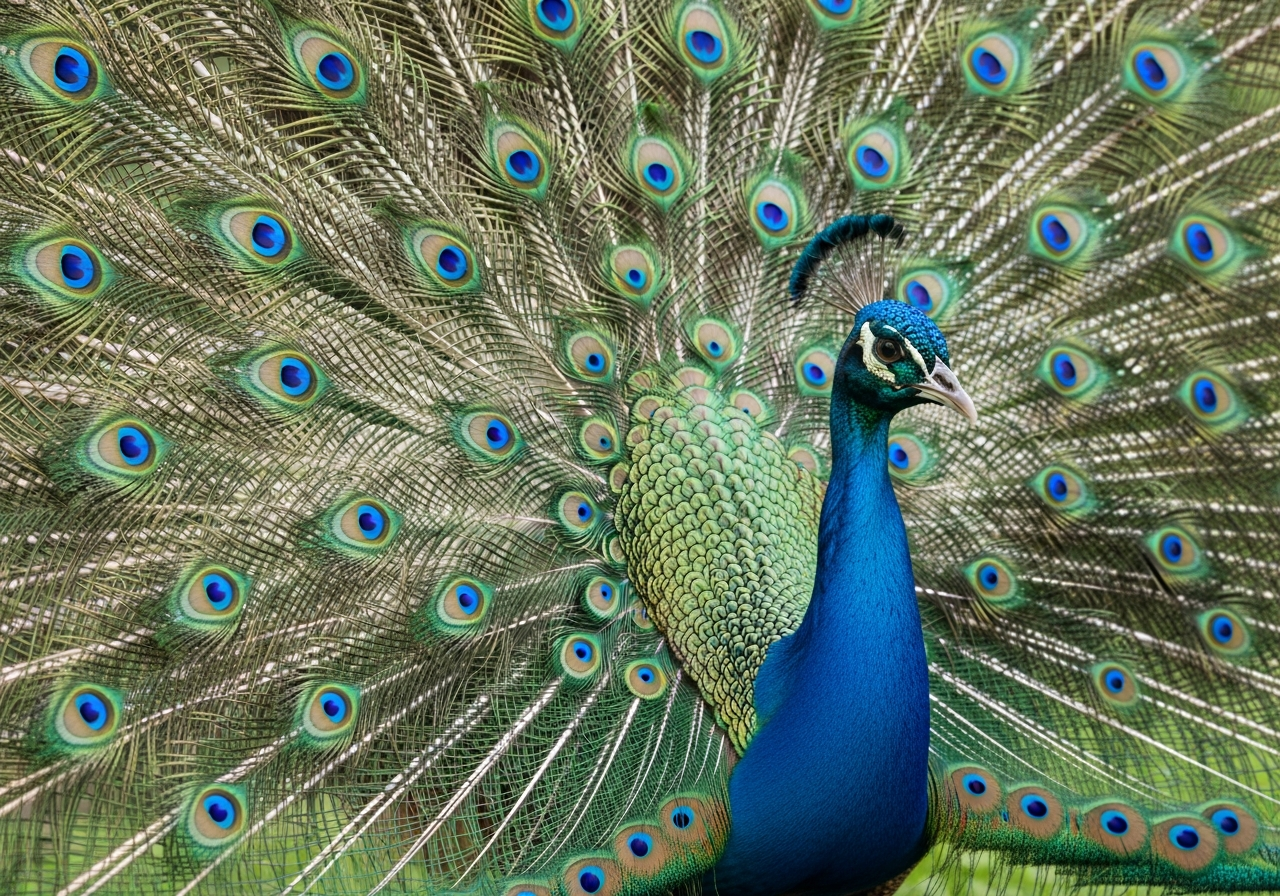
The peacock is the male of the peafowl, best known for its spectacular train of iridescent, eye-spotted feathers, which it fans out to attract females. The most familiar species, the Indian peafowl, is native to South Asia. The train can make up more than 60% of the bird's length, and despite its size the peacock can still fly. Peafowl typically live around 15 to 20 years.
Top questions about the Peacock
Peacock facts at a glance
- Weight 5 kg
- Length 1.1 m
- Top speed 16 km/h
- Lifespan 20 years
| Scientific name | Pavo cristatus |
|---|---|
| Diet | Omnivore |
| Habitat | Forest, farmland, and scrub of South Asia |
| Lifespan | 15–20 years |
| Weight | 4–6 kg (9–13 lb) |
| Top speed | Up to 16 km/h (10 mph) on the ground |
| Conservation status | Least Concern (IUCN) |
| Kingdom | Animalia |
|---|---|
| Phylum | Chordata |
| Class | Aves |
| Order | Galliformes |
| Family | Phasianidae |
| Genus | Pavo |
Where it lives
The peacock (Pavo cristatus) is native to Forests and farmland of the Indian subcontinent, with related species in Southeast Asia and central Africa. — recorded across Asia in this guide’s range summary.
For occurrence records, see GBIF species search and sources below.
How big is a peacock?
An adult peacock measures 1.1 m long — about 64% of the height of an average adult person (1.73 m) — and weighs around 5.0 kg, about 7% of an average adult’s body weight (70 kg).
Length vs an average adult’s height (to scale)
What is a group of peacocks called?
Group name (collective noun)
A group of Peacocks is called an ostentation. It is also known as a muster or a party.
Baby name
A baby Peacock is called a peachick.
Explore more animal collective nouns and baby animal names .
Peacock or peafowl?
Strictly speaking, only the male is a peacock; the female is a peahen, and together they are peafowl. The brilliant fan is not the tail itself but greatly elongated upper-tail covert feathers, supported from behind by the real, shorter tail when raised in display.
The dazzling display
A peacock raises and shivers its train to create a shimmering fan of color studded with iridescent 'eyespots'. The colors come not from pigment but from microscopic structures that scatter light. Peahens are thought to judge mates partly on the size, symmetry, and quality of this display.
Diet and behavior
Peafowl are omnivores that forage on the ground for seeds, insects, small reptiles, and plants. They roost in trees at night for safety and are known for their loud, far-carrying calls. Despite the cumbersome-looking train, peacocks are capable of short bursts of flight to reach roosts or escape danger.
Range and species
The Indian peafowl is native to the Indian subcontinent and has been introduced to parks and estates worldwide. There are two other species: the green peafowl of Southeast Asia, which is Endangered, and the lesser-known Congo peafowl of central Africa.
Dig deeper into the Peacock
- How Long Do Peacocks Live?
Peacock lifespan is typically 15–20 years. What shortens or extends life, life stages, and status (Least Concern).
- Peacock: Key Facts
The peacock is the male of the peafowl, best known for its spectacular train of iridescent, eye-spotted feathers, which it fans out to attract females.
- What Do Peacocks Eat?
What peacocks eat: Omnivore, foraging style, and seasonal shifts in Forest, farmland, and scrub of South Asia.
- Where Do Peacocks Live?
Where peacocks live: Forest, farmland, and scrub of South Asia, native range cues, and human overlap. Status Least Concern.
Explore the Peacock
Related Birds
Range & geography
Did you know? Peacock facts
- The peacock is the male of the peafowl, best known for its spectacular train of iridescent, eye-spotted feathers, which it fans out to attract females.
- A peacock is the male and has the spectacular colorful train, while a peahen is the female and is more subtly colored. Together the birds are known as peafowl.
- Yes. Despite their long, heavy-looking trains, peacocks can fly in short bursts, mainly to reach tree branches where they roost at night or to escape predators.
- Peacocks fan and shimmer their trains mainly to court peahens. Females are thought to assess the size, symmetry, and brilliance of the display when choosing a mate.
- Peafowl are omnivores. They forage on the ground for seeds, grains, insects, small reptiles, and plant matter.
- Conservation: Least Concern (IUCN).
Diet & feeding
Peacock feeds primarily as a omnivore. Strictly speaking, only the male is a peacock; the female is a peahen, and together they are peafowl. The brilliant fan is not the tail itself but greatly elongated upper-tail covert feathers, supported from behind by the real, shorter tail when raised in display.
Adaptations
- Strictly speaking, only the male is a peacock; the female is a peahen, and together they are peafowl. The brilliant fan is not the tail itself but greatly elongated upper-tail covert feathers, supported from behind by the real, shorter tail when raised in display.
- A peacock raises and shivers its train to create a shimmering fan of color studded with iridescent 'eyespots'. The colors come not from pigment but from microscopic structures that scatter light. Peahens are thought to judge mates partly on the size, symmetry, and quality of this display.
Behaviour & ecology
- Strictly speaking, only the male is a peacock; the female is a peahen, and together they are peafowl. The brilliant fan is not the tail itself but greatly elongated upper-tail covert feathers, supported from behind by the real, shorter tail when raised in display.
- A peacock raises and shivers its train to create a shimmering fan of color studded with iridescent 'eyespots'. The colors come not from pigment but from microscopic structures that scatter light. Peahens are thought to judge mates partly on the size, symmetry, and quality of this display.
- Peafowl are omnivores that forage on the ground for seeds, insects, small reptiles, and plants. They roost in trees at night for safety and are known for their loud, far-carrying calls. Despite the cumbersome-looking train, peacocks are capable of short bursts of flight to reach roosts or escape danger.
Communication
- Peacock uses calls and visual displays to communicate territory, alarm, and breeding status.
- Vocal repertoires vary by species and are often learned or refined during development.
Habitat & range
Forest, farmland, and scrub of South Asia
Ecological role
Peacock contributes to seed dispersal, insect control, or nutrient cycling depending on diet and foraging habits.
Conservation status of the Peacock
The peacock (Pavo cristatus) is listed as Least Concern on the IUCN Red List. Least Concern (LC) is the IUCN's lowest-risk category, assigned to widespread, abundant species that have been evaluated and found not to be threatened. It does not mean a species faces no pressures — only that it is not currently at risk of extinction.
The peacock (Pavo cristatus) is assessed on the IUCN Red List. Look up on the IUCN Red List .
Frequently asked questions about the Peacock
What is the difference between a peacock and a peahen?
A peacock is the male and has the spectacular colorful train, while a peahen is the female and is more subtly colored. Together the birds are known as peafowl.
Can peacocks fly?
Yes. Despite their long, heavy-looking trains, peacocks can fly in short bursts, mainly to reach tree branches where they roost at night or to escape predators.
Why do peacocks fan their feathers?
Peacocks fan and shimmer their trains mainly to court peahens. Females are thought to assess the size, symmetry, and brilliance of the display when choosing a mate.
What do peacocks eat?
Peafowl are omnivores. They forage on the ground for seeds, grains, insects, small reptiles, and plant matter.
How does a peacock get its colors?
A peacock's iridescent blues and greens come from microscopic structures in the feathers that scatter light, rather than from pigments, so the colors shift and shimmer as the bird moves.
What is a group of peacocks called?
A group of Peacocks is called an ostentation. It is also known as a muster or a party.
What is a baby peacock called?
A baby Peacock is called a peachick.
Sources & references
This guide is compiled and reviewed against established zoological and conservation references. Key sources for the Peacock:
-
IUCN Red List of Threatened Species
Conservation status (Least Concern) reflects the IUCN Red List category for Pavo cristatus.
-
iNaturalist — observations & photos
Search citizen-science observations and community IDs for Pavo cristatus. Useful for range checks and recent sightings — not a substitute for formal Red List status.
-
GBIF — occurrence data
Global Biodiversity Information Facility species search for Pavo cristatus. Explore published occurrence records used in range research.
-
eBird — bird observations
Cornell Lab eBird target search for Peacock. Check recent checklists and seasonal abundance where birders report this species.
- IUCN Red List — Pavo cristatus.
Conservation status (Least Concern) and population trends.
- Animal Diversity Web — Pavo cristatus. University of Michigan Museum of Zoology.
Life history, morphology, and range.
- Wikipedia — Peacock.
General taxonomy and overview (cross-check primary sources).
-
Global Animal Guide editorial standards
How we research, source, review, and update every guide for accuracy.