Mouse
Mus musculus
Quick answer
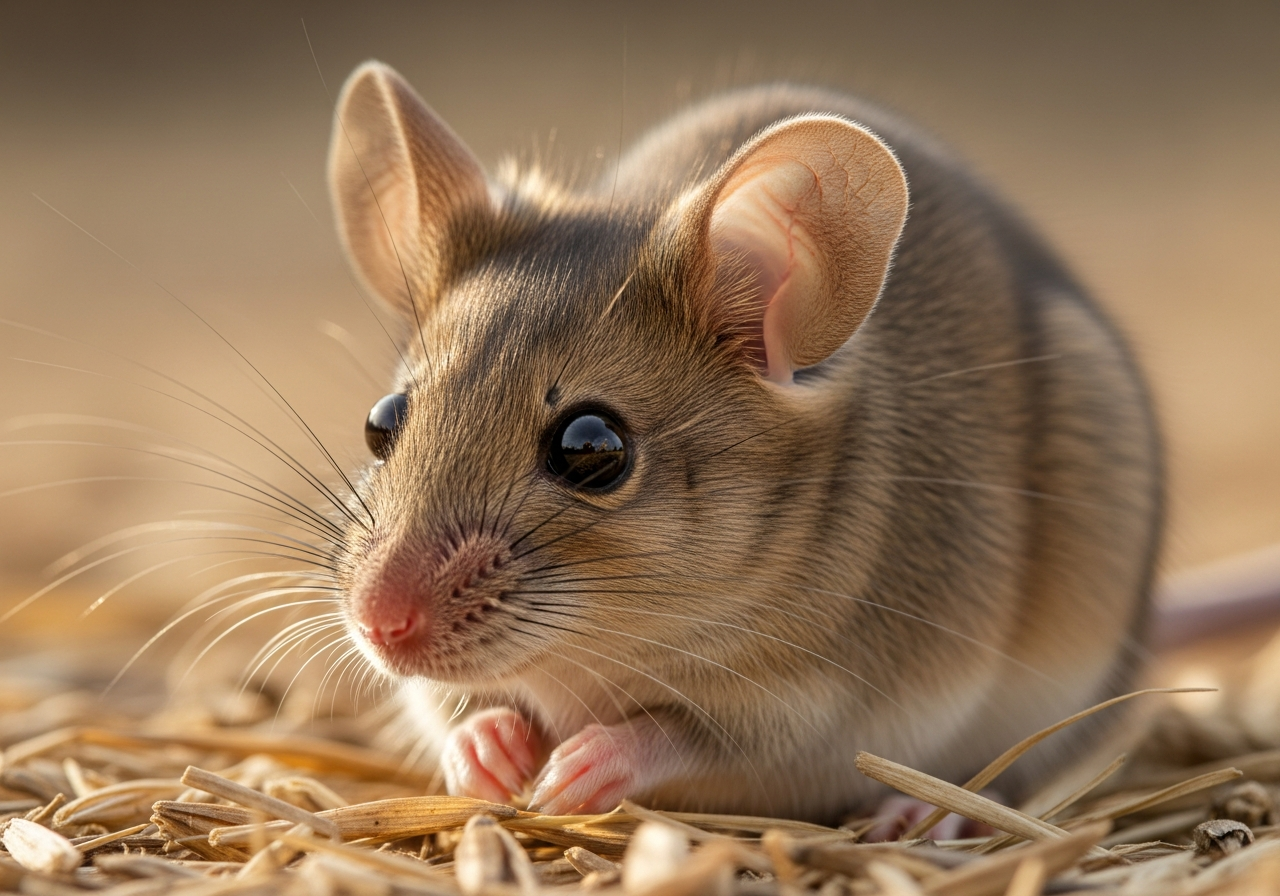
The house mouse is a small rodent with large ears, a pointed snout, and a thin tail roughly as long as its body. It is one of the most successful mammals on Earth, living alongside humans almost everywhere, and is a major laboratory animal. House mice weigh only about 12–30 g, breed rapidly year-round, and usually live around a year in the wild.
Mouse facts at a glance
| Scientific name | Mus musculus |
|---|---|
| Diet | Omnivore (mainly seeds and grains) |
| Habitat | Buildings, fields, and grassland worldwide |
| Lifespan | About 1 year wild (2–3 in captivity) |
| Weight | 12–30 g (0.4–1 oz) |
| Top speed | 13 km/h (8 mph) |
| Conservation status | Least Concern (IUCN) |
| Kingdom | Animalia |
|---|---|
| Phylum | Chordata |
| Class | Mammalia |
| Order | Rodentia |
| Family | Muridae |
| Genus | Mus |
Where it lives
Originally from the Indian subcontinent and Central Asia, the house mouse now lives alongside people on every continent except Antarctica.
What is a group of mouses called?
Group name (collective noun)
A group of Mouses is called a mischief. It is also known as a nest or a horde.
Baby name
A baby Mouse is called a pinkie. It may also be called a pup or a kitten.
Explore more animal collective nouns and baby animal names .
Behaviour and senses
House mice are mainly nocturnal and intensely curious, constantly exploring their surroundings while staying close to cover. They have poor eyesight but an excellent sense of smell, hearing that extends into the ultrasonic, and sensitive whiskers that let them feel their way along walls in the dark. They communicate using scent marks and ultrasonic calls that are too high for people to hear.
Breeding and lifespan
Few mammals breed as fast as the house mouse. A female can produce a litter of around five to eight young every three weeks and can become pregnant again within a day of giving birth, so populations can explode when food and shelter are plentiful. This rapid breeding, combined with a short life, makes the mouse a cornerstone of many food chains.
Living alongside people
Originally from Asia, the house mouse has followed humans across the entire planet, thriving in homes, farms, warehouses, and fields. It feeds opportunistically on seeds, grains, and almost any human food, and its success as a commensal animal — one that lives with people — has made it both a common pest and the most widely used mammal in scientific and medical research.
Conservation
The house mouse is listed as Least Concern and is one of the most abundant mammals in the world. Far from being threatened, it is often controlled as a pest because it contaminates stored food and can spread disease. Native wild mice such as the wood mouse share similar habits but live mainly in fields and woodland rather than buildings.
Dig deeper into the Mouse
- How Long do Mouse Live?
Dig deeper into mouse — how long do mouse live.
- Mouse Facts 4
Dig deeper into mouse — mouse facts 4.
- Mouse Facts 5
Dig deeper into mouse — mouse facts 5.
- What do Mouse Eat
Dig deeper into mouse — what do mouse eat.
- Where do Mouse Live?
Dig deeper into mouse — where do mouse live.
Explore the Mouse
Range & geography
Did you know? Mouse facts
- The house mouse is a small rodent with large ears, a pointed snout, and a thin tail roughly as long as its body.
- A group of mice is called a mischief. A baby mouse is called a pinkie, kitten, or pup, with 'pinkie' referring to a newborn before it grows fur.
- House mice usually live about a year in the wild, where predators and harsh conditions are common. In captivity, with food and shelter, pet and laboratory mice often live two to three years.
- Mice are omnivores that prefer seeds and grains but will eat almost any human food, along with insects and plant material. They nibble small amounts from many sources rather than eating one large meal.
- Very fast. A female house mouse can have a litter roughly every three weeks and can mate again within a day of giving birth, so a small number of mice can multiply quickly when conditions are good.
- Conservation: Least Concern (IUCN).
Diet & feeding
Mouse feeds primarily as a omnivore (mainly seeds and grains). Originally from Asia, the house mouse has followed humans across the entire planet, thriving in homes, farms, warehouses, and fields. It feeds opportunistically on seeds, grains, and almost any human food, and its success as a commensal animal — one that li
Adaptations
- House mice are mainly nocturnal and intensely curious, constantly exploring their surroundings while staying close to cover. They have poor eyesight but an excellent sense of smell, hearing that extends into the ultrasonic, and sensitive whiskers that let them feel their way along walls in the dark. They communicate using scent marks and ultrasonic calls that are too high for people to hear.
- Few mammals breed as fast as the house mouse. A female can produce a litter of around five to eight young every three weeks and can become pregnant again within a day of giving birth, so populations can explode when food and shelter are plentiful. This rapid breeding, combined with a short life, makes the mouse a cornerstone of many food chains.
Behaviour & ecology
- House mice are mainly nocturnal and intensely curious, constantly exploring their surroundings while staying close to cover. They have poor eyesight but an excellent sense of smell, hearing that extends into the ultrasonic, and sensitive whiskers that let them feel their way along walls in the dark. They communicate using scent marks and ultrasonic calls that are too high for people to hear.
- Few mammals breed as fast as the house mouse. A female can produce a litter of around five to eight young every three weeks and can become pregnant again within a day of giving birth, so populations can explode when food and shelter are plentiful. This rapid breeding, combined with a short life, makes the mouse a cornerstone of many food chains.
- Originally from Asia, the house mouse has followed humans across the entire planet, thriving in homes, farms, warehouses, and fields. It feeds opportunistically on seeds, grains, and almost any human food, and its success as a commensal animal — one that lives with people — has made it both a common pest and the most widely used mammal in scientific and medical research.
Communication
- Mouse uses scent, posture, and vocal signals to mark territory and coordinate social behaviour.
- Communication intensity often peaks during breeding seasons and territorial disputes.
Habitat & range
Buildings, fields, and grassland worldwide
Ecological role
Mouse plays a recognised ecological role in buildings, fields, and grassland worldwide.
Frequently asked questions about the Mouse
What is a group of mice called?
A group of mice is called a mischief. A baby mouse is called a pinkie, kitten, or pup, with 'pinkie' referring to a newborn before it grows fur.
How long do mice live?
House mice usually live about a year in the wild, where predators and harsh conditions are common. In captivity, with food and shelter, pet and laboratory mice often live two to three years.
What do mice eat?
Mice are omnivores that prefer seeds and grains but will eat almost any human food, along with insects and plant material. They nibble small amounts from many sources rather than eating one large meal.
How fast do mice breed?
Very fast. A female house mouse can have a litter roughly every three weeks and can mate again within a day of giving birth, so a small number of mice can multiply quickly when conditions are good.
Can mice see well?
Mice have poor eyesight and are colour-blind, but they make up for it with an excellent sense of smell, sharp ultrasonic hearing, and sensitive whiskers that help them navigate in the dark.
What is a group of mouses called?
A group of Mouses is called a mischief. It is also known as a nest or a horde.
What is a baby mouse called?
A baby Mouse is called a pinkie. It may also be called a pup or a kitten.
Sources & references
This guide is compiled and reviewed against established zoological and conservation references. Key sources for the Mouse:
-
IUCN Red List of Threatened Species
Conservation status (Least Concern) reflects the IUCN Red List category for Mus musculus.
- IUCN Red List — Mus musculus.
Conservation status (Least Concern) and population trends.
- Animal Diversity Web — Mus musculus. University of Michigan Museum of Zoology.
Life history, morphology, and range.
- Wikipedia — Mouse.
General taxonomy and overview (cross-check primary sources).
-
Global Animal Guide editorial standards
How we research, source, review, and update every guide for accuracy.