Komodo Dragon
Varanus komodoensis
Quick answer
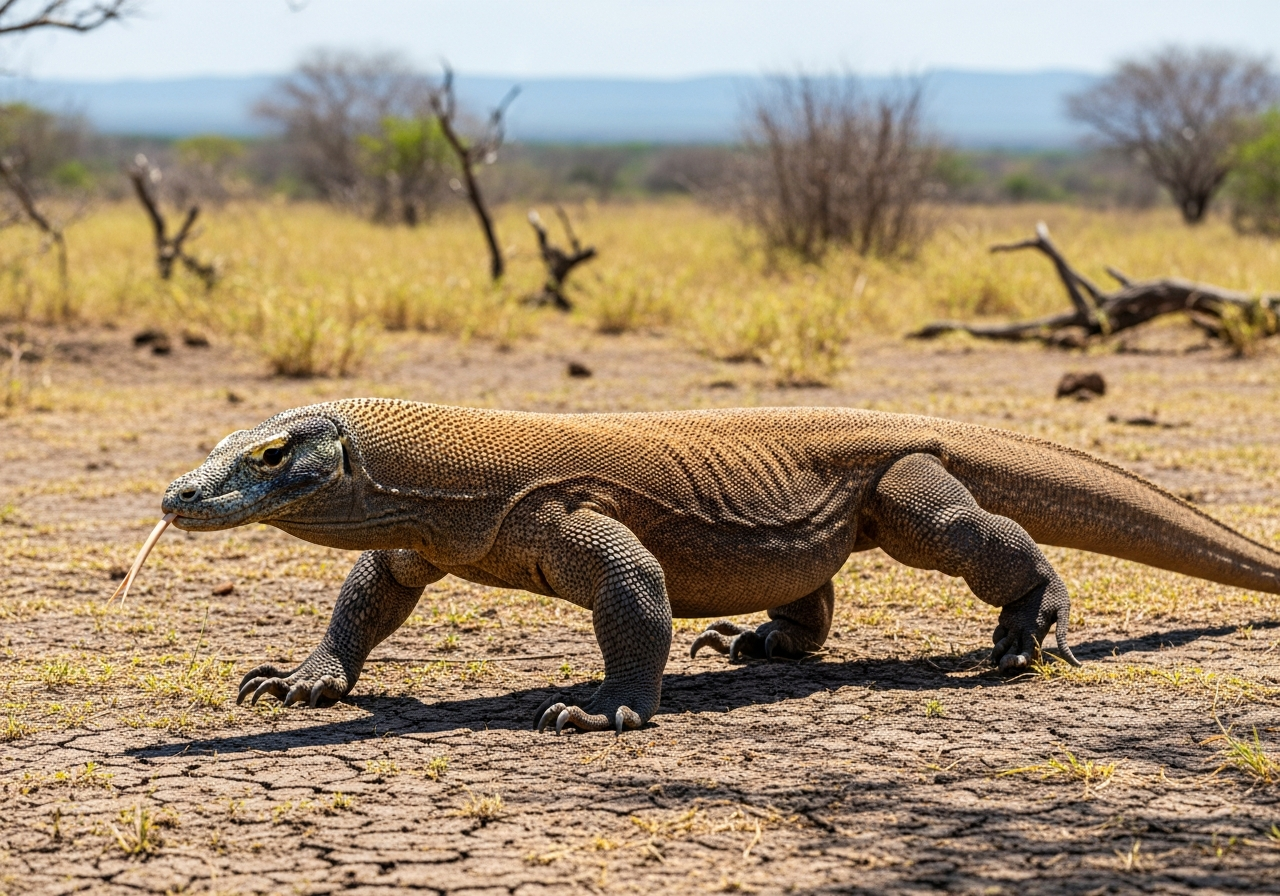
The Komodo dragon is the largest living lizard, growing up to 3 m (10 ft) long and 90 kg (200 lb). Found only on a handful of Indonesian islands, it is a powerful ambush predator with serrated teeth and venom that lowers a victim's blood pressure. It can take prey as large as deer and water buffalo. Komodo dragons can live around 30 years.
Komodo Dragon facts at a glance
| Scientific name | Varanus komodoensis |
|---|---|
| Diet | Carnivore |
| Habitat | Tropical savanna and forest on Indonesian islands |
| Lifespan | ~30 years |
| Length | Up to 3 m (10 ft) |
| Top speed | 20 km/h (12 mph) in short bursts |
| Conservation status | Endangered (IUCN) |
| Kingdom | Animalia |
|---|---|
| Phylum | Chordata |
| Class | Reptilia |
| Order | Squamata |
| Family | Varanidae |
| Genus | Varanus |
Where it lives
A handful of Indonesian islands, including Komodo, Rinca, and Flores.
What is a group of komodo dragons called?
Group name (collective noun)
A group of Komodo Dragons is called a bank.
Baby name
A baby Komodo Dragon is called a hatchling.
Explore more animal collective nouns and baby animal names .
Behavior and hunting
Komodo dragons are ambush hunters that lie in wait and rush prey with a sudden burst of speed. They use serrated teeth to deliver deep wounds, and venom glands that release toxins which prevent clotting and lower blood pressure, weakening prey that escapes the initial attack. They have an excellent sense of smell, using their forked tongue to detect carrion from kilometers away.
Diet
Komodo dragons eat almost any meat, from carrion and birds to deer, pigs, and even water buffalo. They can consume a large portion of their body weight in a single meal and may go weeks between large kills.
Habitat and range
The species is found only on a few Indonesian islands, including Komodo, Rinca, Flores, and a couple of smaller ones, in tropical savanna and dry forest. This tiny range makes the entire species vulnerable to local threats.
Conservation
Komodo dragons are listed as Endangered. Their limited island range, small total population, habitat loss, and the effects of climate change and rising seas all threaten their future. Most live within Komodo National Park, a World Heritage Site.
Dig deeper into the Komodo Dragon
- Are Komodo Dragon Endangered
Dig deeper into komodo dragon — are komodo dragon endangered.
- How Long do Komodo Dragon Live?
Dig deeper into komodo dragon — how long do komodo dragon live.
- Komodo Dragon Bite Venom
Dig deeper into komodo dragon — komodo dragon bite venom.
- Komodo Dragon Conservation
Dig deeper into komodo dragon — komodo dragon conservation.
- Komodo Dragon Dangerous
Dig deeper into komodo dragon — komodo dragon dangerous.
- Komodo Dragon Hunting
Dig deeper into komodo dragon — komodo dragon hunting.
- Komodo Dragon Parthenogenesis
Dig deeper into komodo dragon — komodo dragon parthenogenesis.
- Komodo Dragon Size
Dig deeper into komodo dragon — komodo dragon size.
- Komodo Dragon Venom Or Bacteria
Dig deeper into komodo dragon — komodo dragon venom or bacteria.
- Komodo Dragon Vs Crocodile
Dig deeper into komodo dragon — komodo dragon vs crocodile.
- Komodo National Park
Dig deeper into komodo dragon — komodo national park.
- What do Komodo Dragon Eat
Dig deeper into komodo dragon — what do komodo dragon eat.
- Where do Komodo Dragon Live?
Dig deeper into komodo dragon — where do komodo dragon live.
Explore the Komodo Dragon
Compare
Related Reptiles
Collections
Range & geography
Did you know? Komodo Dragon facts
- The Komodo dragon is the largest living lizard, reaching about 3 m.
- It is venomous — glands in the lower jaw deliver toxins that prevent clotting.
- The old idea that it kills with 'dirty', bacteria-laden saliva is largely a myth.
- Komodo dragons can detect carrion from kilometres away using their tongue.
- They are powerful enough to take prey as large as deer and water buffalo.
- They live only on a few Indonesian islands and are endangered.
Diet & feeding
Komodo dragons eat carrion and live prey including deer, pigs, and water buffalo, using venom and serrated teeth to bring down animals far larger than themselves.
Adaptations
- Venom glands deliver anticoagulant toxins that cause prey to bleed and weaken. (Fry et al. 2009)
- Serrated, blade-like teeth open deep, ragged wounds in large prey.
- A forked tongue and keen chemical sense detect carrion at great distance.
- A powerful build and tail support ambush and subduing of large animals.
Behaviour & ecology
- Komodo dragons ambush large prey, then track bitten animals until they weaken.
- They are strong swimmers and can move between islands.
- Dominant dragons take precedence at carcasses, sometimes cannibalising young.
- Young shelter in trees to avoid larger dragons.
Communication
- Komodo dragons rely on chemical cues via tongue-flicking to sense prey and rivals.
- Posture and gaping convey dominance and threat at carcasses.
- They are largely silent, with hissing in defensive contexts.
Habitat & range
Komodo dragons live only on a handful of Indonesian islands — including Komodo, Rinca, and parts of Flores — in dry savanna, scrub, and forest.
Ecological role
As the apex predator of its island habitat, the Komodo dragon regulates deer and pig populations and acts as the islands' principal scavenger.
Conservation status of the Komodo Dragon
Endangered (EN) means a species faces a very high risk of extinction in the wild. Populations are usually declining sharply due to habitat loss, hunting, disease, or climate pressure. It sits one level below Critically Endangered on the IUCN Red List.
The komodo dragon (Varanus komodoensis) is assessed on the IUCN Red List. Look up on the IUCN Red List .
Frequently asked questions about the Komodo Dragon
How big do Komodo dragons get?
Komodo dragons are the largest lizards on Earth, reaching up to 3 m (10 ft) in length and around 90 kg (200 lb) in weight.
Are Komodo dragons venomous?
Yes. Komodo dragons have venom glands that release toxins which prevent blood clotting and lower blood pressure, helping to weaken prey after a bite.
What do Komodo dragons eat?
They are carnivores that eat carrion, birds, deer, pigs, and even water buffalo. A Komodo dragon can eat a huge amount in one meal and then go weeks without eating.
Where do Komodo dragons live?
Komodo dragons live only on a few Indonesian islands, including Komodo, Rinca, and Flores, in tropical savanna and dry forest.
How fast can a Komodo dragon run?
Komodo dragons can sprint up to about 20 km/h (12 mph) in short bursts, relying on ambush rather than long chases.
Are Komodo dragons endangered?
Yes. Komodo dragons are listed as Endangered, threatened by their tiny range, habitat loss, and climate change. Most are protected within Komodo National Park.
What is a group of komodo dragons called?
A group of Komodo Dragons is called a bank.
What is a baby komodo dragon called?
A baby Komodo Dragon is called a hatchling.
Sources & references
This guide is compiled and reviewed against established zoological and conservation references. Key sources for the Komodo Dragon:
-
IUCN Red List of Threatened Species
Conservation status (Endangered) reflects the IUCN Red List category for Varanus komodoensis.
- Jessop, T. et al. (2021). Varanus komodoensis. IUCN Red List of Threatened Species.
Status (Endangered) and range.
- Fry, B. G. et al. (2009). A central role for venom in predation by Varanus komodoensis. PNAS.
Evidence of venom function.
- The Reptile Database (reptile-database.org).
Taxonomy and distribution.
-
Global Animal Guide editorial standards
How we research, source, review, and update every guide for accuracy.