Northern Flying Squirrel
Glaucomys sabrinus
Quick answer
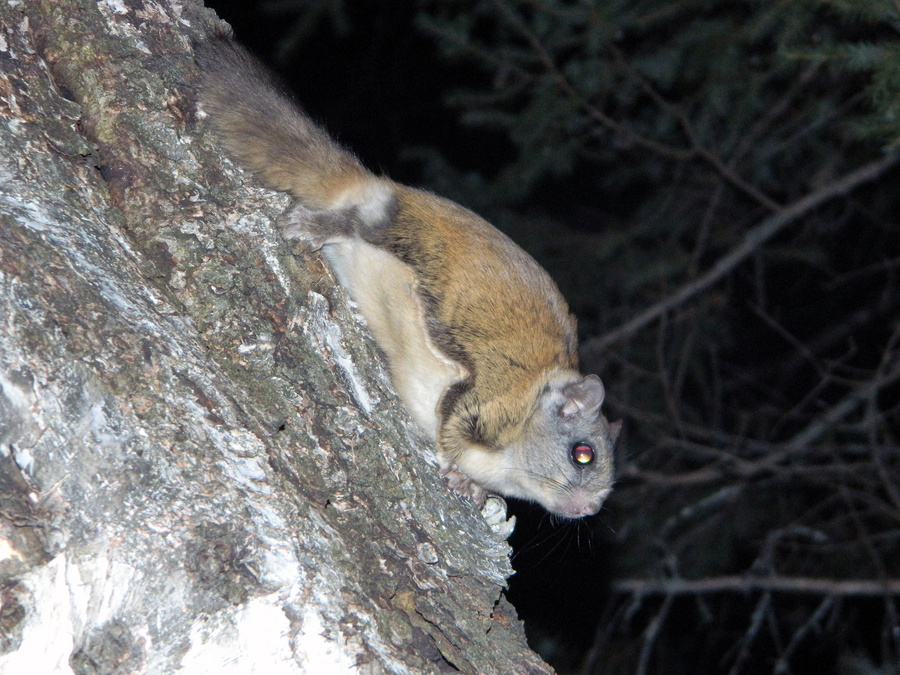
Northern flying squirrels do not truly fly — they glide between trees on a furry membrane called a patagium, steering with their flat tail. They live in boreal forests across North America, weigh about 110–230 g, and are active at night feeding on fungi, nuts, and tree sap.
Northern Flying Squirrel facts at a glance
| Scientific name | Glaucomys sabrinus |
|---|---|
| Diet | Fungi, nuts, seeds, insects, tree sap |
| Habitat | Mature boreal and mixed forests of Canada and the northern United States |
| Lifespan | About 5–6 years in the wild |
| Weight | 110–230 g (4–8 oz) |
| Top speed | Glides up to 50 m (160 ft) between trees |
| Conservation status | Least Concern (IUCN) |
| Kingdom | Animalia |
|---|---|
| Phylum | Chordata |
| Class | Mammalia |
| Order | Rodentia |
| Family | Sciuridae |
| Genus | Glaucomys |
Where it lives
Boreal and mixed forests of Canada, Alaska, and the northern and western United States.
What is a group of northern flying squirrels called?
Group name (collective noun)
A group of Northern Flying Squirrels is called a scurry.
Baby name
A baby Northern Flying Squirrel is called a pup.
Explore more animal collective nouns and baby animal names .
Patagium gliding
A skin flap stretches from wrist to ankle, letting flying squirrels steer mid-glide with tail and limbs. They climb to a height, launch, and land on tree trunks up to 50 metres away — saving energy and avoiding ground predators.
Nocturnal and communal
Large eyes suit night foraging on lichens, truffles, and bird eggs. Multiple squirrels may share tree cavities in winter, huddling for warmth in harsh boreal climates.
Ecological role
Flying squirrels disperse mycorrhizal fungi spores through droppings, supporting forest health. Owls, martens, and house cats are major predators.
Southern flying squirrel cousin
The smaller southern flying squirrel (Glaucomys volans) ranges through eastern North America. Both species are Least Concern but depend on mature forest — logging of old trees reduces nest sites.
Explore the Northern Flying Squirrel
Range & geography
Frequently asked questions about the Northern Flying Squirrel
Do flying squirrels fly?
No — they glide using a patagium skin flap. Powered flight requires wings; mammals this size cannot achieve it.
Where do flying squirrels live?
Boreal and mixed forests of Canada, Alaska, and the northern and western United States.
Can you keep a flying squirrel as a pet?
Native species are protected in many areas. Some exotic species are restricted; check local wildlife laws.
What do flying squirrels eat?
Mainly fungi and lichens, plus nuts, seeds, insects, and tree sap.
How far can flying squirrels glide?
Typically 20–30 metres, with exceptional glides over 50 metres between tall trees.
What is a group of northern flying squirrels called?
A group of Northern Flying Squirrels is called a scurry.
What is a baby northern flying squirrel called?
A baby Northern Flying Squirrel is called a pup.
Sources & references
This guide is compiled and reviewed against established zoological and conservation references. Key sources for the Northern Flying Squirrel:
-
IUCN Red List of Threatened Species
Conservation status (Least Concern) reflects the IUCN Red List category for Glaucomys sabrinus.
-
Global Animal Guide editorial standards
How we research, source, review, and update every guide for accuracy.