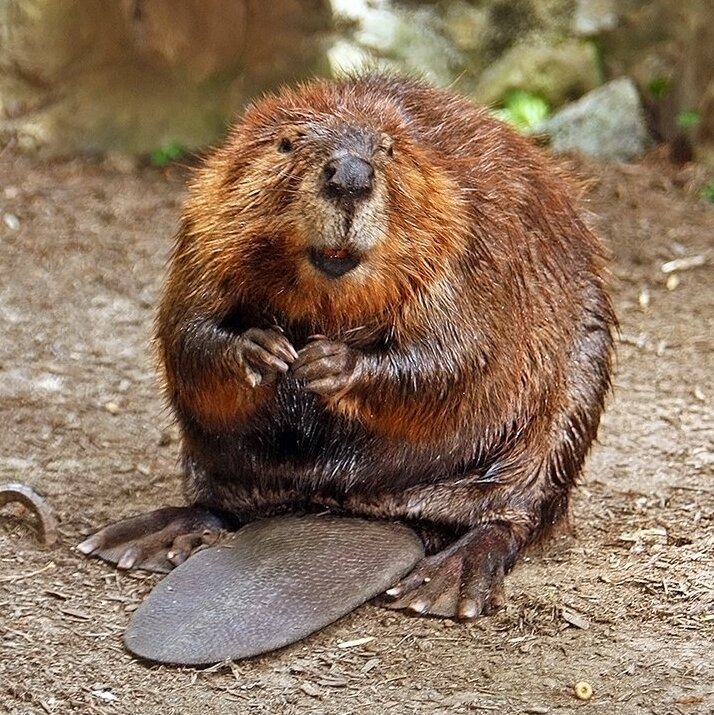
North American Beaver
Castor canadensis
Quick answer
The North American beaver is a large rodent that fells trees and builds dams and lodges, creating wetlands that benefit fish, birds, and other wildlife. Adults weigh 16–32 kg (35–70 lb), have webbed feet and a flat tail, and can stay underwater for up to 15 minutes.
North American Beaver facts at a glance
| Scientific name | Castor canadensis |
|---|---|
| Diet | Herbivore — bark, twigs, aquatic plants, and roots |
| Habitat | Rivers, lakes, and ponds across North America |
| Lifespan | 10–20 years in the wild |
| Weight | 16–32 kg (35–70 lb) |
| Top speed | Up to 55 km/h (34 mph) swimming; clumsy on land |
| Conservation status | Least Concern (IUCN) |
| Kingdom | Animalia |
|---|---|
| Phylum | Chordata |
| Class | Mammalia |
| Order | Rodentia |
| Family | Castoridae |
| Genus | Castor |
Where it lives
Rivers, lakes, and ponds across Canada, the United States, and northern Mexico; reintroduced to parts of Europe where the Eurasian beaver also occurs.
What is a group of north american beavers called?
Group name (collective noun)
A group of North American Beavers is called a colony.
Baby name
A baby North American Beaver is called a kit.
Explore more animal collective nouns and baby animal names .
Dam building
Beavers cut trees with powerful incisors and weave branches into dams that raise water levels, protecting lodge entrances and creating ponds. These wetlands filter water, reduce flooding downstream, and provide habitat for hundreds of species — beavers are considered ecosystem engineers.
Lodges and family life
Beaver families live in dome-shaped lodges with underwater entrances. Kits are born in spring and stay with parents for up to two years, helping maintain dams and learn construction skills. Castoreum from scent glands marks territory.
Recovery from trapping
Beavers were trapped nearly to extinction for fur hats in the 1800s but rebounded after protection and reintroduction. Today they are Least Concern, though conflicts with landowners over flooded roads and timber prompt relocation or flow-device management in many states.
Keystone role
By slowing water and creating ponds, beavers increase biodiversity, store carbon in sediments, and improve drought resilience. Reintroduction projects in the UK and Europe aim to restore these benefits after centuries of local extinction.
Dig deeper into the North American Beaver
- Beaver Facts 5
Dig deeper into north american beaver — beaver facts 5.
- How Fast Is A Beaver
Dig deeper into north american beaver — how fast is a beaver.
- How Long do Beaver Live?
Dig deeper into north american beaver — how long do beaver live.
- What do Beaver Eat
Dig deeper into north american beaver — what do beaver eat.
- Where do Beaver Live?
Dig deeper into north american beaver — where do beaver live.
Explore the North American Beaver
Did you know? North American Beaver facts
- The North American beaver is a large rodent that fells trees and builds dams and lodges, creating wetlands that benefit fish, birds, and other wildlife.
- Dams raise water around lodge entrances, making predators harder to reach and giving beavers safe access to food stores in winter.
- Up to about 15 minutes underwater, aided by transparent eyelids and valves that close ears and nostrils.
- Yes — beavers are the second-largest rodents after capybaras, in the family Castoridae.
- No. Beavers are herbivores that eat bark, twigs, and aquatic plants. They do not hunt fish.
- Conservation: Least Concern (IUCN).
Diet & feeding
North American Beaver feeds primarily as a herbivore — bark, twigs, aquatic plants, and roots. Beavers cut trees with powerful incisors and weave branches into dams that raise water levels, protecting lodge entrances and creating ponds. These wetlands filter water, reduce flooding downstream, and provide habitat for hu
Adaptations
- Beavers cut trees with powerful incisors and weave branches into dams that raise water levels, protecting lodge entrances and creating ponds. These wetlands filter water, reduce flooding downstream, and provide habitat for hundreds of species — beavers are considered ecosystem engineers.
- Beaver families live in dome-shaped lodges with underwater entrances. Kits are born in spring and stay with parents for up to two years, helping maintain dams and learn construction skills. Castoreum from scent glands marks territory.
Behaviour & ecology
- Beavers cut trees with powerful incisors and weave branches into dams that raise water levels, protecting lodge entrances and creating ponds. These wetlands filter water, reduce flooding downstream, and provide habitat for hundreds of species — beavers are considered ecosystem engineers.
- Beaver families live in dome-shaped lodges with underwater entrances. Kits are born in spring and stay with parents for up to two years, helping maintain dams and learn construction skills. Castoreum from scent glands marks territory.
- Beavers were trapped nearly to extinction for fur hats in the 1800s but rebounded after protection and reintroduction. Today they are Least Concern, though conflicts with landowners over flooded roads and timber prompt relocation or flow-device management in many states.
Communication
- North American Beaver uses scent, posture, and vocal signals to mark territory and coordinate social behaviour.
- Communication intensity often peaks during breeding seasons and territorial disputes.
Habitat & range
Rivers, lakes, and ponds across North America
Ecological role
North American Beaver shapes vegetation through grazing or browsing and serves as prey for larger predators where ranges overlap.
Frequently asked questions about the North American Beaver
Why do beavers build dams?
Dams raise water around lodge entrances, making predators harder to reach and giving beavers safe access to food stores in winter.
How long can beavers hold their breath?
Up to about 15 minutes underwater, aided by transparent eyelids and valves that close ears and nostrils.
Are beavers rodents?
Yes — beavers are the second-largest rodents after capybaras, in the family Castoridae.
Do beavers eat fish?
No. Beavers are herbivores that eat bark, twigs, and aquatic plants. They do not hunt fish.
Are beavers good for the environment?
Yes. Beaver wetlands increase biodiversity, improve water quality, and can reduce downstream flooding — reasons for active reintroduction in Europe.
What is a group of north american beavers called?
A group of North American Beavers is called a colony.
What is a baby north american beaver called?
A baby North American Beaver is called a kit.
Sources & references
This guide is compiled and reviewed against established zoological and conservation references. Key sources for the North American Beaver:
-
IUCN Red List of Threatened Species
Conservation status (Least Concern) reflects the IUCN Red List category for Castor canadensis.
- IUCN Red List — Castor canadensis.
Conservation status (Least Concern) and population trends.
- Animal Diversity Web — Castor canadensis. University of Michigan Museum of Zoology.
Life history, morphology, and range.
-
Global Animal Guide editorial standards
How we research, source, review, and update every guide for accuracy.