Image sourcing: see credits & licences
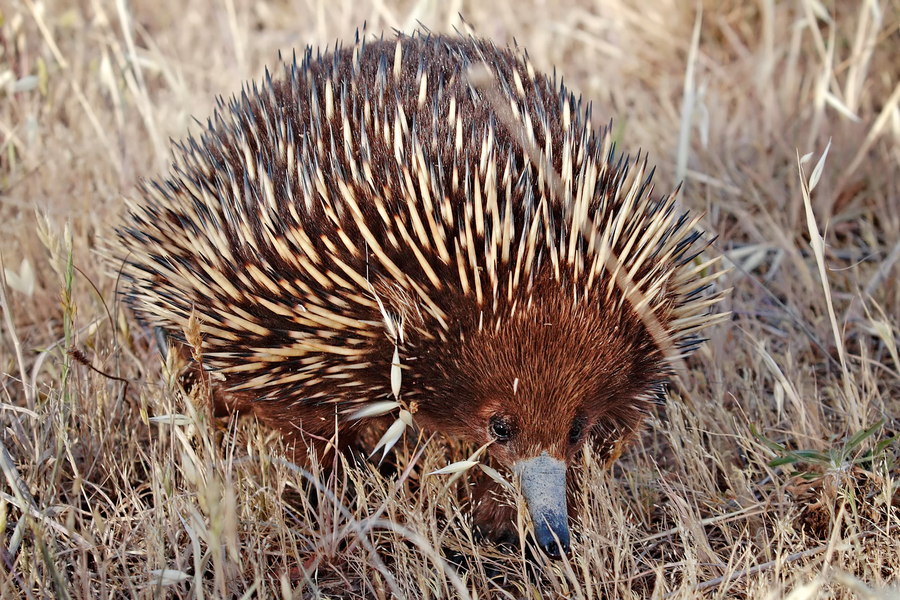
The short-beaked echidna (Tachyglossus aculeatus) is a mammal of the family Tachyglossidae, in the order Monotremata.
Quick answer
The short-beaked echidna (Tachyglossus aculeatus) is a spiny, egg-laying monotreme that eats ants and termites across Australia and coastal New Guinea. Adults weigh about 5 kg, dig with powerful claws, and can live around 40 years. It is listed Least Concern, though some island populations face local pressures.
Top questions about the Short-beaked Echidna
Also available in Español (Equidna de pico corto)
Short-beaked Echidna facts at a glance
- Weight 5 kg
- Length 45 cm
- Top speed 15 km/h
- Lifespan 40 years
| Scientific name | Tachyglossus aculeatus |
|---|---|
| Diet | Ants and termites |
| Habitat | Forests, woodland, scrub, and arid inland Australia |
| Lifespan | Around 40 years in the wild (varies by population and captivity). |
| Weight | About 5 kg typical adult mass (sex and region vary). |
| Top speed | Up to roughly 15 km/h when moving at speed. |
| Conservation status | Least Concern (IUCN) |
| Kingdom | Animalia |
|---|---|
| Phylum | Chordata |
| Class | Mammalia |
| Order | Monotremata |
| Family | Tachyglossidae |
| Genus | Tachyglossus |
Where it lives
The short-beaked echidna (Tachyglossus aculeatus) is native to Australia and coastal New Guinea, including Tasmania and many islands. — recorded across Oceania in this guide’s range summary.
For occurrence records, see GBIF species search and sources below.
How big is a short-beaked echidna?
An adult short-beaked echidna measures 45 cm long — about 26% of the height of an average adult person (1.73 m) — and weighs around 5.0 kg, about 7% of an average adult’s body weight (70 kg).
Length vs an average adult’s height (to scale)
What is a group of short-beaked echidnas called?
Group name (collective noun)
A group of Short-beaked Echidnas is called a parade.
Baby name
A baby Short-beaked Echidna is called a puggle.
Explore more animal collective nouns and baby animal names .
A mammal that lays eggs
Echidnas belong to Monotremata with the platypus — mammals that lay leathery eggs. A single egg incubates in a temporary pouch; the hatchling, called a puggle, laps milk from specialised skin patches rather than nipples. Dense spines cover the back, and when threatened the animal digs in or curls to present only spines.
Ant and termite specialist
A long, sticky tongue flicks into nests while electroreceptors in the snout help detect prey underground. They lack teeth; grit in the stomach grinds insects. Short-beaked echidnas take ants, termites, and other soil invertebrates rather than large prey.
From Tasmania to New Guinea
They occupy forests, woodland, scrub, and arid inland Australia, plus Tasmania and coastal New Guinea. Individuals may roam widely, sheltering in hollows, under logs, or self-dug burrows. They cope with heat by being largely crepuscular or nocturnal in hot districts.
Roadkill and feral predators
The species is Least Concern overall, but vehicle strikes, habitat fragmentation, and foxes or cats on some islands reduce local numbers. In colder regions they may enter deep torpor lasting days to weeks when food and temperatures drop.
Explore the Short-beaked Echidna
Range & geography
Conservation status of the Short-beaked Echidna
The short-beaked echidna (Tachyglossus aculeatus) is listed as Least Concern on the IUCN Red List. Least Concern (LC) is the IUCN's lowest-risk category, assigned to widespread, abundant species that have been evaluated and found not to be threatened. It does not mean a species faces no pressures — only that it is not currently at risk of extinction.
The short-beaked echidna (Tachyglossus aculeatus) is assessed on the IUCN Red List. Look up on the IUCN Red List .
Frequently asked questions about the Short-beaked Echidna
Why do echidnas lay eggs?
They are monotremes — an ancient mammal lineage that retained egg-laying. The egg hatches into a tiny puggle that continues developing on milk, combining reptile-like reproduction with mammalian care.
Are echidnas related to hedgehogs?
No. Spines evolved independently; echidnas are Australian monotremes, while hedgehogs are placental mammals from Eurasia and Africa.
What is a baby echidna called?
A puggle — the same informal name sometimes used for baby platypuses — that is the usual English name for a young short-beaked echidna.
Do echidnas have venom?
Male echidnas have spurs on the hind ankles, but unlike platypuses they are not considered dangerously venomous to humans.
How long do echidnas live?
Wild adults often reach several decades; captive records approach or exceed 40 years, unusually long for a small mammal.
What is a group of short-beaked echidnas called?
A group of Short-beaked Echidnas is called a parade.
What is a baby short-beaked echidna called?
A baby Short-beaked Echidna is called a puggle.
Sources & references
This guide is compiled and reviewed against established zoological and conservation references. Key sources for the Short-beaked Echidna:
-
IUCN Red List of Threatened Species
Conservation status (Least Concern) reflects the IUCN Red List category for Tachyglossus aculeatus.
-
iNaturalist — observations & photos
Search citizen-science observations and community IDs for Tachyglossus aculeatus. Useful for range checks and recent sightings — not a substitute for formal Red List status.
-
GBIF — occurrence data
Global Biodiversity Information Facility species search for Tachyglossus aculeatus. Explore published occurrence records used in range research.
-
Global Animal Guide editorial standards
How we research, source, review, and update every guide for accuracy.