Image sourcing: see credits & licences
Quick answer
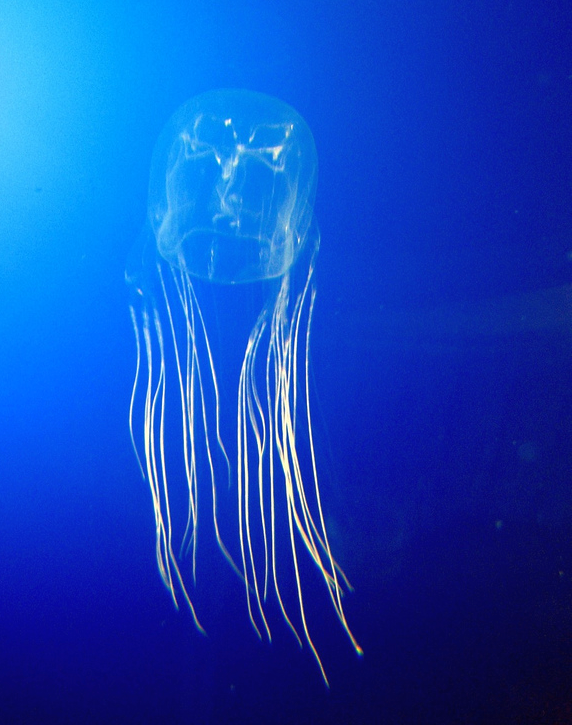
The box jellyfish (Chironex fleckeri) is the most venomous marine animal, with cube-shaped bells and trailing tentacles in northern Australian waters. Adults reach 30 cm bell height and are Least Concern.
Top questions about the Box Jellyfish
Box Jellyfish facts at a glance
- Weight 2 kg
- Length 30 cm
- Top speed 7 km/h
- Lifespan 1 years
| Scientific name | Chironex fleckeri |
|---|---|
| Diet | Carnivore |
| Habitat | Coastal tropical waters |
| Lifespan | 1–2 years |
| Weight | 1–3 kg |
| Top speed | up to 7 km/h |
| Conservation status | Least Concern (IUCN) |
| Kingdom | Animalia |
|---|---|
| Phylum | Cnidaria |
| Class | Cubozoa |
| Order | Carybdeida |
| Family | Chirodropidae |
| Genus | Chironex |
Where it lives
The box jellyfish (Chironex fleckeri) is native to Northern Australian coastal waters. — recorded across Oceania in this guide’s range summary.
For occurrence records, see GBIF species search and sources below.
How big is a box jellyfish?
An adult box jellyfish measures 30 cm long — about 17% of the height of an average adult person (1.73 m) — and weighs around 2.0 kg, about 3% of an average adult’s body weight (70 kg).
Length vs an average adult’s height (to scale)
What is a group of box jellyfish called?
Group name (collective noun)
A group of Box Jellyfish is called a smack.
Baby name
A baby Box Jellyfish is called an ephyra.
Explore more animal collective nouns and baby animal names .
Cube bell, deadly tentacles
Four-sided bells and up to 15 tentacles each carry millions of nematocysts. Complex eyes on stalks may help navigate mangrove channels toward prey.
Shrimp and fish in shallows
Fast pulsating swimming lets them hunt in tropical shallows rather than drifting like many jellyfish. Venom can kill fish instantly and humans within minutes.
Northern Australian coasts
Shallow tropical waters from Western Australia through Queensland. Seasonal stinger nets protect popular beaches in Cairns and Townsville.
Dangerous but not endangered
IUCN lists Chironex fleckeri Least Concern. Public health measures — vinegar, nets, education — manage risk; populations remain robust.
Explore the Box Jellyfish
Close relatives
- Octopus Same class
- Black Widow Same class
- Jellyfish Same class
- Tarantula Same class
Collections
Range & geography
Conservation status of the Box Jellyfish
The box jellyfish (Chironex fleckeri) is listed as Least Concern on the IUCN Red List. Least Concern (LC) is the IUCN's lowest-risk category, assigned to widespread, abundant species that have been evaluated and found not to be threatened. It does not mean a species faces no pressures — only that it is not currently at risk of extinction.
The box jellyfish (Chironex fleckeri) is assessed on the IUCN Red List. Look up on the IUCN Red List .
Frequently asked questions about the Box Jellyfish
How venomous is Chironex fleckeri?
Its sting can cause cardiac arrest within minutes — among the deadliest venoms known.
Do box jellyfish have eyes?
Yes — clusters of eyes on the bell may support navigation toward light gaps and prey.
What should you do for a box jelly sting?
Pour vinegar to disable undischarged stingers and seek emergency medical care immediately.
When are box jellyfish most common?
Warm wet-season months in northern Australia — stinger nets are seasonal.
Are box jellyfish endangered?
No — IUCN lists them Least Concern despite their medical danger to humans.
What is a group of box jellyfish called?
A group of Box Jellyfish is called a smack.
What is a baby box jellyfish called?
A baby Box Jellyfish is called an ephyra.
Sources & references
This guide is compiled and reviewed against established zoological and conservation references. Key sources for the Box Jellyfish:
-
IUCN Red List of Threatened Species
Conservation status (Least Concern) reflects the IUCN Red List category for Chironex fleckeri.
-
iNaturalist — observations & photos
Search citizen-science observations and community IDs for Chironex fleckeri. Useful for range checks and recent sightings — not a substitute for formal Red List status.
-
GBIF — occurrence data
Global Biodiversity Information Facility species search for Chironex fleckeri. Explore published occurrence records used in range research.
-
Global Animal Guide editorial standards
How we research, source, review, and update every guide for accuracy.