Quick answer
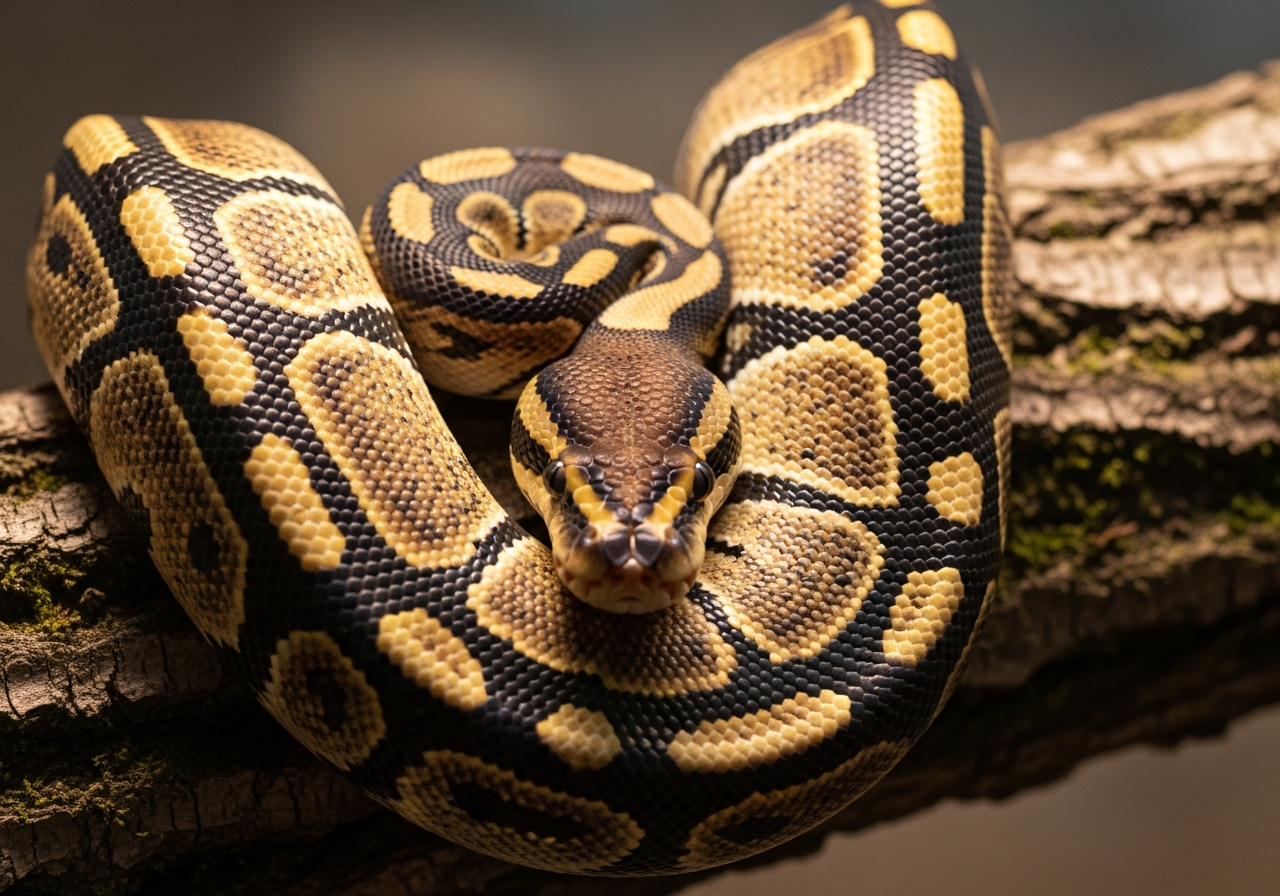
The ball python is a small, non-venomous constrictor from the grasslands and forests of West and Central Africa, named for its habit of curling into a tight ball when stressed. Docile and slow-moving, it is one of the most popular pet snakes in the world and comes in hundreds of color and pattern 'morphs'. Ball pythons are long-lived, often reaching 20 to 30 years in captivity.
Top questions about the Ball Python
Ball Python facts at a glance
- Weight 1.8 kg
- Length 1.5 m
- Top speed 2 km/h
- Lifespan 30 years
| Scientific name | Python regius |
|---|---|
| Diet | Carnivore |
| Habitat | Grassland and open forest of West/Central Africa |
| Lifespan | 20–30 years in captivity |
| Length | 1–1.5 m (3–5 ft) |
| Top speed | Slow-moving |
| Conservation status | Near Threatened (IUCN) |
| Kingdom | Animalia |
|---|---|
| Phylum | Chordata |
| Class | Reptilia |
| Order | Squamata |
| Family | Pythonidae |
| Genus | Python |
Where it lives
The ball python (Python regius) is native to Grasslands and open forests of West and Central Africa. — recorded across Africa in this guide’s range summary.
For occurrence records, see GBIF species search and sources below.
How big is a ball python?
An adult ball python measures 1.5 m long — about 87% of the height of an average adult person (1.73 m) — and weighs around 1.8 kg, about 3% of an average adult’s body weight (70 kg).
Length vs an average adult’s height (to scale)
What is a group of ball pythons called?
Group name (collective noun)
A group of Ball Pythons is called a nest. It is also known as a bed.
Baby name
A baby Ball Python is called a hatchling. It may also be called a snakelet.
Explore more animal collective nouns and baby animal names .
Why the name?
When frightened, a ball python tucks its head into the center of its coils and rolls into a tight ball, protecting its most vulnerable part. This shy, defensive behavior, rather than biting, gives the snake its name and is a big reason it is considered easy and safe to keep.
A harmless constrictor
Ball pythons are non-venomous. They kill prey such as rodents by constriction, coiling around it and tightening until it can no longer breathe. To humans they are harmless and docile, and their calm temperament has made them one of the most kept snakes in the world.
Heat-sensing pits
Like other pythons, ball pythons have heat-sensing pits along the lips that detect the body warmth of nearby prey. Combined with a keen sense of smell, gathered by flicking the tongue, this lets them hunt small mammals effectively even in darkness.
Morphs and conservation
Selective breeding has produced hundreds of color and pattern variations called morphs, fueling a huge pet industry. In the wild, ball pythons are listed as Near Threatened, with collection for the pet and skin trades and habitat loss putting pressure on wild populations in West Africa.
Dig deeper into the Ball Python
- Ball Python: Key Facts
The ball python is a small, non-venomous constrictor from the grasslands and forests of West and Central Africa, named for its habit of curling into a…
- How Big Is A Ball Python?
Ball Python size and weight: typical about 1.8 kg, dimorphism, and growth.
- How Long Do Ball Pythons Live?
Ball Python lifespan is typically 20–30 years in captivity. What shortens or extends life, life stages, and status (Near Threatened).
- What Do Ball Pythons Eat?
What ball pythons eat: Carnivore, foraging style, and seasonal shifts in Grassland and open forest of West/Central Africa.
- Where Do Ball Pythons Live?
Where ball pythons live: Grassland and open forest of West/Central Africa, native range cues, and human overlap. Status Near Threatened.
Explore the Ball Python
Related Reptiles
Range & geography
Did you know? Ball Python facts
- The ball python is a small, non-venomous constrictor from the grasslands and forests of West and Central Africa, named for its habit of curling into a tight ball when stressed.
- The ball python is named for its habit of curling into a tight ball, with its head tucked safely in the middle of its coils, when it feels stressed or threatened.
- No. Ball pythons are non-venomous constrictors and are harmless to humans. They are known for their docile, shy nature, which is why they are such popular pets.
- Ball pythons are carnivores that eat small mammals, mainly rodents such as mice and rats, killing them by constriction rather than venom.
- Ball pythons are long-lived snakes, commonly reaching 20 to 30 years in captivity, so they are a long-term commitment for an owner.
- Conservation: Near Threatened (IUCN).
Diet & feeding
Ball Python feeds primarily as a carnivore. Ball pythons are non-venomous. They kill prey such as rodents by constriction, coiling around it and tightening until it can no longer breathe. To humans they are harmless and docile, and their calm temperament has made them one of the most kept snakes in the world.
Adaptations
- When frightened, a ball python tucks its head into the center of its coils and rolls into a tight ball, protecting its most vulnerable part. This shy, defensive behavior, rather than biting, gives the snake its name and is a big reason it is considered easy and safe to keep.
- Ball pythons are non-venomous. They kill prey such as rodents by constriction, coiling around it and tightening until it can no longer breathe. To humans they are harmless and docile, and their calm temperament has made them one of the most kept snakes in the world.
Behaviour & ecology
- When frightened, a ball python tucks its head into the center of its coils and rolls into a tight ball, protecting its most vulnerable part. This shy, defensive behavior, rather than biting, gives the snake its name and is a big reason it is considered easy and safe to keep.
- Ball pythons are non-venomous. They kill prey such as rodents by constriction, coiling around it and tightening until it can no longer breathe. To humans they are harmless and docile, and their calm temperament has made them one of the most kept snakes in the world.
- Like other pythons, ball pythons have heat-sensing pits along the lips that detect the body warmth of nearby prey. Combined with a keen sense of smell, gathered by flicking the tongue, this lets them hunt small mammals effectively even in darkness.
Communication
- Scent marking, body posture, and head-bobbing or tail signals communicate threat and dominance.
- Vocalisations are limited in many reptiles but hissing or bellowing occurs in some groups.
Habitat & range
Grassland and open forest of West/Central Africa
Ecological role
Ball Python acts as a predator that helps regulate prey populations and maintain balance in grassland and open forest of west/central africa.
Conservation status of the Ball Python
The ball python (Python regius) is listed as Near Threatened on the IUCN Red List. Near Threatened (NT) means a species does not yet qualify as threatened but is close to it, or likely to become so in the near future without ongoing conservation. It is a watch-list category just below Vulnerable.
The ball python (Python regius) is assessed on the IUCN Red List. Look up on the IUCN Red List .
Frequently asked questions about the Ball Python
Why is it called a ball python?
The ball python is named for its habit of curling into a tight ball, with its head tucked safely in the middle of its coils, when it feels stressed or threatened.
Are ball pythons venomous or dangerous?
No. Ball pythons are non-venomous constrictors and are harmless to humans. They are known for their docile, shy nature, which is why they are such popular pets.
What do ball pythons eat?
Ball pythons are carnivores that eat small mammals, mainly rodents such as mice and rats, killing them by constriction rather than venom.
How long do ball pythons live?
Ball pythons are long-lived snakes, commonly reaching 20 to 30 years in captivity, so they are a long-term commitment for an owner.
How big do ball pythons get?
Ball pythons are relatively small pythons, usually growing to about 1 to 1.5 m (3 to 5 ft), with females typically larger than males.
What is a group of ball pythons called?
A group of Ball Pythons is called a nest. It is also known as a bed.
What is a baby ball python called?
A baby Ball Python is called a hatchling. It may also be called a snakelet.
Sources & references
This guide is compiled and reviewed against established zoological and conservation references. Key sources for the Ball Python:
-
IUCN Red List of Threatened Species
Conservation status (Near Threatened) reflects the IUCN Red List category for Python regius.
-
iNaturalist — observations & photos
Search citizen-science observations and community IDs for Python regius. Useful for range checks and recent sightings — not a substitute for formal Red List status.
-
GBIF — occurrence data
Global Biodiversity Information Facility species search for Python regius. Explore published occurrence records used in range research.
- IUCN Red List — Python regius.
Conservation status (Near Threatened) and population trends.
- Animal Diversity Web — Python regius. University of Michigan Museum of Zoology.
Life history, morphology, and range.
- Wikipedia — Ball Python.
General taxonomy and overview (cross-check primary sources).
-
Global Animal Guide editorial standards
How we research, source, review, and update every guide for accuracy.