Why Are Pandas Endangered? Habitat, Bamboo, and Hope
Giant pandas are a conservation icon — but why did they become endangered, and what is helping them recover? The biology and politics behind panda protection.
Global Animal Guide · June 24, 2026
Quick answer
Giant pandas became endangered mainly because habitat loss and fragmentation cut them off from bamboo forests they depend on. Pandas eat almost nothing but bamboo, breed slowly, and need large home ranges — so when forests were logged or divided by roads and farms, populations crashed. Intensive protection, reserve expansion, and captive breeding have moved the species from Endangered to Vulnerable on the IUCN Red List, though climate change threatens future bamboo supplies.
A specialist in a changing forest
The giant panda is one of the world’s most recognised conservation symbols. Its black-and-white coat and calm demeanour hide a harder reality: pandas are ecological specialists tied to bamboo forests in China’s mountains — forests that shrank dramatically during the twentieth century.
The giant panda is a genuine bear, in the same family as the brown bear, the polar bear, and the black bear. The red panda that shares its mountains and its bamboo habit is not a close relative — it belongs to its own family and arrived at the same diet independently.
A carnivore’s body running on grass
Here is the biological knot at the centre of everything. The panda is built like a meat-eater: a short, simple gut with no rumen, no fermentation chamber, none of the plumbing that lets a cow extract energy from vegetation. It makes no enzyme capable of breaking down cellulose, relies on gut microbes to do the work, and has a gut far too short to give them much time.
The result is a digestive efficiency unsustainable for almost any other herbivore — most of what a panda eats passes through barely touched. Its adaptations to bamboo are mechanical rather than metabolic: enlarged jaw muscles and crushing molars, and a famous “false thumb,” an enlarged wrist bone serving as an opposable pad for gripping stalks. Even its taste has shifted, the gene that lets other carnivores detect the savoury flavour of meat now inactivated.
Every consequence flows from that inefficiency. A panda cannot hibernate like other bears, store meaningful fat, fast through a hard season, or roam widely — it must simply keep eating, all day, close to the food.
Bamboo dependence
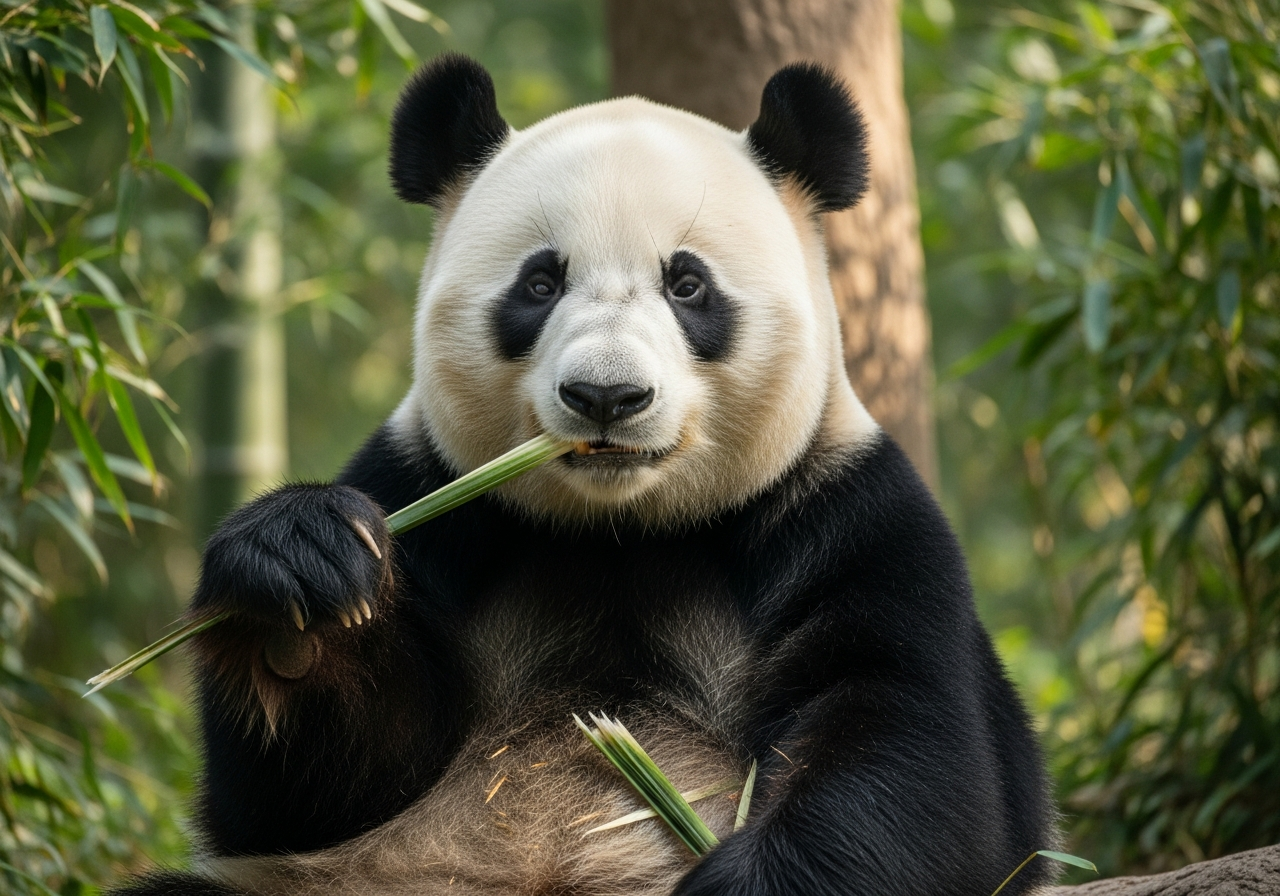
Pandas eat bamboo almost exclusively — stems, leaves, and shoots depending on season. Bamboo is low in protein and hard to digest. An adult may spend 12 hours a day eating and consume 12–20 kg of plant material. When a bamboo species flowers and dies en masse — a natural cycle — pandas must migrate to other bamboo types or starve.
This diet locks pandas to specific elevations and forest types, making them vulnerable when those forests disappear.
The mass flowering is what turns habitat loss into starvation. Bamboo is a grass, and many species flower synchronously across a whole region after decades of vegetative growth — then die at once, leaving years before seedlings regrow into anything edible. This was always survivable: a panda walked to the next valley, where a different bamboo species was on a different clock, and came back later.
Die-offs in the 1970s and 1980s killed pandas precisely because that walking had become impossible — the neighbouring valleys were farmland, roads, and villages. The natural disaster had not changed. The landscape’s ability to absorb it had.
Habitat loss and fragmentation
Logging, agriculture, and infrastructure development broke continuous forest into isolated patches. Isolated pandas face:
- Reduced mating opportunities — males need to find females across rugged terrain
- Low genetic exchange — inbreeding risk in small populations
- Food shortages when local bamboo cycles crash
China established giant panda reserves and corridor projects to reconnect fragments — one of the largest species-focused conservation programmes ever run.
Pandas once ranged across much of southern and eastern China. What survives is a scatter of forest patches in Sichuan, Shaanxi, and Gansu, the wild population divided among roughly thirty subpopulations. Several hold only a handful of animals: technically alive, functionally already lost, because a group that small cannot ride out a bamboo die-off.
This is why corridors, rather than reserve area, became the central tool. A reserve conserves pandas; a corridor conserves the option of moving. Highways and railways in valley bottoms are the hardest barriers to undo, since pandas and human transport routes want the same terrain.
Slow reproduction
Female pandas are fertile only briefly each year — often two to three days. Cubs are born tiny and helpless, usually one at a time. In the wild, a female may raise only a handful of cubs across her lifetime. Population recovery is inherently slow even when habitat is secure.
The numbers are stark. A newborn panda weighs around a hundred grams — blind, pink, hairless, and among the smallest infants relative to its mother of any placental mammal. Twins are common, but a wild mother almost always raises only one, because she cannot generate enough milk on a bamboo diet to support two. The second cub is abandoned. It is not cruelty; it is arithmetic.
A cub then depends on its mother for well over a year, so a female breeds at best every other year. Stack that against a short fertile window and the recovery ceiling is low no matter how much habitat exists: protection buys decades of slow gain, not a quick rebound.
Poaching and protection
Historically, poaching for fur was a serious threat. Strict anti-poaching laws, community engagement, and ecotourism revenue shifted local incentives toward protection. Camera traps and ranger patrols now monitor many core habitats.
Snares set for musk deer also killed pandas incidentally, so enforcement had to target trapping in general rather than panda hunting specifically. The larger turning point was structural: after catastrophic flooding in the late 1990s, China banned logging across the upper Yangtze watershed. It was a flood-control measure, not a panda measure — yet it did more for pandas than any panda-specific policy had.
Captive breeding and reintroduction
Breeding centres in China improved captive reproduction through better nutrition and behavioural research. Some captive-born pandas have been reintroduced to the wild with mixed but improving results — a supplement to, not a replacement for, habitat conservation.
Captive breeding was for decades a byword for failure, for biological rather than institutional reasons. Pandas show delayed implantation, so gestation length varies unpredictably, and pseudopregnancy is common enough that hormones and behaviour can be indistinguishable from a real pregnancy until a cub appears or does not. The breakthroughs were unglamorous — pinning down the oestrus window, twin-swapping between mother and incubator so both cubs survive, and respecting mate choice.
Reintroduction has proved harder. Captive-raised pandas lack the skills to avoid wild males and navigate steep terrain, and early releases ended badly. It remains a supplement at the margins: nearly all the population gain of recent decades came from wild pandas breeding in protected forest.
A cautious success story
The wild population has risen enough for the IUCN to downlist the species to Vulnerable. That is genuine progress — but pandas remain dependent on active management, bamboo health, and climate stability.
Some of the recorded increase reflects better survey methods rather than more bears. The underlying trend is still real, and it is one of the few large-mammal recoveries anywhere.
The remaining threat is one protection cannot fence out. Bamboo grows within a narrow temperature and moisture band, and warming pushes that band upslope. Pandas live on mountains, and mountains run out. Where suitable bamboo shifts above the treeline, the reserve stays put while the food moves — a problem no enforcement solves.
The consolation is that panda habitat is not only panda habitat. The same forests shelter the snow leopard, the leopard, takin, and golden snub-nosed monkeys, none of which command the funding a panda does. That is the real argument for charismatic species: the tiger, the koala, and the panda are umbrellas, and much unphotogenic biodiversity shelters underneath.
Sources
Related reading: Animals saved from extinction · Understanding the IUCN Red List · Giant panda guide
Frequently asked questions
How many giant pandas are left in the wild?
Recent surveys estimate roughly 1,800–1,900 wild individuals, nearly all in China's mountain forests — a significant increase from earlier decades thanks to protection efforts.
Why do pandas eat bamboo if they are carnivores?
Pandas retain a carnivore-like digestive tract but evolved to specialise on abundant bamboo. Low nutrition means they must eat up to 20 kg daily and spend most of their time feeding.
Are pandas still endangered?
The IUCN reclassified them as Vulnerable in 2016 after population growth — still at risk, but no longer in the highest Endangered category.
What is the biggest future threat to pandas?
Climate models suggest some bamboo species may shift or decline in pandas' current range, potentially forcing relocation or adaptation.