How Do Caterpillars Become Butterflies? Metamorphosis Explained
A caterpillar dissolves much of its body inside a chrysalis and rebuilds as a butterfly. The stages of complete metamorphosis and why this radical transformation evolved.
Global Animal Guide · June 24, 2026
Quick answer
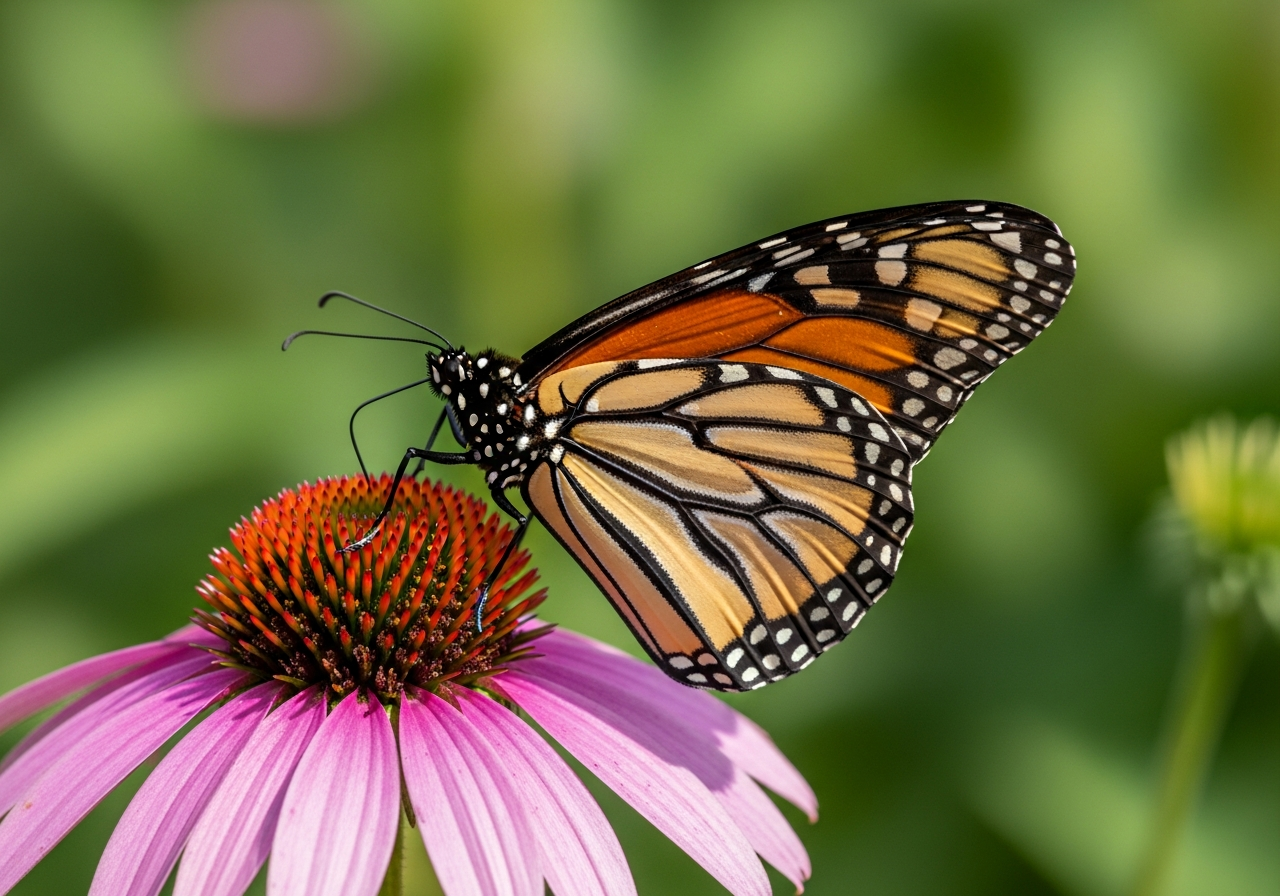
Butterflies undergo complete metamorphosis in four stages: egg, caterpillar (larva), chrysalis (pupa), and adult. Inside the chrysalis, much of the caterpillar's body breaks down into a nutrient soup while clusters of cells called imaginal discs grow into wings, legs, antennae, and adult organs. The adult butterfly emerges, pumps fluid into its wings, and flies off to feed and reproduce — often on different food than the caterpillar ate.
Four stages, two completely different lifestyles
A caterpillar becomes a butterfly by taking itself apart and rebuilding from blueprints it has carried since the day it hatched. Inside the chrysalis, digestive enzymes dismantle most of the larval muscle and gut into a nutrient-rich broth, while small reserved pockets of cells draw on that broth and grow into wings, legs, compound eyes, and reproductive organs. The insect that emerges carries the same genome as the caterpillar and almost none of its anatomy.
Butterflies and moths belong to the order Lepidoptera, and nearly all of them are holometabolous — they pass through four discrete stages (egg, larva, pupa, adult) rather than gradually growing into an adult shape. This is the crucial distinction. A grasshopper or a praying mantis hatches as a miniature, wingless version of its parent and simply gets bigger with each moult. A caterpillar does nothing of the kind. It is not a small butterfly; it is a separate feeding machine that happens to share a genome with one.
The consequence is that larva and adult live in different worlds. A caterpillar chews leaves in one square metre of hedgerow; the butterfly it becomes drinks nectar and may cross a continent. Eating different food in different places, parent and offspring never compete.
Stage 1: The egg and the host-plant gamble
A female lays her eggs on or beside the host plant her caterpillars can digest, and the choice is rarely casual. Many Lepidoptera are specialists: monarch butterfly larvae need milkweed, cabbage whites need brassicas, and a female that lays on the wrong plant condemns her whole brood. Females taste leaves with chemoreceptors on their feet, drumming the surface to confirm the chemistry before committing.
Egg shape, colour, and placement all reflect pressure from parasitoid wasps — tiny relatives of the familiar wasp that inject their own eggs into caterpillars. Some butterflies scatter eggs singly rather than hand a parasitoid a whole cluster; others lay in dense batches so predators are swamped and most survive by sheer arithmetic.
Stage 2: The caterpillar as an eating machine
The larva has one job: accumulate mass. Its body is essentially a gut with legs — powerful chewing mandibles at the front, a long digestive tract, and simple eyes (stemmata) that resolve little more than light and shade. The three pairs of true legs at the front are supplemented by fleshy prolegs tipped with hooked crochets that grip leaf edges like Velcro.
Because the cuticle cannot stretch indefinitely, growth happens in steps. The caterpillar moults through stages called instars, splitting its old skin and expanding rapidly before the new one hardens; many species eat the shed skin, which is expensive protein. Over a few weeks a larva may increase its mass thousands of times, much of it stored as fat body — the fuel the pupa will spend on rebuilding itself.
Defence varies widely. Monarch caterpillars sequester milkweed toxins and advertise them with warning colours; others mimic bird droppings or twigs much as the stick insect does; some swallowtail larvae evert a forked, foul-smelling organ behind the head when touched.
Stage 3: Inside the chrysalis
Once fully fed, the caterpillar stops eating, empties its gut, and finds a sheltered anchor point. It spins a silk pad, hangs from it, and moults one final time — revealing not another caterpillar skin but the pupa. In butterflies this hardened case is a chrysalis; most moths, including the luna moth, spin a silk cocoon around themselves first.
Inside, enzymes break down larval muscle, gut, and most other tissue into a protein-rich soup. But “the caterpillar turns to liquid” is only half true. Certain structures persist — notably the nervous system, parts of the tracheal network, and clusters of cells called imaginal discs. These discs were set aside in the embryo and sat dormant, quietly dividing, throughout larval life. Now they expand, feeding on the dissolved tissue around them, and differentiate into:
- Wings, complete with the overlapping scales that create colour
- Long adult legs and a coiled proboscis for drinking
- Compound eyes and antennae
- Reproductive organs
Because the nervous system is remodelled rather than erased, some learned associations formed by the caterpillar can survive into the adult — a striking hint that this is reorganisation, not a fresh start.
The hormonal switch that decides what happens next
Two hormones govern the whole sequence. Ecdysone triggers a moult; juvenile hormone determines what kind of moult it will be. While juvenile hormone stays high, each ecdysone pulse produces another larval instar. When the larva reaches a critical weight, juvenile hormone falls away, and the next ecdysone pulse produces a pupa instead. A further pulse with juvenile hormone absent produces the adult.
This is why the timing is so precise, and why disrupting it is so effective: several insecticides are juvenile-hormone analogues that simply prevent an insect from ever maturing.
Stage 4: Eclosion and the adult’s short, mobile life
The adult ecloses — splits the pupal case and climbs out — often in the morning, when humidity is high and the wings are less likely to dry mid-expansion. Its wings emerge crumpled and useless. The butterfly pumps haemolymph through the wing veins to inflate them, then hangs still for an hour or more while the cuticle hardens. Interrupt it in that window and the wings set deformed for life.
From then on the adult’s priorities are nectar, mates, and egg-laying sites. Many species live only a few weeks. Others overwinter or migrate: the eastern monarch generation that flies to Mexico lives months rather than weeks, a physiological shift triggered by shortening days.
Why evolution favours a complete rebuild
The pupal stage is a real cost. A pupa cannot flee, cannot feed, and cannot defend itself beyond twitching. So why is complete metamorphosis so overwhelmingly successful that it defines the ant, the honey bee, the ladybug, the dung beetle, and the firefly as well as every butterfly?
The leading explanation is division of labour across the life cycle. A body optimised for chewing and storing is a poor body for flying and mating, and vice versa. Gradual developers like the cicada must compromise: every juvenile stage has to be a functional animal on the way to adulthood. Holometabolous insects refuse the compromise. They build one specialist, dissolve it, and build another — and by that route they have come to make up the large majority of described insect species.
Where the life cycle breaks
A butterfly population needs host plants for the larva, nectar for the adult, and pesticide-free ground between the two. Any one of those failing takes the species down. Habitat loss usually bites at the caterpillar stage first, because host-plant specialists have nowhere to go: no milkweed, no monarchs, no matter how many flowers bloom nearby.
Climate change adds a subtler problem — phenological mismatch. If warm springs push leaf-out earlier but egg-laying cues shift at a different rate, caterpillars hatch onto leaves that are already tough and low in nitrogen. Planting native host species, leaving some untidy ground, and avoiding insecticides on anything in bloom supports the whole cycle rather than just the photogenic end of it.
Sources
Related reading: Why do birds migrate? · Animal camouflage explained · How to help wildlife from home
Frequently asked questions
Does a caterpillar turn completely to liquid?
Much of the larval body is dismantled by enzymes, but some tissues survive and imaginal discs expand using those nutrients — it is reorganisation, not total erasure.
How long does the chrysalis stage last?
Days to months depending on species and season — some butterflies overwinter as pupae.
What do caterpillars eat versus butterflies?
Caterpillars often eat leaves of specific host plants; many adult butterflies drink nectar, sap, or minerals from mud and rotting fruit.
Why do butterflies have such bright wings?
Colours can warn predators of toxicity, attract mates, or provide camouflage when wings are closed — species use colour differently.