Animal Behavior Explained: Ethology Basics
Animal behavior (ethology) covers foraging, mating, migration, communication, and social living. Types of behavior, innate vs learned, and why it matters for conservation.
Global Animal Guide · July 10, 2026
Quick answer
Animal behavior is everything an animal does — moving, feeding, mating, defending territory, communicating, and caring for young. Ethology studies these actions scientifically. Behaviors can be innate (instinctive) or learned, and they evolve because they improve survival or reproduction in a given environment.
Last updated: July 2026.
What counts as behavior?
Behavior includes:
- Locomotion — walking, flying, swimming, burrowing
- Foraging and feeding
- Thermoregulation — basking, huddling, panting
- Rest and sleep
- Migration and navigation
- Predator avoidance and defense
- Aggression, territoriality, dominance
- Sociality and cooperation
- Communication — sound, scent, colour, dance
- Courtship, mating, parental care
- Grooming, play, learning, problem-solving
If it is an action that interacts with the environment or other individuals, ethologists study it.
The breadth is the point. Anatomy tells you what an animal can do; behaviour is what it actually does, and it is usually the first thing to change when the environment shifts. A red fox in a city has the same body as one in a wood but a different routine, diet, and tolerance of people — behaviour is evolution’s fastest-moving surface.
Innate vs learned
Innate behaviours (fixed action patterns) appear reliably — a spider spinning a species-typical web, a newborn mammal suckling.
Learned behaviours change with experience — a crow recognising a particular human face, a dog responding to “sit.”
Imprinting is a special learning window (e.g. goslings following the first moving object). Social learning spreads skills through groups without genetic change — the root of animal culture.
The dichotomy is a teaching tool rather than a real border, and most behaviour sits on both sides at once. A songbird such as the barn swallow hatches with a rough template of its species’ song but must hear adults to sharpen it, and a bird raised in silence produces something recognisable yet wrong — like an accent learned from a description. A sea otter has an innate urge to pound food against a hard surface, but which rock it favours, and whether it uses one at all, depends on what its mother did.
A fixed action pattern is also more mechanical than it looks. Once triggered, it usually runs to completion even when the point of it has vanished — a goose will go on rolling a nonexistent egg back to the nest after the egg is removed. That stubbornness is a clue: the behaviour is not being reasoned out, it is being released.
Ultimate vs proximate questions
Classic ethology asks:
- Proximate — How does the behaviour work right now? (hormones, nerves, stimuli)
- Ultimate — Why did it evolve? (survival, mating success)
Both matter. A bird sings because testosterone rises in spring and because song attracts mates and deters rivals.
Tinbergen split the question further into four, and the full set is still the standard checklist. Alongside mechanism and adaptive value sit development (how the behaviour assembles over an individual’s lifetime) and phylogeny (what the behaviour’s ancestors did). Ask all four of a single act and the picture stops being a story and starts being an explanation. The spray of a skunk is, proximately, a reflex arc and a pair of muscular glands; adaptively, a defence cheap enough to bluff with and costly enough to remember; developmentally, present in young kits before they have any practice; and phylogenetically, an elaboration of scent glands that the whole weasel lineage carries in milder form.
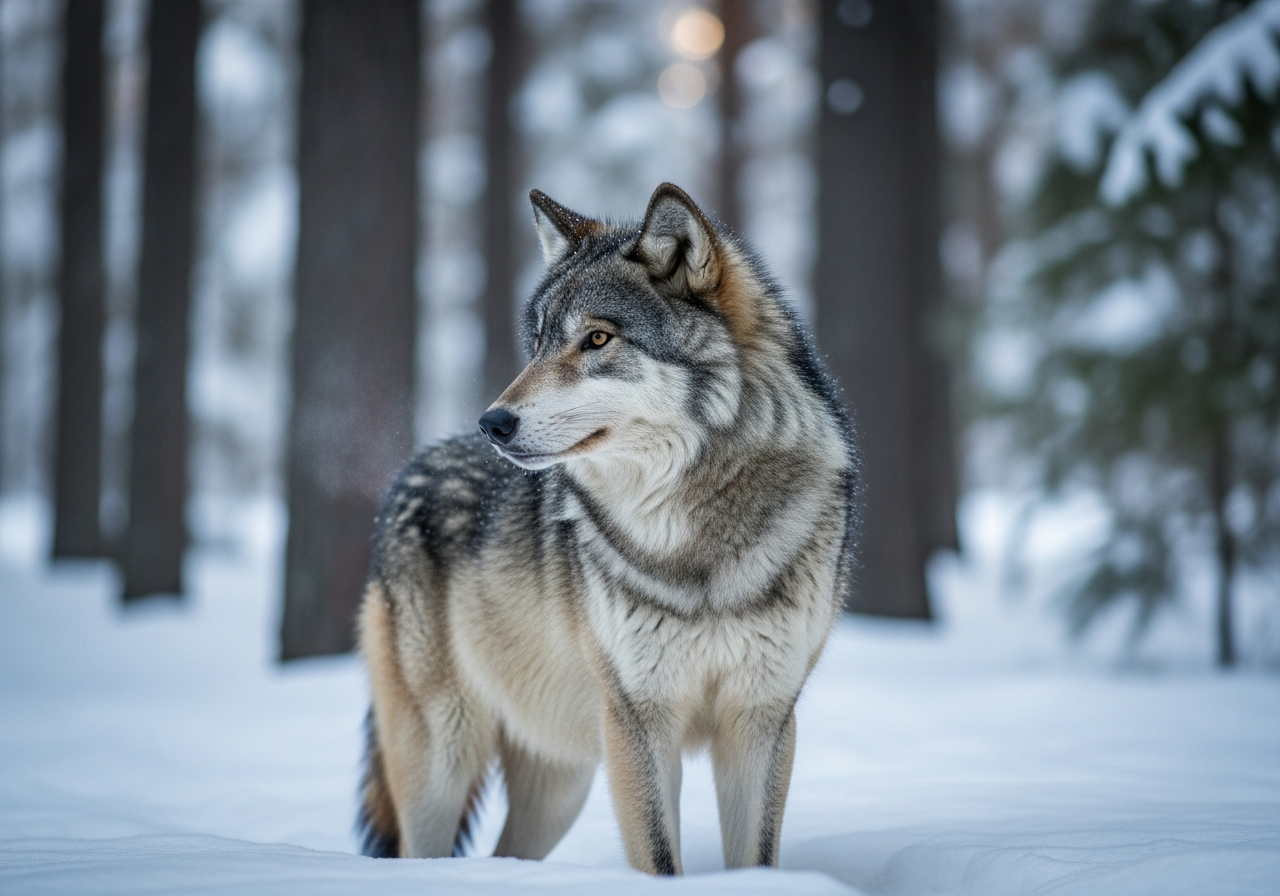
Confusing the levels is the commonest error in popular writing about animals. “The wolf howls because it is lonely” and “the wolf howls to keep a dispersed pack coordinated” are not rival claims. They are answers to different questions.
Signals, honesty, and deception
Communication is where behaviour gets strategic, because a signal only survives if it pays both the sender and, on average, the receiver. That creates a permanent tension. Signals that are cheap to fake get faked and then ignored; signals that persist tend to be ones that are expensive or physically impossible to bluff. The tail of a peacock is costly precisely because it is a handicap — a bird carrying it well is advertising that it can afford to. The alarm calls of the prairie dog work differently: they are cheap, but they are aimed at relatives, so an honest warning helps copies of the caller’s own genes even when the caller is exposed.
The most studied case is the vervet monkey, which gives acoustically distinct calls for different threats — up a tree for one, scanning the sky for another. Young vervets over-apply the calls and are corrected by experience, a neat demonstration of innate and learned machinery interlocking.
And where signals exist, cheating follows. Some fireflies mimic the flash pattern of another species to lure and eat responding males; the orchid mantis is itself a signal, a false flower that lures the pollinators it eats. Deception is not a moral failure in an animal — it is what happens when a communication system becomes valuable enough to exploit.
Why animals live in groups
Sociality looks like generosity and is usually accounting. Grouping dilutes each individual’s odds of being the one taken, multiplies the eyes watching for danger, and makes prey available that no solo hunter could handle — a pack of gray wolves can bring down an animal many times the mass of any one member, and orcas coordinate hunts with techniques passed down within pods.
The bill comes due in competition and disease. Group members eat the same food, attract the same parasites, and squabble over rank — which is why dominance hierarchies exist at all: a stable pecking order is cheaper than settling every dispute with a fight. The meerkat shows both sides at once — sentinels take real risk on watch, helpers raise young that are not their own, and yet dominant females routinely suppress subordinate breeding.
Extreme cooperation, as in the honey bee, makes sense once relatedness is counted. A sterile worker never reproduces, but the sisters she raises carry most of her genes, so helping the colony is reproducing by proxy. Cooperation does not require kindness — it requires that the arithmetic works out.
Behavior and conservation
Understanding behaviour prevents failed reintroductions, reduces human–wildlife conflict, and designs better sanctuaries. Migratory corridors, breeding seasons, and social structure decide whether a protected area actually works.
The failures are instructive. Captive-bred animals released without ever having met a predator often do not recognise one, and survival rates rise when release programmes include anti-predator training. Reserves drawn without reference to a migratory route — the monarch butterfly’s multi-generational journey being the classic case — protect an animal for part of the year and abandon it for the rest. Artificial light, shipping noise, and roads do their damage not by killing directly but by breaking behaviours: navigation, calling, mate-finding.
There is also a subtler trap. Environments can change fast enough that a once-reliable cue now leads animals astray, an evolutionary trap — insects laying eggs on shiny asphalt they read as water, hatchling turtles crawling towards streetlights instead of the sea. The instinct is intact. The world it was tuned to is gone. Reading behaviour correctly is how conservationists spot that difference before a population pays for it.
Related reading
- Why do birds migrate?
- Animal intelligence explained
- Animal camouflage explained
- Animals that mate for life
- How do bats use echolocation?
Sources
Frequently asked questions
What is ethology?
Ethology is the scientific study of animal behavior, usually in natural or naturalistic settings.
What is the difference between instinct and learning?
Instinctive behaviors appear without prior practice; learned behaviors change with experience. Most animals use both.
Why do animals migrate?
To track seasonal food, breeding sites, or safer climates — see our bird migration guide.
Do animals have culture?
Some do — chimpanzees, whales, and birds pass local traditions (tool use, songs, hunting styles) socially.