Image sourcing: see credits & licences
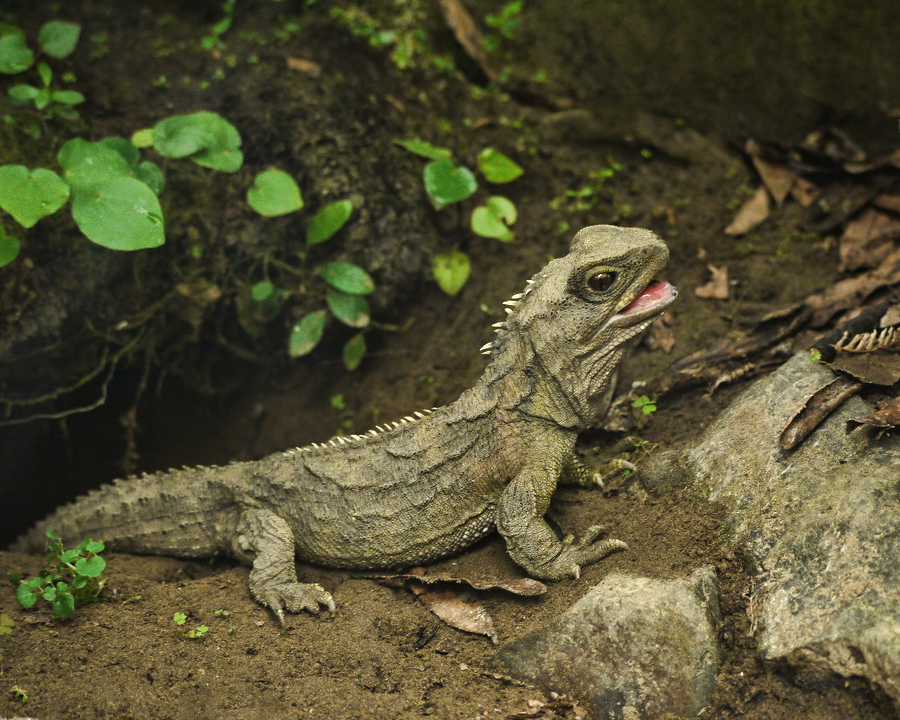
The tuatara (Sphenodon punctatus) is a reptile of the family Sphenodontidae, in the order Rhynchocephalia.
Quick answer
The tuatara (Sphenodon punctatus) is New Zealand's living rhynchocephalian — a lizard-like reptile lineage otherwise known only from fossils. It survives on predator-free offshore islands and sanctuaries, eats invertebrates, grows slowly to about 1 kg, and can live 60 years or more. IUCN lists it Least Concern under intensive management.
Top questions about the Tuatara
Tuatara facts at a glance
- Weight 1 kg
- Length 60 cm
- Top speed 5 km/h
- Lifespan 60 years
| Scientific name | Sphenodon punctatus |
|---|---|
| Diet | Insects and other invertebrates |
| Habitat | Coastal forest and scrub on predator-free islands |
| Lifespan | Around 60 years in the wild (varies by population and captivity). |
| Weight | About 1 kg typical adult mass (sex and region vary). |
| Top speed | Up to roughly 5 km/h when moving at speed. |
| Conservation status | Least Concern (IUCN) |
| Kingdom | Animalia |
|---|---|
| Phylum | Chordata |
| Class | Reptilia |
| Order | Rhynchocephalia |
| Family | Sphenodontidae |
| Genus | Sphenodon |
Where it lives
The tuatara (Sphenodon punctatus) is native to Offshore islands of New Zealand after mainland extinctions; managed sanctuaries. — recorded across Oceania in this guide’s range summary.
For occurrence records, see GBIF species search and sources below.
How big is a tuatara?
An adult tuatara measures 60 cm long — about 35% of the height of an average adult person (1.73 m) — and weighs around 1.0 kg, about 1% of an average adult’s body weight (70 kg).
Length vs an average adult’s height (to scale)
What is a group of tuataras called?
Group name (collective noun)
A group of Tuataras is called a committee.
Baby name
A baby Tuatara is called a hatchling.
Explore more animal collective nouns and baby animal names .
Not a lizard — a rhynchocephalian
Tuatara are the sole survivors of Rhynchocephalia, separated from lizards and snakes for roughly 200 million years. They have a parietal "third eye" under skin on the forehead, two rows of upper teeth that shear against one lower row, and remarkably slow metabolism even for reptiles.
Nocturnal invertebrate hunter
Adults take beetles, spiders, weta, snails, and occasionally lizard eggs or chicks. They forage mainly at night in cool coastal forest and scrub. Juveniles may be more diurnal to avoid cannibalistic adults.
Islands after mainland extinction
Pacific rats (kiore), dogs, and other introduced mammals wiped tuatara from mainland New Zealand. Remaining wild groups live on managed offshore islands; reintroductions to fenced sanctuaries are expanding secure habitat.
Temperature-dependent sex and rats
Eggs incubated cooler tend to produce females; warmer nests yield more males — a climate concern for nesting sites. Eradicating rats and restoring islands remain the core conservation tools that keep the species Least Concern today.
Explore the Tuatara
Close relatives
- Leatherback Sea Turtle Same class
- Hawksbill Sea Turtle Same class
- Alligator Snapping Turtle Same class
- Black Mamba Same class
Range & geography
Conservation status of the Tuatara
The tuatara (Sphenodon punctatus) is listed as Least Concern on the IUCN Red List. Least Concern (LC) is the IUCN's lowest-risk category, assigned to widespread, abundant species that have been evaluated and found not to be threatened. It does not mean a species faces no pressures — only that it is not currently at risk of extinction.
The tuatara (Sphenodon punctatus) is assessed on the IUCN Red List. Look up on the IUCN Red List .
Frequently asked questions about the Tuatara
Is a tuatara a dinosaur?
No. It is a living rhynchocephalian reptile — a cousin lineage to lizards and snakes, not a dinosaur.
Why do tuatara have a third eye?
The parietal eye senses light and may help regulate circadian and seasonal cycles; it does not form sharp images like the lateral eyes.
How long can tuatara live?
Decades are normal; well-documented individuals exceed 60 years, and some captive animals are thought to be older.
Where can you see tuatara in the wild?
Almost only on protected New Zealand offshore islands and mainland sanctuaries free of introduced mammalian predators.
Do tuatara hibernate?
In cooler months they become inactive and may remain in burrows for long periods, matching their slow metabolism.
What is a group of tuataras called?
A group of Tuataras is called a committee.
What is a baby tuatara called?
A baby Tuatara is called a hatchling.
Sources & references
This guide is compiled and reviewed against established zoological and conservation references. Key sources for the Tuatara:
-
IUCN Red List of Threatened Species
Conservation status (Least Concern) reflects the IUCN Red List category for Sphenodon punctatus.
-
iNaturalist — observations & photos
Search citizen-science observations and community IDs for Sphenodon punctatus. Useful for range checks and recent sightings — not a substitute for formal Red List status.
-
GBIF — occurrence data
Global Biodiversity Information Facility species search for Sphenodon punctatus. Explore published occurrence records used in range research.
-
Global Animal Guide editorial standards
How we research, source, review, and update every guide for accuracy.