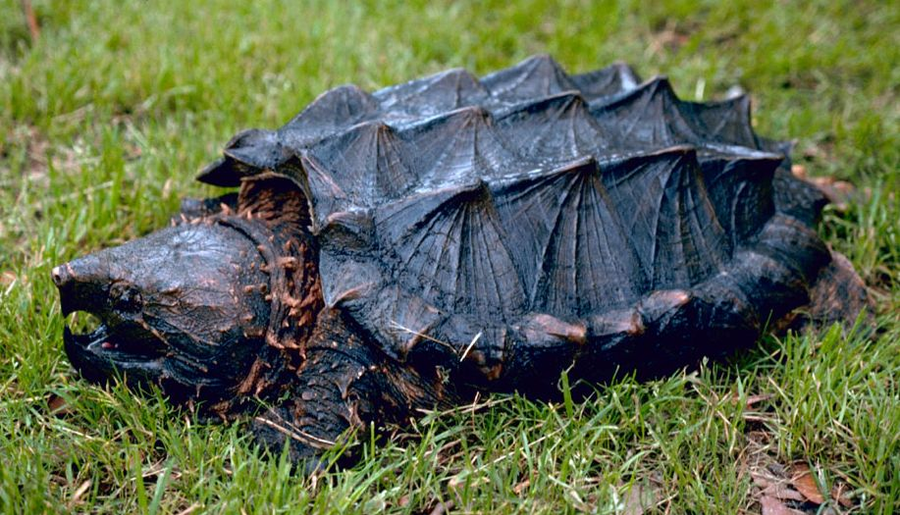
The alligator snapping turtle (Macrochelys temminckii) is a reptile of the family Chelydridae, in the order Testudines.
Quick answer
The alligator snapping turtle (Macrochelys temminckii) is North America's heaviest freshwater turtle, a prehistoric-looking ambush predator that lures fish within striking range using a worm-like appendage on its tongue. Adults typically weigh 45–80 kg (100–175 lb), grow shells up to 80 cm long, and may live 70 years or more.
Top questions about the Alligator Snapping Turtle
Also available in Español (Tortuga lagarto)
Alligator Snapping Turtle facts at a glance
- Weight 80 kg
- Length 80 cm
- Top speed 4 km/h
- Lifespan 70 years
| Scientific name | Macrochelys temminckii |
|---|---|
| Diet | Fish, molluscs, crayfish, amphibians, snakes, and carrion — anything it can catch |
| Habitat | Deep, slow rivers, bayous, and lakes of the south-central United States |
| Lifespan | Commonly 50–80 years; possibly a century or more |
| Weight | Typically 45–80 kg (100–175 lb); exceptional males exceed 100 kg |
| Top speed | A slow, deliberate walker — but its strike takes a fraction of a second |
| Conservation status | Vulnerable (IUCN) |
| Kingdom | Animalia |
|---|---|
| Phylum | Chordata |
| Class | Reptilia |
| Order | Testudines |
| Family | Chelydridae |
| Genus | Macrochelys |
Where it lives
The alligator snapping turtle (Macrochelys temminckii) is native to Rivers, bayous, and lakes draining to the Gulf of Mexico, from the Florida Panhandle to East Texas and up the Mississippi basin. — recorded across North America in this guide’s range summary.
For occurrence records, see GBIF species search and sources below.
How big is a alligator snapping turtle?
An adult alligator snapping turtle measures 80 cm long — about 46% of the height of an average adult person (1.73 m) — and weighs around 80 kg, about 1.1× an average adult’s body weight (70 kg).
Length vs an average adult’s height (to scale)
A living fossil
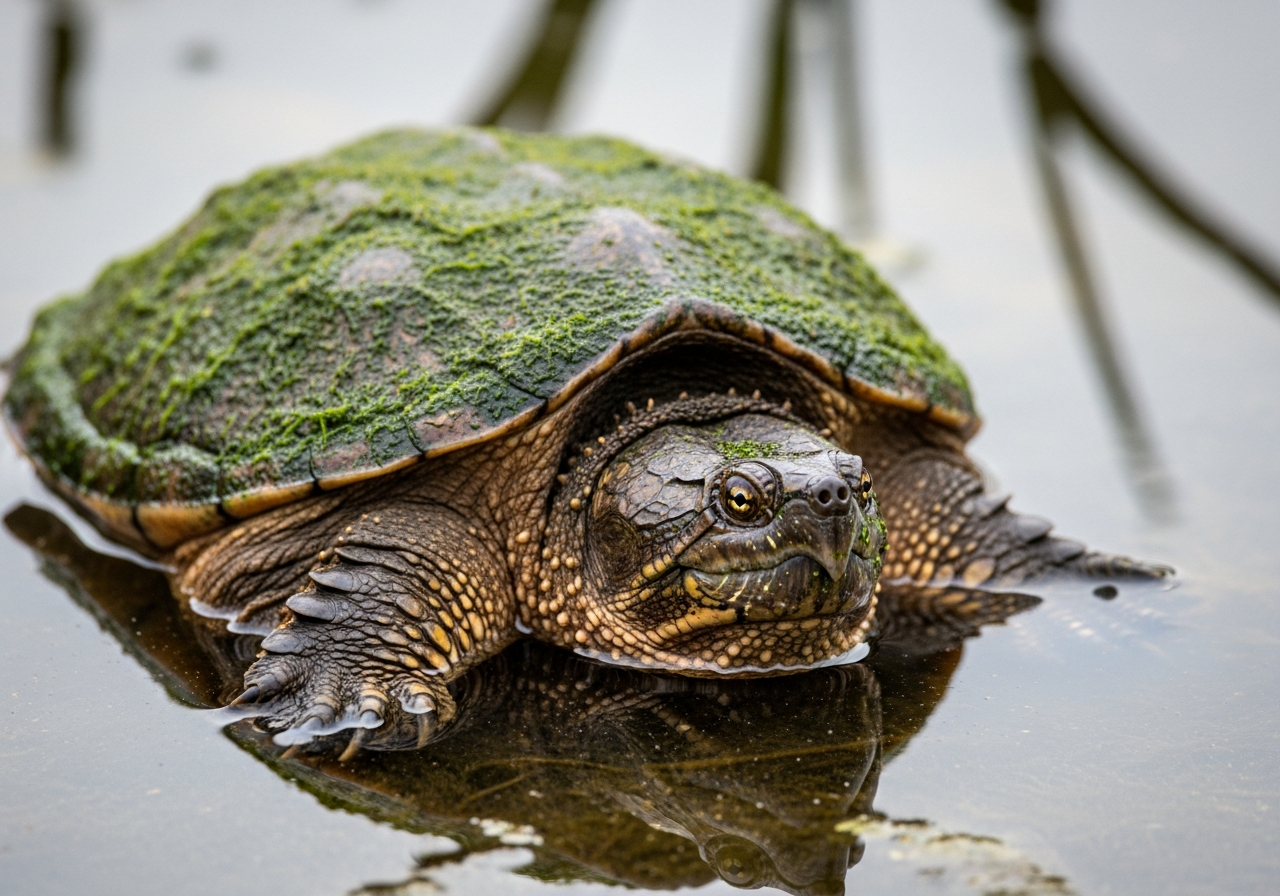
With a spiked, three-keeled shell, a massive head that will not fit inside it, a hooked beak, and eyes on the sides of the skull, the alligator snapping turtle looks unchanged since the age of dinosaurs. Algae often grows on the shell, completing its camouflage as a mossy log. Big males can exceed 100 kg, though 45–80 kg is typical.
The tongue lure
This turtle hunts by deception. It lies motionless on the riverbed with jaws agape and wiggles a pink, worm-shaped appendage on its tongue — the only lingual lure known in any reptile. A fish that swims in to investigate the 'worm' is engulfed by a strike among the fastest movements in the animal kingdom.
Habitat and range
The species lives in river systems draining into the Gulf of Mexico: the Mississippi basin and rivers of the Florida Panhandle, Georgia, Alabama, Louisiana, and East Texas, historically north to Kansas, Iowa, and Illinois. It favours deep, slow water with muddy bottoms and plenty of submerged structure.
An aquatic homebody
Alligator snappers are almost fully aquatic, able to stay submerged for the better part of an hour, and males may never leave the water. Females come ashore only to nest, sometimes travelling considerable distances to reach a suitable bank. Home ranges can span many kilometres of river.
Reproduction
Females nest in late spring, laying 10–50 eggs in a flask-shaped nest dug above the flood line. Incubation lasts around 100–120 days, and nest temperature determines the sex of the hatchlings. The turtles grow slowly and do not mature until roughly 11–13 years old.
Conservation
Commercial harvesting for turtle soup in the 1960s and 1970s devastated populations, and the species is now listed as Vulnerable and protected across its range. Dams, channel dredging, and bycatch add further pressure. Genetic work has recently split the complex into additional species — the Suwannee and Apalachicola alligator snapping turtles — and head-start programmes are releasing juveniles in several states.
Explore the Alligator Snapping Turtle
Close relatives
- Snapping Turtle Same family
- Leatherback Sea Turtle Same order
- Hawksbill Sea Turtle Same order
- Loggerhead Sea Turtle Same order
Collections
Range & geography
Conservation status of the Alligator Snapping Turtle
The alligator snapping turtle (Macrochelys temminckii) is listed as Vulnerable on the IUCN Red List. Vulnerable (VU) means a species faces a high risk of extinction in the medium-term future. It is the lowest-risk of the three 'threatened' IUCN categories — one step below Endangered, which is itself below Critically Endangered — and is often an early warning that a population is in trouble.
The alligator snapping turtle (Macrochelys temminckii) is assessed on the IUCN Red List. Look up on the IUCN Red List .
Frequently asked questions about the Alligator Snapping Turtle
How strong is an alligator snapping turtle's bite?
Powerful enough to crush mollusc shells and amputate fingers, although tales of it shearing through broom handles are exaggerated. It is not aggressive but should never be handled — the neck reaches surprisingly far back.
How long do alligator snapping turtles live?
Captive individuals routinely pass 50 years, and wild lifespans of 70 years or more are considered likely; some authorities suspect they can approach a century.
Where do alligator snapping turtles live?
In rivers, bayous, and lakes draining to the Gulf of Mexico — the Mississippi basin and waterways of the southeastern United States, from the Florida Panhandle to East Texas.
How does the tongue lure work?
The turtle rests on the bottom with its mouth open and wriggles a small pink, worm-like projection on its tongue. Fish attracted by the 'worm' swim straight into the open jaws, which snap shut in a split second.
Are alligator snapping turtles endangered?
They are listed as Vulnerable by the IUCN after heavy historical harvesting for soup, and are protected by law throughout their range; captive breeding and release programmes are helping some populations recover.
Sources & references
This guide is compiled and reviewed against established zoological and conservation references. Key sources for the Alligator Snapping Turtle:
-
IUCN Red List of Threatened Species
Conservation status (Vulnerable) reflects the IUCN Red List category for Macrochelys temminckii.
-
iNaturalist — observations & photos
Search citizen-science observations and community IDs for Macrochelys temminckii. Useful for range checks and recent sightings — not a substitute for formal Red List status.
-
GBIF — occurrence data
Global Biodiversity Information Facility species search for Macrochelys temminckii. Explore published occurrence records used in range research.
-
Global Animal Guide editorial standards
How we research, source, review, and update every guide for accuracy.