Image sourcing: see credits & licences
Quick answer
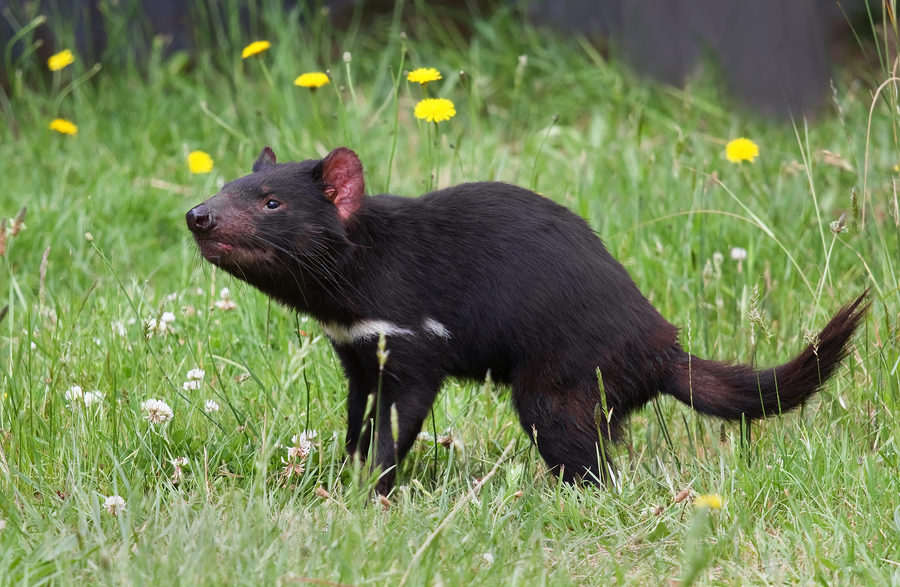
The Tasmanian devil is the world's largest surviving carnivorous marsupial, weighing 6–14 kg (13–31 lb) with powerful jaws that can crush bone. Found only on Tasmania, it is Endangered after devil facial tumour disease (DFTD) wiped out most of the population — captive insurance groups and a vaccine offer hope for recovery.
Top questions about the Tasmanian Devil
Also available in Español (Demonio de Tasmania)
Tasmanian Devil facts at a glance
- Weight 10 kg
- Length 65 cm
- Top speed 24 km/h
- Lifespan 6 years
| Scientific name | Sarcophilus harrisii |
|---|---|
| Diet | Carnivore — carrion, small mammals, birds, and insects |
| Habitat | Forests, scrub, and farmland across Tasmania |
| Lifespan | 5–6 years in the wild (up to 8 in captivity) |
| Weight | 6–14 kg (13–31 lb); males larger than females |
| Top speed | Up to 24 km/h (15 mph) in short bursts |
| Conservation status | Endangered (IUCN) |
| Kingdom | Animalia |
|---|---|
| Phylum | Chordata |
| Class | Mammalia |
| Order | Dasyuromorphia |
| Family | Dasyuridae |
| Genus | Sarcophilus |
Where it lives
The tasmanian devil (Sarcophilus harrisii) is native to Forests, scrub, and farmland across Tasmania, Australia — extinct on the mainland for roughly 3,000 years; the only place devils survive in the wild today. — recorded across Oceania in this guide’s range summary.
For occurrence records, see GBIF species search and sources below.
How big is a tasmanian devil?
An adult tasmanian devil measures 65 cm long — about 38% of the height of an average adult person (1.73 m) — and weighs around 10 kg, about 14% of an average adult’s body weight (70 kg).
Length vs an average adult’s height (to scale)
What is a group of tasmanian devils called?
Group name (collective noun)
A group of Tasmanian Devils is called a litter.
Baby name
A baby Tasmanian Devil is called a joey.
Explore more animal collective nouns and baby animal names .
Jaw power and scavenging
Tasmanian devils have one of the strongest bites relative to body size of any mammal — their wide jaws and thick teeth let them consume entire carcasses including bone and fur. They are primarily scavengers, locating dead wallabies and other animals by smell across kilometres of forest, though they also hunt small prey.
Nocturnal habits and vocalisations
Devils are active mainly at night, resting in dens by day in hollow logs, burrows, or dense scrub. Their eerie screeches, growls, and coughs during communal feeding gave them the 'devil' name — settlers found the night-time squabbles over carcasses unsettling.
Devil facial tumour disease
DFTD is a contagious cancer spread when devils bite each other during feeding and mating. Tumours on the face prevent eating and kill within months. The disease caused an estimated 80% population crash since the 1990s. Captive insurance populations, fenced disease-free areas, and vaccine trials are central to recovery efforts.
Conservation and recovery
Listed Endangered, devils are now found only on Tasmania — extinct on mainland Australia for thousands of years, likely outcompeted by dingoes. Roadkill, habitat loss, and DFTD remain threats. Tourism and the Save the Tasmanian Devil Programme fund research and captive breeding.
Dig deeper into the Tasmanian Devil
- Are Tasmanian Devils Endangered?
Are tasmanian devils endangered? Status Endangered, main threats, and what protection means.
- How Long Do Tasmanian Devils Live?
Tasmanian Devil lifespan is typically 5–6 years in the wild (up to 8 in captivity). What shortens or extends life, life stages, and status (Endangered).
- Tasmanian Devil: Key Facts
The Tasmanian devil is the world's largest surviving carnivorous marsupial, weighing 6–14 kg (13–31 lb) with powerful jaws that can crush bone.
- What Do Tasmanian Devils Eat?
What tasmanian devils eat: Carnivore — carrion, small mammals, birds, and insects, foraging style, and seasonal shifts in Forests, scrub, and farmland across Tasmania.
- Where Do Tasmanian Devils Live?
Where tasmanian devils live: Forests, scrub, and farmland across Tasmania, native range cues, and human overlap. Status Endangered.
Explore the Tasmanian Devil
Collections
Range & geography
Did you know? Tasmanian Devil facts
- Tasmanian devils have one of the strongest bites relative to body size of any mammal.
- Devil facial tumour disease (DFTD) is a contagious cancer spread through biting — it devastated wild populations.
- Devils store fat in their tails — a plump tail indicates a healthy devil before winter.
- Their loud screeches during communal feeding gave them the 'devil' name from early European settlers.
Diet & feeding
Carrion specialist eating every part of a carcass; also hunts small mammals, birds, and reptiles opportunistically.
Adaptations
- Massive jaw muscles and bone-crushing teeth let devils consume entire carcasses including bone.
- Keen sense of smell detects carrion from kilometres away.
- Black coat with white chest blaze provides camouflage in low forest light.
Behaviour & ecology
- Mostly solitary scavengers but gather noisily at large carcasses — squabbling is normal.
- Nocturnal foraging; rest in dens during daylight in hollow logs or burrows.
Communication
- Harsh screeches, growls, and coughs dominate feeding aggregations.
- Scent marking from anal and chest glands advertises territory.
Habitat & range
Forests, coastal scrub, and farmland across Tasmania — absent from mainland Australia since the thylacine era.
Ecological role
Apex scavenger that removes carrion quickly, reducing disease spread and nutrient cycling lag in ecosystems.
Conservation status of the Tasmanian Devil
The tasmanian devil (Sarcophilus harrisii) is listed as Endangered on the IUCN Red List. Endangered (EN) means a species faces a very high risk of extinction in the wild. Populations are usually declining sharply due to habitat loss, hunting, disease, or climate pressure. It sits one level below Critically Endangered on the IUCN Red List.
Main threats to the tasmanian devil
- Devil facial tumour disease (DFTD)
- Vehicle strikes
- Habitat degradation
- Competition and persecution
Tasmanian Devil (Sarcophilus harrisii) was most recently assessed for the IUCN Red List in 2008. View the full IUCN assessment .
Frequently asked questions about the Tasmanian Devil
Are Tasmanian devils dangerous to humans?
They avoid people and attacks are extremely rare. Devils may defend a food source aggressively if cornered but do not hunt humans.
Why are they called Tasmanian devils?
Early European settlers named them for loud night screams and fierce squabbles when feeding on carcasses — not because they are evil, but because the sounds were eerie in the bush.
What is devil facial tumour disease?
A contagious cancer transmitted through biting that causes fatal facial tumours. It devastated wild populations but captive insurance groups and research programmes aim to restore numbers.
How strong is a Tasmanian devil's bite?
Devils can generate bite force disproportionate to their size — enough to crush bone and consume entire carcasses that other scavengers leave.
Where do Tasmanian devils live?
Only on the island of Tasmania, Australia — in forests, coastal scrub, and farmland. They are extinct on the mainland.
What is a group of tasmanian devils called?
A group of Tasmanian Devils is called a litter.
What is a baby tasmanian devil called?
A baby Tasmanian Devil is called a joey.
Sources & references
This guide is compiled and reviewed against established zoological and conservation references. Key sources for the Tasmanian Devil:
-
IUCN Red List of Threatened Species
Conservation status (Endangered) reflects the IUCN Red List category for Sarcophilus harrisii, most recently assessed in 2008.
-
iNaturalist — observations & photos
Search citizen-science observations and community IDs for Sarcophilus harrisii. Useful for range checks and recent sightings — not a substitute for formal Red List status.
-
GBIF — occurrence data
Global Biodiversity Information Facility species search for Sarcophilus harrisii. Explore published occurrence records used in range research.
- Hawkins, C. et al. (2008). Sarcophilus harrisii. IUCN Red List of Threatened Species.
Endangered status and DFTD impact.
- Save the Tasmanian Devil Program (dpipwe.tas.gov.au).
Conservation breeding and disease research.
-
Global Animal Guide editorial standards
How we research, source, review, and update every guide for accuracy.