Image sourcing: see credits & licences
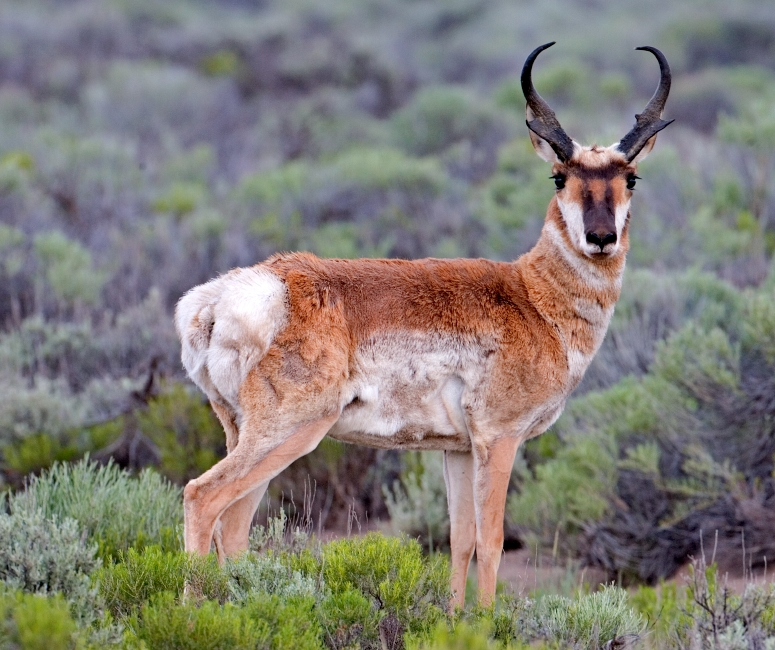
The pronghorn (Antilocapra americana) is a mammal of the family Antilocapridae, in the order Artiodactyla.
Quick answer
The pronghorn (Antilocapra americana) is the fastest land mammal in the Americas, sprinting near 90 km/h across western grasslands and sagebrush from Canada to northern Mexico. Adults weigh about 50 kg, eat forbs and shrubs, and are listed Least Concern — though fences that block migration still threaten some herds.
Top questions about the Pronghorn
Also available in Español (Antílope americano)
Pronghorn facts at a glance
- Weight 50 kg
- Length 1.4 m
- Top speed 90 km/h
- Lifespan 10 years
| Scientific name | Antilocapra americana |
|---|---|
| Diet | Herbivore |
| Habitat | Open plains, sagebrush, and desert grassland |
| Lifespan | Around 10 years in the wild (varies by population and captivity). |
| Weight | About 50 kg typical adult mass (sex and region vary). |
| Top speed | Up to roughly 90 km/h when moving at speed. |
| Conservation status | Least Concern (IUCN) |
| Kingdom | Animalia |
|---|---|
| Phylum | Chordata |
| Class | Mammalia |
| Order | Artiodactyla |
| Family | Antilocapridae |
| Genus | Antilocapra |
Where it lives
The pronghorn (Antilocapra americana) is native to Grasslands and sagebrush of western North America from Canada to northern Mexico. — recorded across North America in this guide’s range summary.
For occurrence records, see GBIF species search and sources below.
How big is a pronghorn?
An adult pronghorn measures 1.4 m long — about 81% of the height of an average adult person (1.73 m) — and weighs around 50 kg, about 71% of an average adult’s body weight (70 kg).
Length vs an average adult’s height (to scale)
What is a group of pronghorns called?
Group name (collective noun)
A group of Pronghorns is called a herd.
Baby name
A baby Pronghorn is called a fawn.
Explore more animal collective nouns and baby animal names .
America's speed specialist
Pronghorns are not true antelopes; they are the sole living antilocaprids. Hollow hairs provide insulation, and oversized hearts and lungs support sustained high-speed flight from extinct American cheetahs' legacy predators. Horns are shed annually in males — unique among horned bovids' relatives.
Forbs of the open plains
Diet focuses on forbs, sagebrush, and other shrubs more than pure grass. Keen eyesight detects movement kilometres away on flat terrain. Across its range it is tied to open plains, sagebrush, and desert grassland, and field accounts emphasise this species’ distinctive ecology rather than generic habitat labels.
Canada to Mexico grasslands
Open plains, sagebrush, and desert grassland of western North America from southern Canada through the western United States into northern Mexico.
Fences versus migration
Least Concern overall after near-extirpation in the nineteenth century, yet woven-wire fences block traditional routes. Wildlife-friendly fence designs and corridor protection help migrating herds.
Explore the Pronghorn
Close relatives
- Giraffe Same order
- Pygmy Hippopotamus Same order
- Blue Whale Same order
- Cow Same order
Range & geography
Conservation status of the Pronghorn
The pronghorn (Antilocapra americana) is listed as Least Concern on the IUCN Red List. Least Concern (LC) is the IUCN's lowest-risk category, assigned to widespread, abundant species that have been evaluated and found not to be threatened. It does not mean a species faces no pressures — only that it is not currently at risk of extinction.
The pronghorn (Antilocapra americana) is assessed on the IUCN Red List. Look up on the IUCN Red List .
Frequently asked questions about the Pronghorn
Is a pronghorn an antelope?
It is often called the American antelope but belongs to its own family, Antilocapridae — not the African-Asian Bovidae antelopes.
How fast can a pronghorn run?
Top speeds approach roughly 90 km/h, with remarkable endurance at slightly lower paces.
Do pronghorns shed their horns?
Males shed the outer horn sheath annually — unusual among horned ungulates.
Why are fences bad for pronghorns?
They rarely jump and instead crawl under barriers; tight woven fences block seasonal migrations to food and fawning grounds.
Where do pronghorns live?
Grasslands and sagebrush of western North America from Canada to northern Mexico.
What is a group of pronghorns called?
A group of Pronghorns is called a herd.
What is a baby pronghorn called?
A baby Pronghorn is called a fawn.
Sources & references
This guide is compiled and reviewed against established zoological and conservation references. Key sources for the Pronghorn:
-
IUCN Red List of Threatened Species
Conservation status (Least Concern) reflects the IUCN Red List category for Antilocapra americana.
-
iNaturalist — observations & photos
Search citizen-science observations and community IDs for Antilocapra americana. Useful for range checks and recent sightings — not a substitute for formal Red List status.
-
GBIF — occurrence data
Global Biodiversity Information Facility species search for Antilocapra americana. Explore published occurrence records used in range research.
-
Global Animal Guide editorial standards
How we research, source, review, and update every guide for accuracy.