Mule Deer
Odocoileus hemionus
Quick answer
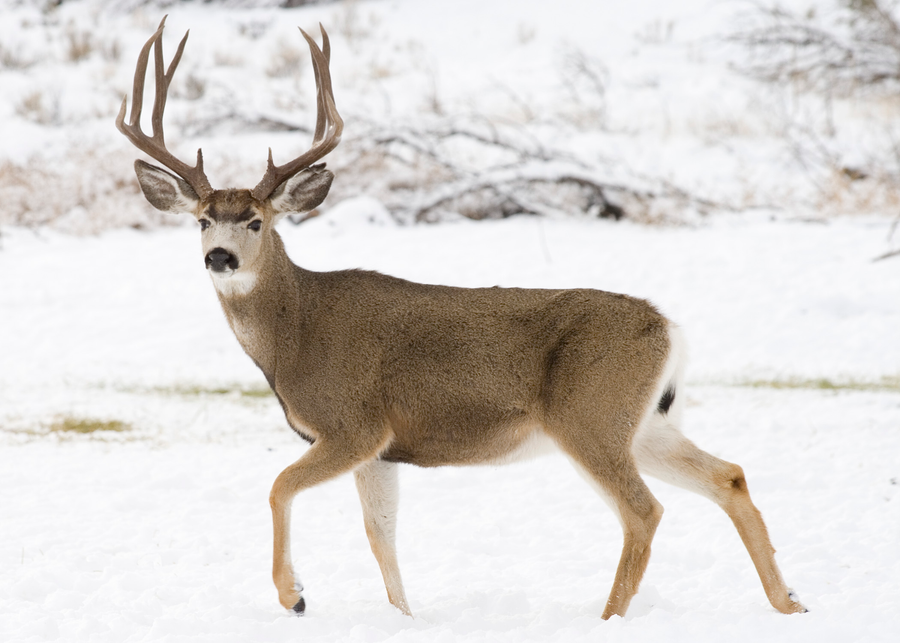
Mule deer are named for their large mule-like ears and black-tipped tail, ranging across western North America from Canada to Mexico. Bucks weigh up to 150 kg (330 lb), bound stiff-legged when fleeing ('stotting'), and migrate seasonally in many mountain populations.
Mule Deer facts at a glance
| Scientific name | Odocoileus hemionus |
|---|---|
| Diet | Herbivore — browse, forbs, grasses, and acorns |
| Habitat | Western forests, sagebrush, deserts, and foothills of North America |
| Lifespan | 9–11 years in the wild |
| Weight | Bucks 55–150 kg; does 43–75 kg |
| Top speed | Up to 48 km/h (30 mph); stotting escape gait |
| Conservation status | Least Concern (IUCN) |
| Kingdom | Animalia |
|---|---|
| Phylum | Chordata |
| Class | Mammalia |
| Order | Artiodactyla |
| Family | Cervidae |
| Genus | Odocoileus |
Where it lives
Western North America from Alaska and British Columbia through the Rocky Mountains, Great Basin, and deserts to Baja California and central Mexico.
What is a group of mule deer called?
Group name (collective noun)
A group of Mule Deer is called a herd.
Baby name
A baby Mule Deer is called a fawn.
Explore more animal collective nouns and baby animal names .
Stotting and escape behaviour
When alarmed, mule deer often flee with a four-legged bounce called stotting, which may signal fitness to predators or improve visibility over brush. This gait distinguishes them from the running gallop of white-tailed deer.
Forked antlers and the rut
Bucks grow bifurcating antlers that fork rather than branch from a main beam like white-tailed deer. The rut peaks in late autumn; bucks spar for access to does. Afterward antlers are shed and regrow through spring and summer.
Migration and urban edge
Many Rocky Mountain herds migrate vertically between summer high country and lower winter range — journeys increasingly blocked by highways and development. Suburban mule deer adapt to irrigated lawns and parks, raising collision and conflict concerns.
Conservation status
Listed Least Concern overall, but some migratory herds face declines from habitat fragmentation, chronic wasting disease, and severe winters. Wildlife crossings and protected winter range help maintain connectivity in the western United States and Canada.
Dig deeper into the Mule Deer
- How Fast Is A Mule Deer
Dig deeper into mule deer — how fast is a mule deer.
- How Long do Mule Deer Live?
Dig deeper into mule deer — how long do mule deer live.
- Mule Deer Facts 5
Dig deeper into mule deer — mule deer facts 5.
- What do Mule Deer Eat
Dig deeper into mule deer — what do mule deer eat.
- Where do Mule Deer Live?
Dig deeper into mule deer — where do mule deer live.
Explore the Mule Deer
Compare
Range & geography
Did you know? Mule Deer facts
- Mule deer are named for their large mule-like ears and black-tipped tail, ranging across western North America from Canada to Mexico.
- Mule deer have larger ears, a black-tipped tail, and bifurcating antlers. White-tailed deer flash a white tail underside and have antlers branching from a main beam. Ranges overlap in some areas.
- The stiff-legged bounce may warn predators the deer is fit and hard to catch, or help them see over vegetation while fleeing.
- Western North America from coastal British Columbia and Alaska south through the Rocky Mountains, Great Basin, and deserts to Baja California and Mexico.
- Browse such as sagebrush and willow, plus forbs, grasses, and acorns — diet varies by season and region.
- Conservation: Least Concern (IUCN).
Diet & feeding
Mule Deer feeds primarily as a herbivore — browse, forbs, grasses, and acorns.
Adaptations
- When alarmed, mule deer often flee with a four-legged bounce called stotting, which may signal fitness to predators or improve visibility over brush. This gait distinguishes them from the running gallop of white-tailed deer.
- Bucks grow bifurcating antlers that fork rather than branch from a main beam like white-tailed deer. The rut peaks in late autumn; bucks spar for access to does. Afterward antlers are shed and regrow through spring and summer.
Behaviour & ecology
- When alarmed, mule deer often flee with a four-legged bounce called stotting, which may signal fitness to predators or improve visibility over brush. This gait distinguishes them from the running gallop of white-tailed deer.
- Bucks grow bifurcating antlers that fork rather than branch from a main beam like white-tailed deer. The rut peaks in late autumn; bucks spar for access to does. Afterward antlers are shed and regrow through spring and summer.
- Many Rocky Mountain herds migrate vertically between summer high country and lower winter range — journeys increasingly blocked by highways and development. Suburban mule deer adapt to irrigated lawns and parks, raising collision and conflict concerns.
Communication
- Mule Deer uses scent, posture, and vocal signals to mark territory and coordinate social behaviour.
- Communication intensity often peaks during breeding seasons and territorial disputes.
Habitat & range
Western forests, sagebrush, deserts, and foothills of North America
Ecological role
Mule Deer shapes vegetation through grazing or browsing and serves as prey for larger predators where ranges overlap.
Frequently asked questions about the Mule Deer
Mule deer vs white-tailed deer?
Mule deer have larger ears, a black-tipped tail, and bifurcating antlers. White-tailed deer flash a white tail underside and have antlers branching from a main beam. Ranges overlap in some areas.
Why do mule deer stot?
The stiff-legged bounce may warn predators the deer is fit and hard to catch, or help them see over vegetation while fleeing.
Where do mule deer live?
Western North America from coastal British Columbia and Alaska south through the Rocky Mountains, Great Basin, and deserts to Baja California and Mexico.
What do mule deer eat?
Browse such as sagebrush and willow, plus forbs, grasses, and acorns — diet varies by season and region.
How big do mule deer get?
Large bucks may reach 150 kg, though 90–100 kg is more typical. Does are considerably smaller.
What is a group of mule deer called?
A group of Mule Deer is called a herd.
What is a baby mule deer called?
A baby Mule Deer is called a fawn.
Sources & references
This guide is compiled and reviewed against established zoological and conservation references. Key sources for the Mule Deer:
-
IUCN Red List of Threatened Species
Conservation status (Least Concern) reflects the IUCN Red List category for Odocoileus hemionus.
- IUCN Red List — Odocoileus hemionus.
Conservation status (Least Concern) and population trends.
- Animal Diversity Web — Odocoileus hemionus. University of Michigan Museum of Zoology.
Life history, morphology, and range.
- Wikipedia — Mule Deer.
General taxonomy and overview (cross-check primary sources).
-
Global Animal Guide editorial standards
How we research, source, review, and update every guide for accuracy.