Llama
Lama glama
Quick answer
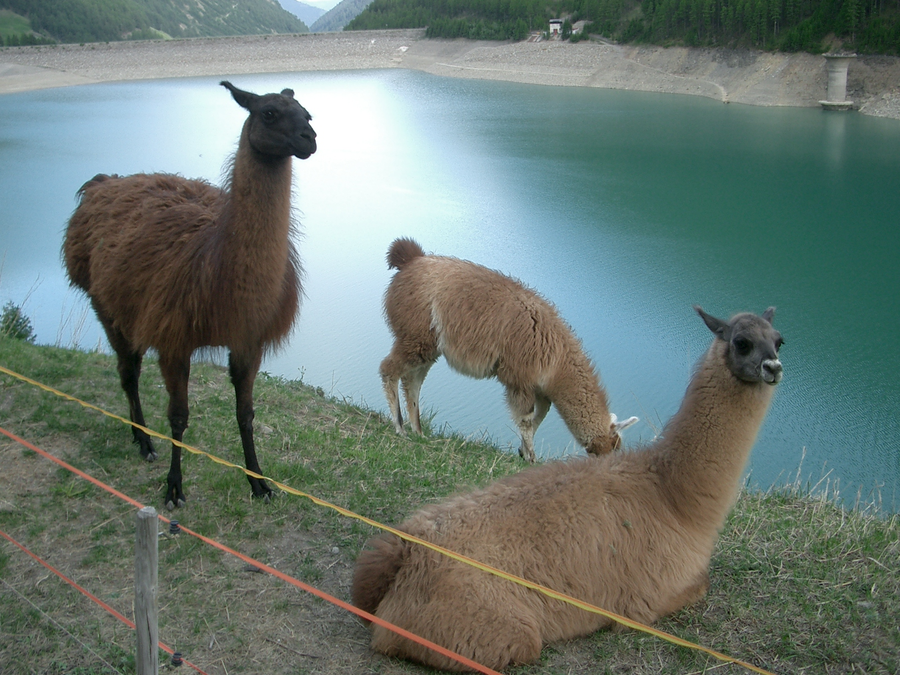
Llamas are domesticated South American camelids used for centuries as pack animals, fibre producers, and livestock guardians in the Andes. They weigh 130–200 kg (290–440 lb), communicate with hums and ear posture, and spit at rivals — occasionally at people who annoy them.
Llama facts at a glance
| Scientific name | Lama glama |
|---|---|
| Diet | Herbivore — grass, hay, and mountain vegetation |
| Habitat | Andean highlands; domestic herds worldwide |
| Lifespan | 15–20 years (up to 25 with good care) |
| Weight | 130–200 kg (290–440 lb) |
| Top speed | Up to 45 km/h (28 mph) at a gallop |
| Conservation status | Domesticated (IUCN) |
| Kingdom | Animalia |
|---|---|
| Phylum | Chordata |
| Class | Mammalia |
| Order | Artiodactyla |
| Family | Camelidae |
| Genus | Lama |
Where it lives
Domesticated in the Andean highlands of Peru, Bolivia, Chile, and Argentina; farmed worldwide on every continent except Antarctica.
What is a group of llamas called?
Group name (collective noun)
A group of Llamas is called a herd.
Baby name
A baby Llama is called a cria.
Explore more animal collective nouns and baby animal names .
Andean domestication
Llamas were domesticated from guanacos more than 5,000 years ago by cultures such as the Inca, who used them to carry goods along mountain trails where wheeled transport was impossible. Selective breeding produced animals with calm temperaments and strong pack capacity.
Guard animals
Modern farmers deploy llamas with sheep and goat flocks to deter coyotes, foxes, and stray dogs. A guardian llama patrols the pasture, alarm calls, and may chase or strike intruders with its feet. Not every llama suits guard work — gelded males are often preferred.
Care and fibre
Llamas need pasture or hay, shelter from extreme heat, regular hoof trimming, and annual shearing if fibre is collected. Their wool is warm and lanolin-free. Because they are herd animals, a solitary llama becomes stressed without companions.
Dig deeper into the Llama
- How Fast Is A Llama
Dig deeper into llama — how fast is a llama.
- How Long do Llama Live?
Dig deeper into llama — how long do llama live.
- Llama Facts 5
Dig deeper into llama — llama facts 5.
- What do Llama Eat
Dig deeper into llama — what do llama eat.
- Where do Llama Live?
Dig deeper into llama — where do llama live.
Explore the Llama
Range & geography
Did you know? Llama facts
- Llamas are domesticated South American camelids used for centuries as pack animals, fibre producers, and livestock guardians in the Andes.
- Llamas are larger and were bred as pack animals with banana-shaped ears. Alpacas are smaller, bred for fine fleece, with shorter faces and spear-shaped ears.
- Yes — usually at each other over food or hierarchy. People who mishandle or startle llamas may get spat at too.
- Well-socialised llamas can be gentle, but they are livestock with strong kicks and spitting. Supervised interaction and respect for their space are essential.
- A fit adult llama can pack about 25–30% of its body weight — roughly 45–60 kg — on mountain trails.
- Conservation: Domesticated (IUCN).
Diet & feeding
Llama feeds primarily as a herbivore — grass, hay, and mountain vegetation. Llamas need pasture or hay, shelter from extreme heat, regular hoof trimming, and annual shearing if fibre is collected. Their wool is warm and lanolin-free. Because they are herd animals, a solitary llama becomes stressed without companions.
Adaptations
- Llamas were domesticated from guanacos more than 5,000 years ago by cultures such as the Inca, who used them to carry goods along mountain trails where wheeled transport was impossible. Selective breeding produced animals with calm temperaments and strong pack capacity.
- Modern farmers deploy llamas with sheep and goat flocks to deter coyotes, foxes, and stray dogs. A guardian llama patrols the pasture, alarm calls, and may chase or strike intruders with its feet. Not every llama suits guard work — gelded males are often preferred.
Behaviour & ecology
- Llamas were domesticated from guanacos more than 5,000 years ago by cultures such as the Inca, who used them to carry goods along mountain trails where wheeled transport was impossible. Selective breeding produced animals with calm temperaments and strong pack capacity.
- Modern farmers deploy llamas with sheep and goat flocks to deter coyotes, foxes, and stray dogs. A guardian llama patrols the pasture, alarm calls, and may chase or strike intruders with its feet. Not every llama suits guard work — gelded males are often preferred.
- Llamas hum to stay in contact with the herd, cluck to their young, and orgle during breeding. They establish hierarchy through posturing and spitting; spit contains stomach contents and is aimed mainly at other llamas disputing food or rank.
Communication
- Llama uses scent, posture, and vocal signals to mark territory and coordinate social behaviour.
- Communication intensity often peaks during breeding seasons and territorial disputes.
Habitat & range
Andean highlands; domestic herds worldwide
Ecological role
Llama shapes vegetation through grazing or browsing and serves as prey for larger predators where ranges overlap.
Frequently asked questions about the Llama
What's the difference between a llama and an alpaca?
Llamas are larger and were bred as pack animals with banana-shaped ears. Alpacas are smaller, bred for fine fleece, with shorter faces and spear-shaped ears.
Do llamas spit?
Yes — usually at each other over food or hierarchy. People who mishandle or startle llamas may get spat at too.
Are llamas good with children?
Well-socialised llamas can be gentle, but they are livestock with strong kicks and spitting. Supervised interaction and respect for their space are essential.
How much weight can a llama carry?
A fit adult llama can pack about 25–30% of its body weight — roughly 45–60 kg — on mountain trails.
Where do llamas come from?
Llamas were domesticated in the Andes of Peru, Bolivia, Chile, and Argentina. They are now raised on farms worldwide.
What is a group of llamas called?
A group of Llamas is called a herd.
What is a baby llama called?
A baby Llama is called a cria.
Sources & references
This guide is compiled and reviewed against established zoological and conservation references. Key sources for the Llama:
-
IUCN Red List of Threatened Species
Conservation status (Domesticated) reflects the IUCN Red List category for Lama glama.
- IUCN Red List — Lama glama.
Conservation status (Domesticated) and population trends.
- Animal Diversity Web — Lama glama. University of Michigan Museum of Zoology.
Life history, morphology, and range.
-
Global Animal Guide editorial standards
How we research, source, review, and update every guide for accuracy.