Image sourcing: see credits & licences
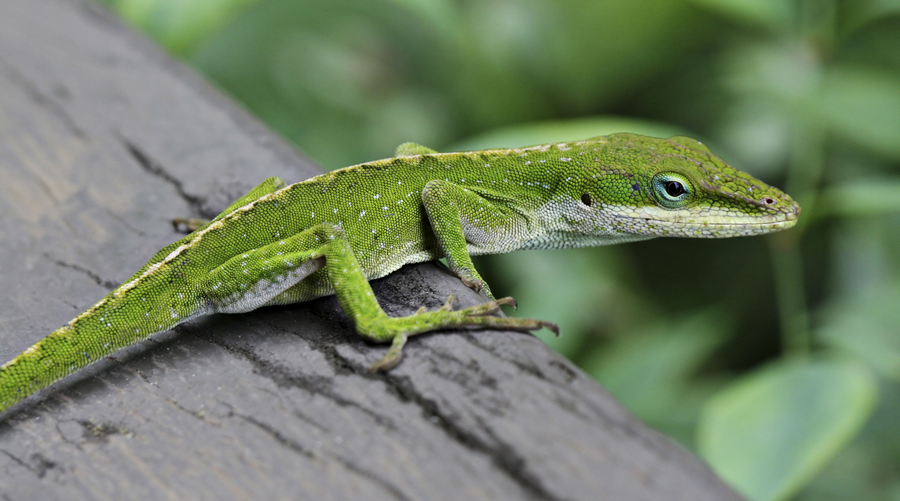
The green anole (Anolis carolinensis) is a reptile of the family Dactyloidae, in the order Squamata.
Quick answer
The green anole (Anolis carolinensis) is a colour-changing lizard of southeastern United States gardens and woodland edges, able to shift between emerald green and brown. Males flash a pink dewlap in displays. Adults weigh only a few grams, eat insects, and are listed Least Concern — though invasive brown anoles displace them in some Florida suburbs.
Top questions about the Green Anole
Green Anole facts at a glance
- Weight 5 g
- Length 20 cm
- Top speed 5 km/h
- Lifespan 5 years
| Scientific name | Anolis carolinensis |
|---|---|
| Diet | Insectivore |
| Habitat | Gardens, woodland edges, and shrubs |
| Lifespan | Around 5 years in the wild (varies by population and captivity). |
| Weight | About 0.005 kg typical adult mass (sex and region vary). |
| Top speed | Up to roughly 5 km/h when moving at speed. |
| Conservation status | Least Concern (IUCN) |
| Kingdom | Animalia |
|---|---|
| Phylum | Chordata |
| Class | Reptilia |
| Order | Squamata |
| Family | Dactyloidae |
| Genus | Anolis |
Where it lives
The green anole (Anolis carolinensis) is native to Southeastern United States; introduced to Hawaii and other islands. — recorded across North America in this guide’s range summary.
For occurrence records, see GBIF species search and sources below.
How big is a green anole?
An adult green anole measures 20 cm long — about 12% of the height of an average adult person (1.73 m) — and weighs around 5 g, a small fraction of an average adult’s body weight (70 kg).
Length vs an average adult’s height (to scale)
What is a group of green anoles called?
Group name (collective noun)
A group of Green Anoles is called a lounge.
Baby name
A baby Green Anole is called a hatchling.
Explore more animal collective nouns and baby animal names .
Dewlaps and colour shifts
Colour change reflects mood, temperature, and camouflage — not true chameleon matching of patterns. Sticky toe pads climb smooth walls. Males extend a pink throat fan in territorial and courtship displays.
Garden insectivore
Diet is insects and spiders gleaned from shrubs, fences, and house walls — crickets, flies, moths, and similar prey. Across its range it is tied to gardens, woodland edges, and shrubs, and field accounts emphasise this species’ distinctive ecology rather than generic habitat labels.
Southeast yards — and beyond
Native to the southeastern United States; introduced to Hawaii and other islands. Prefers gardens, woodland edges, and shrubs with sun and cover.
Competition with brown anoles
Least Concern overall, but Cuban brown anoles (Anolis sagrei) push green anoles higher into the canopy in parts of Florida, changing local behaviour and abundance.
Explore the Green Anole
Close relatives
- Black Mamba Same order
- Inland Taipan Same order
- Copperhead Same order
- Bearded Dragon Same order
Range & geography
Conservation status of the Green Anole
The green anole (Anolis carolinensis) is listed as Least Concern on the IUCN Red List. Least Concern (LC) is the IUCN's lowest-risk category, assigned to widespread, abundant species that have been evaluated and found not to be threatened. It does not mean a species faces no pressures — only that it is not currently at risk of extinction.
The green anole (Anolis carolinensis) is assessed on the IUCN Red List. Look up on the IUCN Red List .
Frequently asked questions about the Green Anole
Can green anoles change colour like chameleons?
They shift between green and brown with temperature and stress, but they do not match complex background patterns like chameleons.
What is the pink flap on a green anole?
The dewlap — used by males in visual displays to rivals and mates.
Why are green anoles disappearing from some Florida yards?
Invasive brown anoles compete for space and drive greens higher into trees.
What do green anoles eat?
Small insects and spiders.
Where do green anoles live?
Southeastern United States gardens and woodland edges; also introduced elsewhere.
What is a group of green anoles called?
A group of Green Anoles is called a lounge.
What is a baby green anole called?
A baby Green Anole is called a hatchling.
Sources & references
This guide is compiled and reviewed against established zoological and conservation references. Key sources for the Green Anole:
-
IUCN Red List of Threatened Species
Conservation status (Least Concern) reflects the IUCN Red List category for Anolis carolinensis.
-
iNaturalist — observations & photos
Search citizen-science observations and community IDs for Anolis carolinensis. Useful for range checks and recent sightings — not a substitute for formal Red List status.
-
GBIF — occurrence data
Global Biodiversity Information Facility species search for Anolis carolinensis. Explore published occurrence records used in range research.
-
Global Animal Guide editorial standards
How we research, source, review, and update every guide for accuracy.