Quick answer
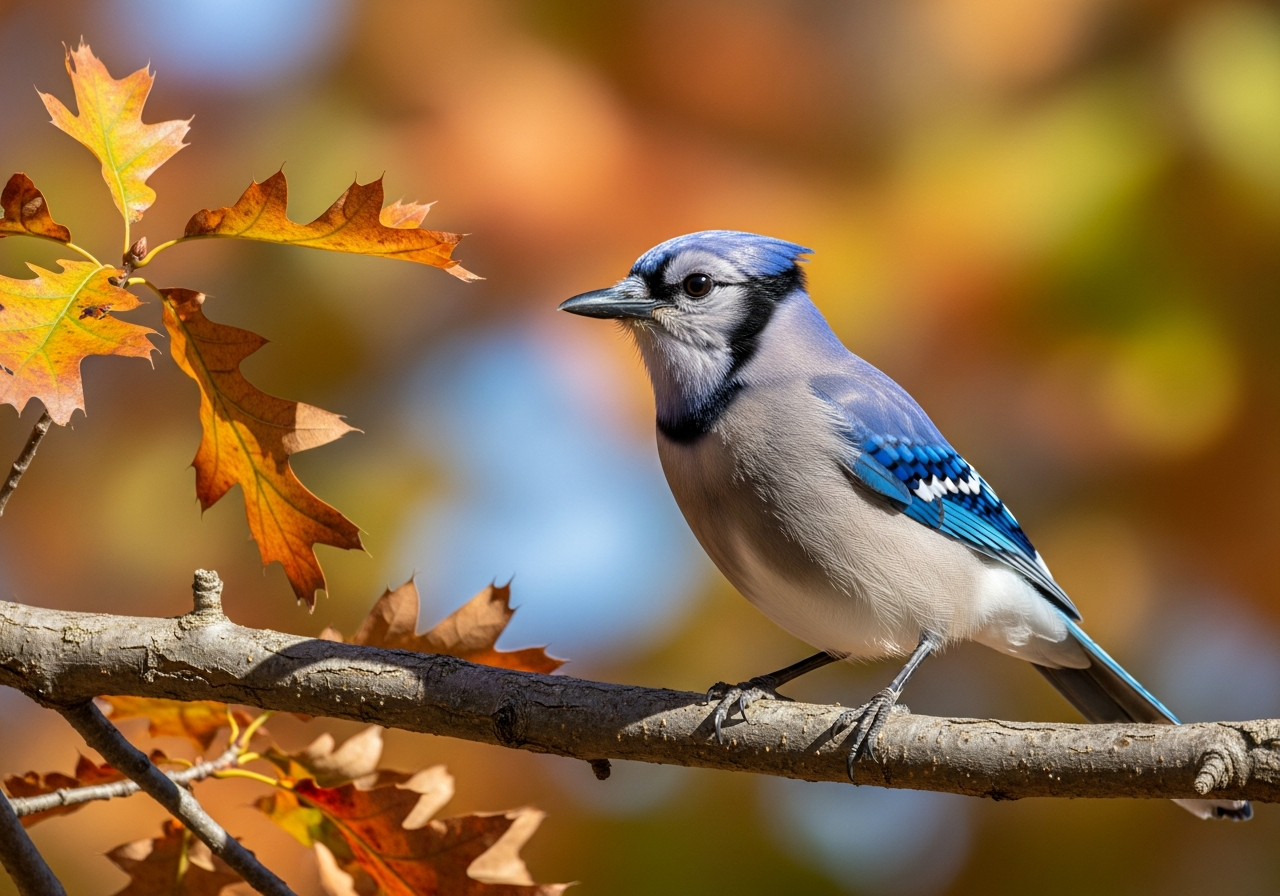
The blue jay is a striking, intelligent songbird of eastern and central North America, known for its blue crest, black necklace markings, and loud, varied calls. A member of the crow family, it is bold, social, and clever, famous for caching acorns and for mimicking the screams of hawks. Blue jays commonly live about 7 years in the wild.
Top questions about the Blue Jay
Blue Jay facts at a glance
- Weight 85 g
- Length 28 cm
- Top speed 40 km/h
- Lifespan 7 years
| Scientific name | Cyanocitta cristata |
|---|---|
| Diet | Omnivore (acorns, seeds, insects, eggs) |
| Habitat | Forests, woodlands, parks, and gardens |
| Lifespan | About 7 years in the wild |
| Length | 25–30 cm (10–12 in) |
| Top speed | Up to 40 km/h (25 mph) |
| Conservation status | Least Concern (IUCN) |
| Kingdom | Animalia |
|---|---|
| Phylum | Chordata |
| Class | Aves |
| Order | Passeriformes |
| Family | Corvidae |
| Genus | Cyanocitta |
Where it lives
The blue jay (Cyanocitta cristata) is native to Forests, woodlands, parks, and gardens across eastern and central North America. — recorded across North America in this guide’s range summary.
For occurrence records, see GBIF species search and sources below.
How big is a blue jay?
An adult blue jay measures 28 cm long — about 16% of the height of an average adult person (1.73 m) — and weighs around 85 g, a small fraction of an average adult’s body weight (70 kg).
Length vs an average adult’s height (to scale)
What is a group of blue jays called?
Group name (collective noun)
A group of Blue Jays is called a party. It is also known as a band or a scold.
Baby name
A baby Blue Jay is called a chick.
Explore more animal collective nouns and baby animal names .
Color and the trick of blue
The blue jay's blue is not made by pigment but by the microscopic structure of its feathers, which scatters light to appear blue, an effect called structural color. A crushed blue feather looks dull brown because the structure is destroyed. The bird's blue crest, white face, and black collar make it one of North America's most recognizable songbirds.
Intelligence and acorns
As members of the crow family, blue jays are highly intelligent and curious. They gather and bury thousands of acorns each autumn, and the ones they never retrieve grow into oak trees, so blue jays help spread and plant forests. They are also known to use tools and to remember rich food sources over long periods.
Calls and mimicry
Blue jays are loud and have a wide range of calls. They are skilled mimics and often imitate the screams of hawks, which may warn other jays of danger or may scare other birds away from a feeder. They also make soft, musical notes among themselves that are very different from their familiar harsh "jay-jay" call.
Habitat and behavior
Blue jays live across eastern and central North America in forests, woodlands, parks, and gardens, and are common at backyard feeders. They are social and often travel in family groups, and they can be bold and assertive, sometimes driving smaller birds away from food while keeping a sharp lookout for predators.
Dig deeper into the Blue Jay
- How Fast Is A Blue Jay?
Blue Jay top speed is up to about 40 km/h (25 mph). Sprint vs endurance and what limits pace.
- How Long Do Blue Jays Live?
Blue Jay lifespan is typically About 7 years in the wild. What shortens or extends life, life stages, and status (Least Concern).
- What Do Blue Jays Eat?
What blue jays eat: Omnivore (acorns, seeds, insects, eggs), foraging style, and seasonal shifts in Forests, woodlands, parks, and gardens.
- Where Do Blue Jays Live?
Where blue jays live: Forests, woodlands, parks, and gardens, native range cues, and human overlap. Status Least Concern.
Explore the Blue Jay
Related Birds
Range & geography
Did you know? Blue Jay facts
- The blue jay is a striking, intelligent songbird of eastern and central North America, known for its blue crest, black necklace markings, and loud, varied calls.
- Blue jays are not blue because of pigment. Tiny structures in their feathers scatter light to create a blue appearance, so a crushed feather actually looks brown once that structure is broken.
- Blue jays are omnivores that eat acorns, nuts, seeds, fruit, and insects, and sometimes eggs or nestlings. Acorns are a favorite, and the jays bury many for winter.
- Yes. Blue jays bury thousands of acorns each autumn and never recover them all. Many of the forgotten acorns sprout, so blue jays play a real role in spreading and planting oak forests.
- Blue jays often mimic hawk screams. This may warn other jays that a predator is near, or it may startle other birds away from a feeder so the jay can eat undisturbed.
- Conservation: Least Concern (IUCN).
Diet & feeding
Blue Jay feeds primarily as a omnivore (acorns, seeds, insects, eggs). The blue jay's blue is not made by pigment but by the microscopic structure of its feathers, which scatters light to appear blue, an effect called structural color. A crushed blue feather looks dull brown because the structure is destroyed. The bird
Adaptations
- The blue jay's blue is not made by pigment but by the microscopic structure of its feathers, which scatters light to appear blue, an effect called structural color. A crushed blue feather looks dull brown because the structure is destroyed. The bird's blue crest, white face, and black collar make it one of North America's most recognizable songbirds.
- As members of the crow family, blue jays are highly intelligent and curious. They gather and bury thousands of acorns each autumn, and the ones they never retrieve grow into oak trees, so blue jays help spread and plant forests. They are also known to use tools and to remember rich food sources over long periods.
Behaviour & ecology
- The blue jay's blue is not made by pigment but by the microscopic structure of its feathers, which scatters light to appear blue, an effect called structural color. A crushed blue feather looks dull brown because the structure is destroyed. The bird's blue crest, white face, and black collar make it one of North America's most recognizable songbirds.
- As members of the crow family, blue jays are highly intelligent and curious. They gather and bury thousands of acorns each autumn, and the ones they never retrieve grow into oak trees, so blue jays help spread and plant forests. They are also known to use tools and to remember rich food sources over long periods.
- Blue jays are loud and have a wide range of calls. They are skilled mimics and often imitate the screams of hawks, which may warn other jays of danger or may scare other birds away from a feeder. They also make soft, musical notes among themselves that are very different from their familiar harsh \
Communication
- Blue Jay uses calls and visual displays to communicate territory, alarm, and breeding status.
- Vocal repertoires vary by species and are often learned or refined during development.
Habitat & range
Forests, woodlands, parks, and gardens
Ecological role
Blue Jay contributes to seed dispersal, insect control, or nutrient cycling depending on diet and foraging habits.
Conservation status of the Blue Jay
The blue jay (Cyanocitta cristata) is listed as Least Concern on the IUCN Red List. Least Concern (LC) is the IUCN's lowest-risk category, assigned to widespread, abundant species that have been evaluated and found not to be threatened. It does not mean a species faces no pressures — only that it is not currently at risk of extinction.
The blue jay (Cyanocitta cristata) is assessed on the IUCN Red List. Look up on the IUCN Red List .
Frequently asked questions about the Blue Jay
Why are blue jays blue?
Blue jays are not blue because of pigment. Tiny structures in their feathers scatter light to create a blue appearance, so a crushed feather actually looks brown once that structure is broken.
What do blue jays eat?
Blue jays are omnivores that eat acorns, nuts, seeds, fruit, and insects, and sometimes eggs or nestlings. Acorns are a favorite, and the jays bury many for winter.
Do blue jays really help plant trees?
Yes. Blue jays bury thousands of acorns each autumn and never recover them all. Many of the forgotten acorns sprout, so blue jays play a real role in spreading and planting oak forests.
Why do blue jays imitate hawks?
Blue jays often mimic hawk screams. This may warn other jays that a predator is near, or it may startle other birds away from a feeder so the jay can eat undisturbed.
Are blue jays aggressive?
Blue jays can be bold and assertive, sometimes chasing smaller birds from feeders and mobbing predators near their nests, but they are also social and cooperative within their own family groups.
How long do blue jays live?
Blue jays commonly live about 7 years in the wild, and some banded individuals have survived well over 15 years.
What is a group of blue jays called?
A group of Blue Jays is called a party. It is also known as a band or a scold.
What is a baby blue jay called?
A baby Blue Jay is called a chick.
Sources & references
This guide is compiled and reviewed against established zoological and conservation references. Key sources for the Blue Jay:
-
IUCN Red List of Threatened Species
Conservation status (Least Concern) reflects the IUCN Red List category for Cyanocitta cristata.
-
iNaturalist — observations & photos
Search citizen-science observations and community IDs for Cyanocitta cristata. Useful for range checks and recent sightings — not a substitute for formal Red List status.
-
GBIF — occurrence data
Global Biodiversity Information Facility species search for Cyanocitta cristata. Explore published occurrence records used in range research.
-
eBird — bird observations
Cornell Lab eBird target search for Blue Jay. Check recent checklists and seasonal abundance where birders report this species.
- IUCN Red List — Cyanocitta cristata.
Conservation status (Least Concern) and population trends.
- Animal Diversity Web — Cyanocitta cristata. University of Michigan Museum of Zoology.
Life history, morphology, and range.
- Wikipedia — Blue Jay.
General taxonomy and overview (cross-check primary sources).
-
Global Animal Guide editorial standards
How we research, source, review, and update every guide for accuracy.