Image sourcing: see credits & licences
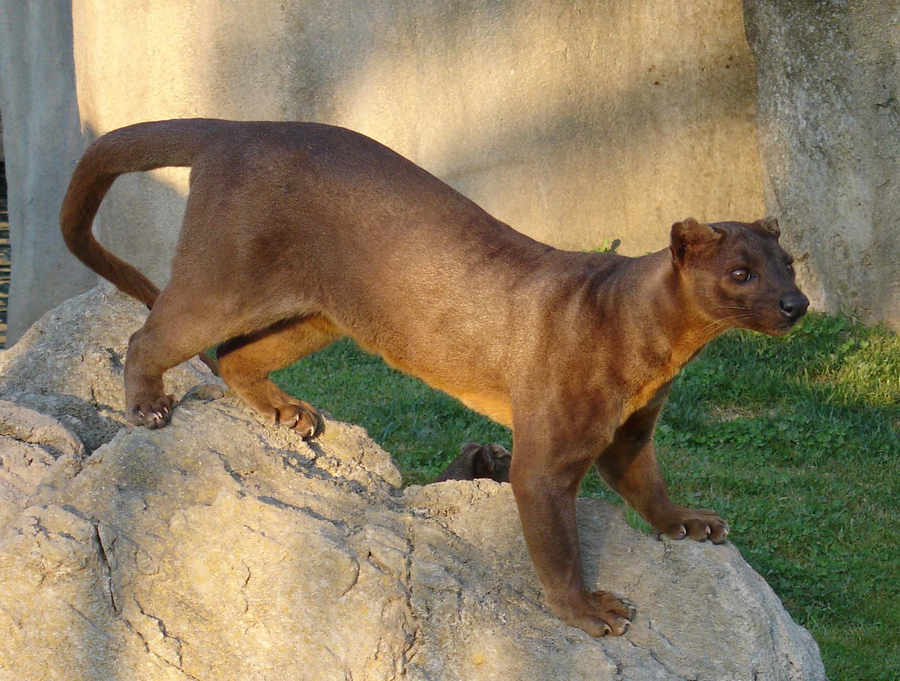
The fossa (Cryptoprocta ferox) is a mammal of the family Eupleridae, in the order Carnivora.
Quick answer
The fossa (Cryptoprocta ferox) is Madagascar's largest native mammalian carnivore — a slender, cat-like hunter that preys heavily on lemurs in rainforest and dry forest. Adults weigh about 8 kg, climb with remarkable agility, and are listed Vulnerable as deforestation fragments hunting grounds.
Top questions about the Fossa
Fossa facts at a glance
- Weight 8 kg
- Length 1.5 m
- Top speed 50 km/h
- Lifespan 15 years
| Scientific name | Cryptoprocta ferox |
|---|---|
| Diet | Carnivore |
| Habitat | Madagascar forests and woodland |
| Lifespan | Around 15 years in the wild (varies by population and captivity). |
| Weight | About 8 kg typical adult mass (sex and region vary). |
| Top speed | Up to roughly 50 km/h when moving at speed. |
| Conservation status | Vulnerable (IUCN) |
| Kingdom | Animalia |
|---|---|
| Phylum | Chordata |
| Class | Mammalia |
| Order | Carnivora |
| Family | Eupleridae |
| Genus | Cryptoprocta |
Where it lives
The fossa (Cryptoprocta ferox) is native to Forests of Madagascar, from dry deciduous woodland to eastern rainforest. — recorded across Africa in this guide’s range summary.
For occurrence records, see GBIF species search and sources below.
How big is a fossa?
An adult fossa measures 1.5 m long — about 87% of the height of an average adult person (1.73 m) — and weighs around 8.0 kg, about 11% of an average adult’s body weight (70 kg).
Length vs an average adult’s height (to scale)
What is a group of fossas called?
Group name (collective noun)
A group of Fossas is called a company.
Baby name
A baby Fossa is called a cub.
Explore more animal collective nouns and baby animal names .
Cat-like, but a mongoose relative
Fossas look feline yet belong with Malagasy carnivorans related to mongooses. Retractable claws, a very long tail for balance, and flexible ankles aid head-first descents from trees.
Lemur specialist predator
Diet centres on lemurs of many sizes, plus rodents, birds, and reptiles. Both nocturnal and diurnal hunts occur; agile leaps through canopy chase arboreal prey.
Forests across Madagascar
Dry deciduous woodland to eastern rainforest across Madagascar — wherever continuous forest still supports lemurs. They avoid open deforested landscapes.
Vulnerable with the forests
IUCN lists fossas Vulnerable. Slash-and-burn clearing, hunting, and declining lemur prey shrink populations; protected corridors are essential.
Explore the Fossa
Collections
Range & geography
Conservation status of the Fossa
The fossa (Cryptoprocta ferox) is listed as Vulnerable on the IUCN Red List. Vulnerable (VU) means a species faces a high risk of extinction in the medium-term future. It is the lowest-risk of the three 'threatened' IUCN categories — one step below Endangered, which is itself below Critically Endangered — and is often an early warning that a population is in trouble.
Main threats to the fossa
- Deforestation in Madagascar
- Habitat fragmentation
- Hunting and persecution
- Competition with introduced carnivores
Fossa (Cryptoprocta ferox) was most recently assessed for the IUCN Red List in 2015. Look up on the IUCN Red List .
Frequently asked questions about the Fossa
Is a fossa a cat?
No — it is a Malagasy carnivoran more closely related to mongooses than to true cats, despite the cat-like build.
What do fossas eat?
Mainly lemurs, supplemented by rodents, birds, and reptiles.
Are fossas dangerous to people?
They rarely confront humans; conflict usually involves predation on poultry near forest edges.
Why are fossas Vulnerable?
Deforestation and hunting reduce both habitat and lemur prey across Madagascar.
Where do fossas live?
Forests of Madagascar, from dry western woodland to eastern rainforest.
What is a group of fossas called?
A group of Fossas is called a company.
What is a baby fossa called?
A baby Fossa is called a cub.
Sources & references
This guide is compiled and reviewed against established zoological and conservation references. Key sources for the Fossa:
-
IUCN Red List of Threatened Species
Conservation status (Vulnerable) reflects the IUCN Red List category for Cryptoprocta ferox, most recently assessed in 2015.
-
iNaturalist — observations & photos
Search citizen-science observations and community IDs for Cryptoprocta ferox. Useful for range checks and recent sightings — not a substitute for formal Red List status.
-
GBIF — occurrence data
Global Biodiversity Information Facility species search for Cryptoprocta ferox. Explore published occurrence records used in range research.
-
Global Animal Guide editorial standards
How we research, source, review, and update every guide for accuracy.