Nine-Banded Armadillo
Dasypus novemcinctus
Quick answer
The nine-banded armadillo is the only armadillo species widespread in the United States, recognised by its bony armour plates and ability to jump vertically when startled. It digs for insects and grubs, gives birth to identical quadruplets, and is expanding its range northward.
Nine-Banded Armadillo facts at a glance
| Scientific name | Dasypus novemcinctus |
|---|---|
| Diet | Insectivore — insects, grubs, and other invertebrates |
| Habitat | Grasslands, forests, and suburbs in the Americas |
| Lifespan | 12–15 years in the wild |
| Weight | 3–6 kg (6.5–13 lb) |
| Top speed | Up to 48 km/h (30 mph) in short bursts |
| Conservation status | Least Concern (IUCN) |
| Kingdom | Animalia |
|---|---|
| Phylum | Chordata |
| Class | Mammalia |
| Order | Cingulata |
| Family | Dasypodidae |
| Genus | Dasypus |
Where it lives
From Argentina and Uruguay north through Central America and Mexico into the southern and central United States, expanding northward.
What is a group of nine-banded armadillos called?
Group name (collective noun)
A group of Nine-Banded Armadillos is called a roll.
Baby name
A baby Nine-Banded Armadillo is called a pup.
Explore more animal collective nouns and baby animal names .
Armour and anatomy
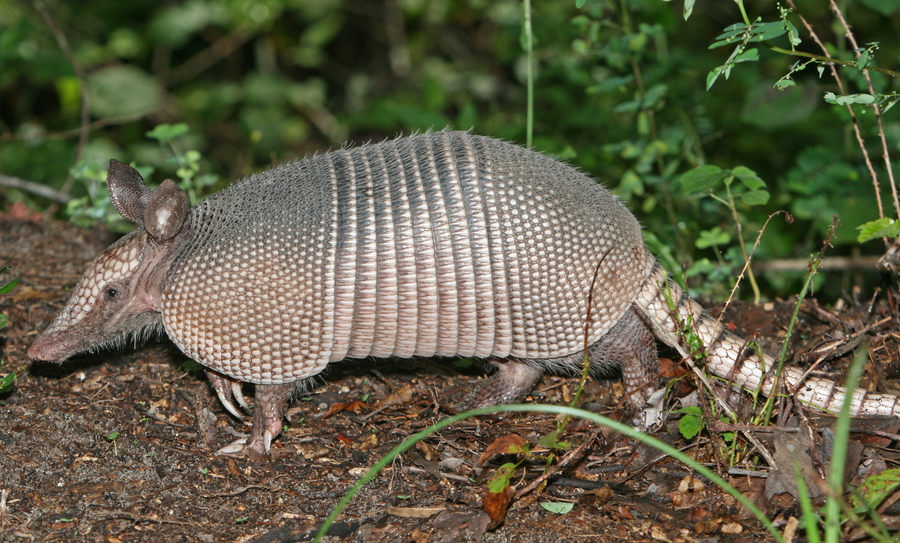
Armadillos are covered in osteoderms — bony plates fused into bands with flexible skin between. The nine-banded armadillo cannot roll into a complete ball (unlike three-banded South American species). Strong claws excavate burrows and unearth beetle larvae and ants.
Reproduction and quadruplets
Nine-banded armadillos almost always give birth to four genetically identical young from a single fertilised egg. Delayed implantation allows breeding timing to match favourable seasons. Newborns have soft skin that hardens within weeks.
Range expansion
Once confined to Latin America, nine-banded armadillos crossed into Texas in the 1800s and continue spreading north and east across the United States, aided by milder winters and lack of specialised predators.
Ecology and health notes
Armadillos aerate soil through digging and eat crop pests, but they also raid gardens and can carry Mycobacterium leprae, the bacterium that causes leprosy — transmission to humans is rare but documented in close-contact settings.
Dig deeper into the Nine-Banded Armadillo
- Armadillo Facts 5
Dig deeper into nine-banded armadillo — armadillo facts 5.
- How Fast Is A Armadillo
Dig deeper into nine-banded armadillo — how fast is a armadillo.
- How Long do Armadillo Live?
Dig deeper into nine-banded armadillo — how long do armadillo live.
- What do Armadillo Eat
Dig deeper into nine-banded armadillo — what do armadillo eat.
- Where do Armadillo Live?
Dig deeper into nine-banded armadillo — where do armadillo live.
Explore the Nine-Banded Armadillo
Compare
Did you know? Nine-Banded Armadillo facts
- The nine-banded armadillo is the only armadillo species widespread in the United States, recognised by its bony armour plates and ability to jump vertically when startled.
- The nine-banded armadillo cannot roll completely into a ball. Three-banded armadillos in South America can.
- They are shy and rarely bite. Their main defence is fleeing or jumping straight up when startled.
- Bony plates protect against predators such as coyotes and dogs. Flexible bands allow movement while covering the back and head.
- From South America through Central America, Mexico, and much of the southern and central United States, expanding northward each decade.
- Conservation: Least Concern (IUCN).
Diet & feeding
Nine-Banded Armadillo feeds primarily as a insectivore — insects, grubs, and other invertebrates. Armadillos aerate soil through digging and eat crop pests, but they also raid gardens and can carry Mycobacterium leprae, the bacterium that causes leprosy — transmission to humans is rare but documented in close-contact s
Adaptations
- Armadillos are covered in osteoderms — bony plates fused into bands with flexible skin between. The nine-banded armadillo cannot roll into a complete ball (unlike three-banded South American species). Strong claws excavate burrows and unearth beetle larvae and ants.
- Nine-banded armadillos almost always give birth to four genetically identical young from a single fertilised egg. Delayed implantation allows breeding timing to match favourable seasons. Newborns have soft skin that hardens within weeks.
Behaviour & ecology
- Armadillos are covered in osteoderms — bony plates fused into bands with flexible skin between. The nine-banded armadillo cannot roll into a complete ball (unlike three-banded South American species). Strong claws excavate burrows and unearth beetle larvae and ants.
- Nine-banded armadillos almost always give birth to four genetically identical young from a single fertilised egg. Delayed implantation allows breeding timing to match favourable seasons. Newborns have soft skin that hardens within weeks.
- Once confined to Latin America, nine-banded armadillos crossed into Texas in the 1800s and continue spreading north and east across the United States, aided by milder winters and lack of specialised predators.
Communication
- Nine-Banded Armadillo uses scent, posture, and vocal signals to mark territory and coordinate social behaviour.
- Communication intensity often peaks during breeding seasons and territorial disputes.
Habitat & range
Grasslands, forests, and suburbs in the Americas
Ecological role
Nine-Banded Armadillo plays a recognised ecological role in grasslands, forests, and suburbs in the americas.
Frequently asked questions about the Nine-Banded Armadillo
Can armadillos roll into a ball?
The nine-banded armadillo cannot roll completely into a ball. Three-banded armadillos in South America can.
Are armadillos dangerous?
They are shy and rarely bite. Their main defence is fleeing or jumping straight up when startled.
Why do armadillos have armour?
Bony plates protect against predators such as coyotes and dogs. Flexible bands allow movement while covering the back and head.
Where do armadillos live?
From South America through Central America, Mexico, and much of the southern and central United States, expanding northward each decade.
Do armadillos always have four babies?
Nine-banded armadillos typically produce one litter of four identical quadruplets from a single egg, a rare reproductive strategy among mammals.
What is a group of nine-banded armadillos called?
A group of Nine-Banded Armadillos is called a roll.
What is a baby nine-banded armadillo called?
A baby Nine-Banded Armadillo is called a pup.
Sources & references
This guide is compiled and reviewed against established zoological and conservation references. Key sources for the Nine-Banded Armadillo:
-
IUCN Red List of Threatened Species
Conservation status (Least Concern) reflects the IUCN Red List category for Dasypus novemcinctus.
- IUCN Red List — Dasypus novemcinctus.
Conservation status (Least Concern) and population trends.
- Animal Diversity Web — Dasypus novemcinctus. University of Michigan Museum of Zoology.
Life history, morphology, and range.
-
Global Animal Guide editorial standards
How we research, source, review, and update every guide for accuracy.