Quick answer
Great Spotted (most common) — bold black-and-white with large white oval shoulder patches and red under-tail. Lesser Spotted (rare, sparrow-sized) — barred black-and-white, NO large white patches, NO red under-tail. Green Woodpecker (largest) — green body, bright yellow-green rump, red crown, and the famous laughing "yaffle" call; spends most time on the ground eating ants.
How to tell apart the three UK woodpeckers
Identify the Great Spotted, Lesser Spotted, and Green Woodpecker by size, markings, sound, and feeding behaviour.
- 1
Judge the size first. Great Spotted is blackbird-sized, Lesser Spotted is tiny and sparrow-sized, and the Green Woodpecker is the largest, roughly pigeon-sized.
- 2
Check colour and markings. A green body with a red crown and yellow-green rump is a Green Woodpecker; bold black-and-white with large white shoulder patches and a red under-tail is Great Spotted; a barred 'ladder' back with no large white patches and no red under-tail is Lesser Spotted.
- 3
Listen for the call and drum. A loud, laughing 'yaffle' is a Green Woodpecker, which rarely drums; loud, frequent drumming and a sharp 'tchick' is Great Spotted; a quieter, weaker drum and a thin 'pee-pee-pee' is Lesser Spotted.
- 4
Note where it is feeding. A woodpecker feeding on the ground, probing a lawn or grassland for ants, is almost always a Green Woodpecker.
Comparison table
| Feature | Great Spotted | Lesser Spotted | Green |
|---|---|---|---|
| Size | Blackbird-sized | Sparrow-sized | Pigeon-sized (largest) |
| Colour | Black and white | Barred black and white | Green with red crown |
| White oval patches? | Yes — large and obvious | No — only barring | No |
| Red under-tail? | Yes | No | No |
| Rump | Black | Barred black-white | Bright yellow-green (flies) |
| Call | 'Tchick' | High, thin 'pee-pee-pee' | Laughing 'yaffle' |
| Drums? | Yes — loud, spring | Yes — quieter, faster | Rarely |
| Ground feeder? | Rarely | No | Often (eats ants) |
| Status | Very common | Scarce — Red List | Fairly common |
Species in detail
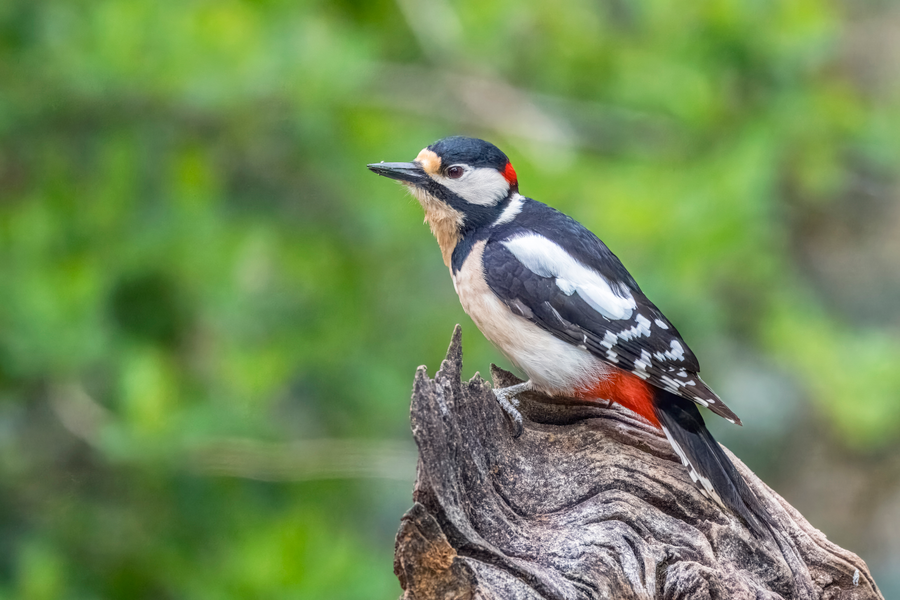
Great Spotted Woodpecker
Blackbird-sized (~23 cm)Dendrocopos major
Key marks: Bold black-and-white plumage; large white oval shoulder patches; red under-tail; male has a red nape patch
Sound: Loud 'tchick' call; powerful drumming (up to 20 strikes/sec) in spring
Habitat: Broadleaved and mixed woodland, parks, large gardens with mature trees
Diet: Insects, larvae, nuts, seeds; caches hazelnuts and pine seeds in bark crevices
Status: Very common — most frequently seen UK woodpecker
Lesser Spotted Woodpecker
Sparrow-sized (~14–15 cm) — Britain's smallest woodpeckerDendrocopos minor
Key marks: Barred black-and-white with NO large white patches; NO red under-tail; male has red crown, female white crown
Sound: High, thin 'pee-pee-pee' call; quieter, faster drumming than Great Spotted
Habitat: Broadleaved woodland, orchards, riverside alders and willows
Diet: Insects and larvae from decaying wood
Status: Scarce and declining — Red List species in the UK
Green Woodpecker
Largest UK woodpecker (~32 cm, roughly pigeon-sized)Picus viridis
Key marks: Green body with bright yellow-green rump (conspicuous in flight); red crown; male has a red 'moustache' with black border
Sound: The iconic 'yaffle' — a loud, laughing 'yah-yah-yah-yah' call. Rarely drums.
Habitat: Broadleaved woodland, parks, large gardens, open country with ant hills
Diet: Specialises in ants — spends most time on the ground probing ant hills with its long, sticky tongue
Status: Fairly common; declining in some areas
UK woodpeckers: FAQs
How many woodpecker species are there in the UK?
Three species breed regularly in the UK: the Great Spotted Woodpecker, the Lesser Spotted Woodpecker, and the Green Woodpecker. The Wryneck formerly bred in England but is now a rare migrant. The Black Woodpecker breeds widely in continental Europe but has not yet colonised the UK.
What is that laughing bird sound in English woodland?
Almost certainly a Green Woodpecker. Its loud, descending, laughing call — the 'yaffle' — is one of the most distinctive sounds of English woodland and farmland, especially in spring and summer. Despite being the largest UK woodpecker, the Green Woodpecker is heard far more often than it is seen.
Do woodpeckers migrate?
UK woodpeckers are all resident year-round — they do not migrate. The Great Spotted Woodpecker is occasionally joined in autumn and winter by individuals from the Continent during irruption years when food supplies fail elsewhere, but UK-resident birds stay put.
How do woodpeckers drum without injuring themselves?
Woodpeckers have several adaptations for drumming: a thick skull with spongy bone that absorbs impact, a brain that is braced in the skull rather than loosely floating, strong neck muscles, a beak with slightly offset upper and lower mandibles to absorb lateral stress, and a third eyelid that closes a millisecond before each strike to prevent the eyes popping out. The brain also sits in a position that minimises shear forces during the impact.
Why is the Lesser Spotted Woodpecker so hard to see?
It is small (sparrow-sized), spends most of its time in the upper canopy, and tends to work along thin branches and twigs rather than the main trunk. Its call is quiet and high-pitched, easily missed among bird song. It is also genuinely scarce — UK populations have declined by over 70% since the 1970s, making it a Red List priority species. Look for it in early spring (January–February) before leaves appear.
Sources & references
Identification marks and calls are compiled from established field guides and ornithological references for the UK.
-
RSPB wildlife guides
UK and international bird identification.
-
Cornell Lab — All About Birds
Photos, calls, and ID tips for North American species.
-
iNaturalist
Community-verified species observations worldwide.
- Global Animal Guide editorial standards