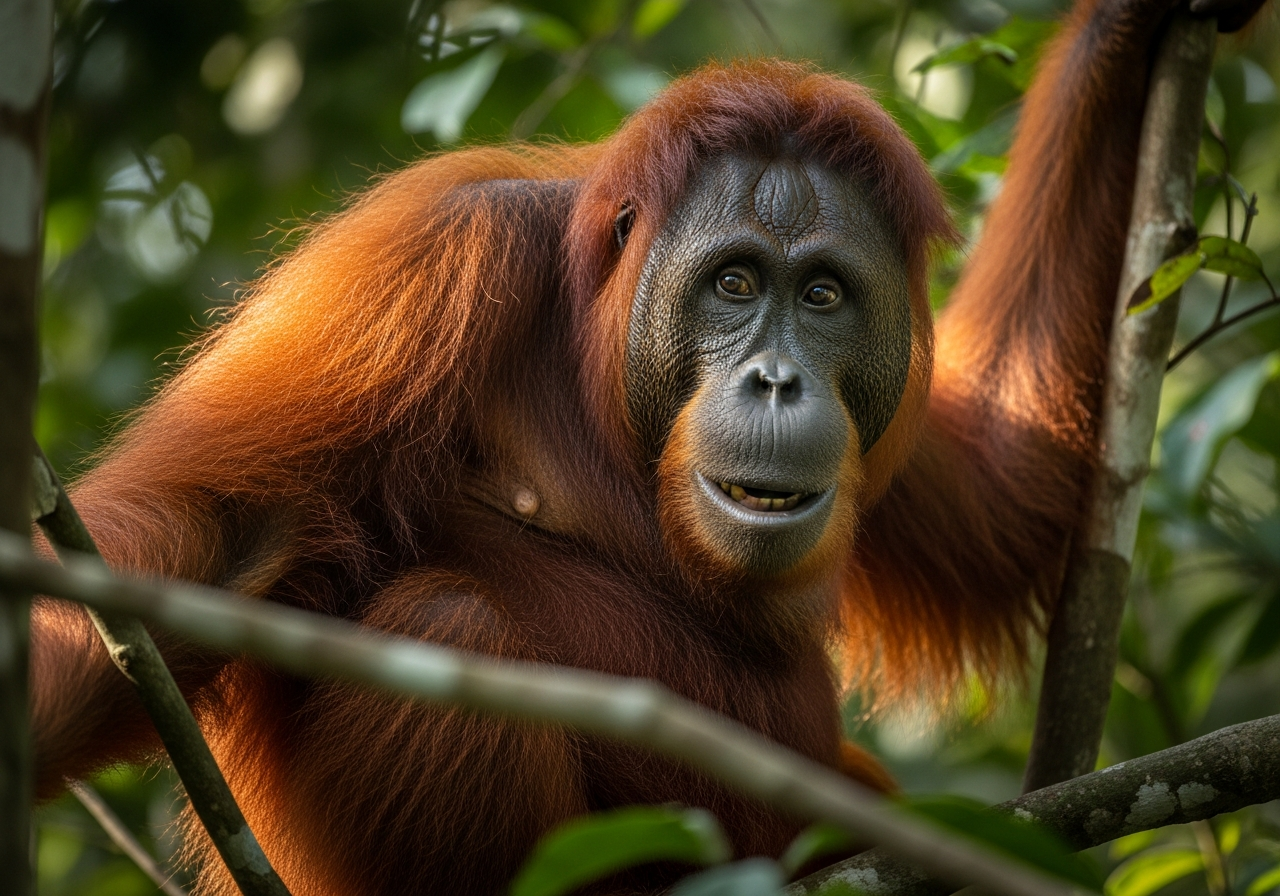
Quick answer
All three species are Critically Endangered: Bornean (Pongo pygmaeus), Sumatran (Pongo abelii), and Tapanuli (Pongo tapanuliensis). This is not a single “orangutan” leftover. Tapanuli, described in 2017, is the rarest great ape — a 2021–2023 survey estimated about 716 individuals. Figures checked 13 August 2026.
Are all three orangutan species Critically Endangered?
Yes. IUCN lists Bornean, Sumatran, and Tapanuli orangutans as Critically Endangered. Treating only Pongo pygmaeus as “the orangutan” understates the crisis. Critically Endangered is the last category before Extinct in the Wild. Regional pockets can look better than the global label; none of the three is secure.
What is driving the decline?
Logging, conversion of forest to oil-palm plantations, fires, and the illegal pet trade. Killing related to crop conflict removes breeding adults. The 2021–2023 Sumatran survey found forest loss explained most population change, but some meta-populations declined faster than habitat loss predicted — a sign that hunting and other mortality still matter. Roads that fragment Batang Toru are an existential Tapanuli issue.
Is the outlook the same for every species?
No. Bornean orangutans are the most numerous and still declining. Sumatran numbers fell about 19.5% versus the 2011 baseline in the 2021–2023 matched comparison (~1.8% per year). Tapanuli, at ~716 individuals, has no demographic buffer. Protected-area gazettement is not enough if 18% of Sumatran and Tapanuli animals still live outside formal protection.
What actually helps?
Keep forest standing, enforce existing parks, restore corridors, and fund rescue that aims at release — not entertainment. WARN’s orangutan appeal and the East Kalimantan forest-school appeal fund partner rehabilitation. WARN does not operate its own orangutan camps.
Where do orangutans still live?
Only on Borneo and Sumatra, in tropical lowland and peat-swamp rainforest. They spend almost all their time in the canopy. Survival is tightly linked to intact forest: an ape that rarely comes to the ground cannot commute across an oil-palm block. Tapanuli’s entire wild range is a sliver of North Sumatra upland forest.
Why is recovery so slow even when forest is saved?
Females give birth only about once every six to eight years. Populations cannot bounce back from hunting the way rodents can. Protecting and restoring forest, rehabilitating confiscated orphans, and cutting demand for pets are the working tools. Certified palm oil is a consumer lever, not a substitute for keeping specific peat-swamp blocks standing. Without that, wild orangutans stay on a path to extinction.
Sources
Orangutan FAQs
Are orangutans endangered?
All three species are Critically Endangered on the IUCN Red List: Bornean (Pongo pygmaeus), Sumatran (Pongo abelii), and Tapanuli (Pongo tapanuliensis). This profile historically labelled the Bornean species; the honest answer is that none of the three is merely “Endangered.” Slow reproduction — a birth roughly every six to eight years — means losses from logging, fire, and the pet trade are hard to reverse.
How many orangutans are left?
Order-of-magnitude figures, not a weekly census: Bornean orangutans are the most numerous (workshop estimates on the order of ~58,000). A 2021–2023 range-wide survey estimated about 11,694 Sumatran orangutans (95% CI 10,949–12,518) and 716 Tapanuli orangutans (95% CI 645–792). Tapanuli is the rarest great ape. Figures checked 13 August 2026.
Where do orangutans live?
Only on Borneo and Sumatra. They are the most arboreal great apes, using lowland and peat-swamp rainforest canopy. Tapanuli orangutans are restricted to the Batang Toru ecosystem in North Sumatra. There is no African orangutan and no wild population outside those islands.
What actually helps orangutans?
Keeping forest standing, stopping fires and the illegal pet trade, and funding rescue that returns animals to protected habitat — not selfie tourism. World Animal Rescue Network’s orangutan appeal describes proposed partner rehabilitation, including East Kalimantan forest-school work. WARN does not run its own orangutan camps.
Who this page is for. This page explains IUCN-style status. Skip it if you need an emergency wildlife-rescue number.