Image sourcing: see credits & licences
Quick answer
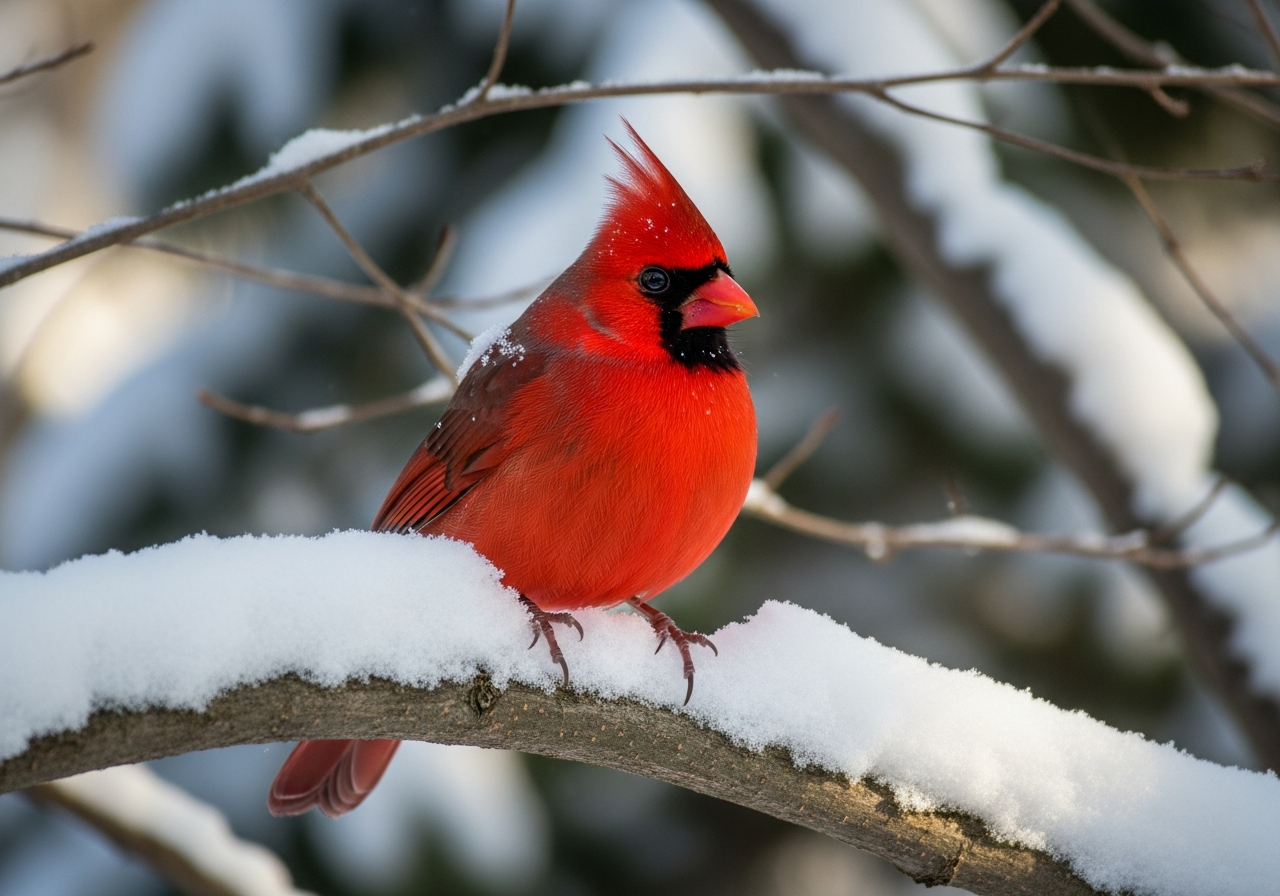
The northern cardinal is a popular North American songbird, the male instantly recognizable by his brilliant red plumage, black face mask, and pointed crest. Females are warm tan with red highlights. A frequent visitor to backyard feeders, the cardinal sings rich, whistling songs year-round and does not migrate. Cardinals usually live about 3 years in the wild, sometimes much longer.
Top questions about the Northern Cardinal
Northern Cardinal facts at a glance
- Weight 45 g
- Length 22 cm
- Top speed 48 km/h
- Lifespan 3 years
| Scientific name | Cardinalis cardinalis |
|---|---|
| Diet | Omnivore (seeds, grains, fruit, insects) |
| Habitat | Woodland edges, gardens, and shrubland |
| Lifespan | About 3 years in the wild, longer possible |
| Length | 21–23 cm (8–9 in) |
| Top speed | Up to 48 km/h (30 mph) |
| Conservation status | Least Concern (IUCN) |
| Kingdom | Animalia |
|---|---|
| Phylum | Chordata |
| Class | Aves |
| Order | Passeriformes |
| Family | Cardinalidae |
| Genus | Cardinalis |
Where it lives
The northern cardinal (Cardinalis cardinalis) is native to Woodland edges, gardens, and shrubland across the eastern and central United States, the Southwest, Mexico, and Central America. — recorded across North America in this guide’s range summary.
For occurrence records, see GBIF species search and sources below.
How big is a northern cardinal?
An adult northern cardinal measures 22 cm long — about 13% of the height of an average adult person (1.73 m) — and weighs around 45 g, a small fraction of an average adult’s body weight (70 kg).
Length vs an average adult’s height (to scale)
What is a group of northern cardinals called?
Group name (collective noun)
A group of Northern Cardinals is called a college. It is also known as a radiance.
Baby name
A baby Northern Cardinal is called a chick.
Explore more animal collective nouns and baby animal names .
Color and appearance
The male northern cardinal is unmistakable, with vivid red feathers, a black mask around the bill, and a tall crest. Females are a soft tan or olive with red tinges in the wings, crest, and tail, and both sexes have a stout, cone-shaped orange-red bill suited to cracking seeds. The male's bright color comes from pigments in the foods he eats.
Song and behavior
Cardinals are accomplished singers, and unusually both males and females sing. Their clear, whistling phrases ring out through much of the year as they defend territory and stay in contact with a mate. Cardinals do not migrate, so their red against winter snow and their songs on cold mornings make them favorites in northern gardens.
Diet and feeders
Northern cardinals eat mainly seeds, grains, and fruit, along with insects, especially when feeding their young. Their strong bills handle tough seeds with ease, and they are among the most common and welcome visitors to backyard feeders, where sunflower seeds are a particular favorite.
Habitat and range
Cardinals live across the eastern and central United States, parts of the Southwest, Mexico, and Central America, and their range has expanded northward over the past century. They favor woodland edges, thickets, gardens, and shrubby areas, and have adapted well to suburbs and towns where feeders and plantings provide food and cover.
Dig deeper into the Northern Cardinal
- How Fast Is A Northern Cardinal?
Northern Cardinal top speed is up to about 48 km/h (30 mph). Sprint vs endurance and what limits pace.
- How Long Do Northern Cardinals Live?
Northern Cardinal lifespan is typically About 3 years in the wild, longer possible. What shortens or extends life, life stages, and status (Least Concern).
- What Do Northern Cardinals Eat?
What northern cardinals eat: Omnivore (seeds, grains, fruit, insects), foraging style, and seasonal shifts in Woodland edges, gardens, and shrubland.
- Where Do Northern Cardinals Live?
Where northern cardinals live: Woodland edges, gardens, and shrubland, native range cues, and human overlap. Status Least Concern.
Explore the Northern Cardinal
Related Birds
Range & geography
Did you know? Northern Cardinal facts
- The northern cardinal is a popular North American songbird, the male instantly recognizable by his brilliant red plumage, black face mask, and pointed crest.
- Male northern cardinals get their bright red color from pigments called carotenoids in the seeds and fruit they eat. A healthy, well-fed male tends to show the most vivid red plumage.
- Yes. Females are warm tan or pale olive with reddish tints in the wings, tail, and crest, while males are brilliant red. Both sexes share the crest, black face, and orange-red bill.
- Cardinals are omnivores that eat mainly seeds, grains, and fruit, plus insects, especially when raising chicks. They readily visit feeders, where sunflower seeds are a favorite.
- No. Northern cardinals stay in their territory year-round, which is why their red plumage and songs are a familiar sight even in the middle of a snowy northern winter.
- Conservation: Least Concern (IUCN).
Diet & feeding
Northern Cardinal feeds primarily as a omnivore (seeds, grains, fruit, insects). The male northern cardinal is unmistakable, with vivid red feathers, a black mask around the bill, and a tall crest. Females are a soft tan or olive with red tinges in the wings, crest, and tail, and both sexes have a stout, cone-shaped or
Adaptations
- The male northern cardinal is unmistakable, with vivid red feathers, a black mask around the bill, and a tall crest. Females are a soft tan or olive with red tinges in the wings, crest, and tail, and both sexes have a stout, cone-shaped orange-red bill suited to cracking seeds. The male's bright color comes from pigments in the foods he eats.
- Cardinals are accomplished singers, and unusually both males and females sing. Their clear, whistling phrases ring out through much of the year as they defend territory and stay in contact with a mate. Cardinals do not migrate, so their red against winter snow and their songs on cold mornings make them favorites in northern gardens.
Behaviour & ecology
- The male northern cardinal is unmistakable, with vivid red feathers, a black mask around the bill, and a tall crest. Females are a soft tan or olive with red tinges in the wings, crest, and tail, and both sexes have a stout, cone-shaped orange-red bill suited to cracking seeds. The male's bright color comes from pigments in the foods he eats.
- Cardinals are accomplished singers, and unusually both males and females sing. Their clear, whistling phrases ring out through much of the year as they defend territory and stay in contact with a mate. Cardinals do not migrate, so their red against winter snow and their songs on cold mornings make them favorites in northern gardens.
- Northern cardinals eat mainly seeds, grains, and fruit, along with insects, especially when feeding their young. Their strong bills handle tough seeds with ease, and they are among the most common and welcome visitors to backyard feeders, where sunflower seeds are a particular favorite.
Communication
- Northern Cardinal uses calls and visual displays to communicate territory, alarm, and breeding status.
- Vocal repertoires vary by species and are often learned or refined during development.
Habitat & range
Woodland edges, gardens, and shrubland
Ecological role
Northern Cardinal contributes to seed dispersal, insect control, or nutrient cycling depending on diet and foraging habits.
Conservation status of the Northern Cardinal
The northern cardinal (Cardinalis cardinalis) is listed as Least Concern on the IUCN Red List. Least Concern (LC) is the IUCN's lowest-risk category, assigned to widespread, abundant species that have been evaluated and found not to be threatened. It does not mean a species faces no pressures — only that it is not currently at risk of extinction.
The northern cardinal (Cardinalis cardinalis) is assessed on the IUCN Red List. Look up on the IUCN Red List .
Frequently asked questions about the Northern Cardinal
Why are male cardinals so red?
Male northern cardinals get their bright red color from pigments called carotenoids in the seeds and fruit they eat. A healthy, well-fed male tends to show the most vivid red plumage.
Do female cardinals look different from males?
Yes. Females are warm tan or pale olive with reddish tints in the wings, tail, and crest, while males are brilliant red. Both sexes share the crest, black face, and orange-red bill.
What do northern cardinals eat?
Cardinals are omnivores that eat mainly seeds, grains, and fruit, plus insects, especially when raising chicks. They readily visit feeders, where sunflower seeds are a favorite.
Do cardinals migrate?
No. Northern cardinals stay in their territory year-round, which is why their red plumage and songs are a familiar sight even in the middle of a snowy northern winter.
How long do cardinals live?
Many cardinals live only about 3 years in the wild because of predators and harsh weather, but some individuals survive much longer, with banded birds recorded at over 15 years.
Do female cardinals sing?
Yes. Unlike many songbirds, female cardinals sing too, often from the nest, and pairs may use song to communicate with each other while raising their young.
What is a group of northern cardinals called?
A group of Northern Cardinals is called a college. It is also known as a radiance.
What is a baby northern cardinal called?
A baby Northern Cardinal is called a chick.
Sources & references
This guide is compiled and reviewed against established zoological and conservation references. Key sources for the Northern Cardinal:
-
IUCN Red List of Threatened Species
Conservation status (Least Concern) reflects the IUCN Red List category for Cardinalis cardinalis.
-
iNaturalist — observations & photos
Search citizen-science observations and community IDs for Cardinalis cardinalis. Useful for range checks and recent sightings — not a substitute for formal Red List status.
-
GBIF — occurrence data
Global Biodiversity Information Facility species search for Cardinalis cardinalis. Explore published occurrence records used in range research.
-
eBird — bird observations
Cornell Lab eBird target search for Northern Cardinal. Check recent checklists and seasonal abundance where birders report this species.
- IUCN Red List — Cardinalis cardinalis.
Conservation status (Least Concern) and population trends.
- Animal Diversity Web — Cardinalis cardinalis. University of Michigan Museum of Zoology.
Life history, morphology, and range.
- Wikipedia — Northern Cardinal.
General taxonomy and overview (cross-check primary sources).
-
Global Animal Guide editorial standards
How we research, source, review, and update every guide for accuracy.