Quick answer
The Goliath birdeater (Theraphosa blondi) is the biggest spider by mass (up to ~175 g) and body length (~13 cm), from South America's rainforests. The giant huntsman (Heteropoda maxima) of Laos wins on leg span at around 30 cm (12 in) across. Despite the Goliath's name, it rarely eats birds — its diet is mainly large insects, frogs, and small rodents.
The heaviest vs the longest-legged
| Spider | Record | Max leg span | Where | |
|---|---|---|---|---|
| Goliath birdeater Theraphosa blondi | Heaviest (~175 g) & longest-bodied (~13 cm body) | ~28 cm | N. South America rainforest | |
| Giant huntsman Heteropoda maxima | Largest leg span (~30 cm) | ~30 cm | Caves of Laos | |
| Brazilian salmon pink birdeater Lasiodora parahybana | Second heaviest tarantula | ~25–27 cm | Brazil | |
| Grammostola anthracina Grammostola anthracina | Very large South American tarantula, extremely long-lived | ~20 cm | Southern South America | |
| Brazilian wandering spider Phoneutria spp. | Large AND highly venomous; listed in Guinness World Records | ~15 cm | South America | |
| Face-sized tarantula Poecilotheria rajaei | Leg span up to ~30 cm; newly described in 2013 | ~30 cm | Sri Lanka | |
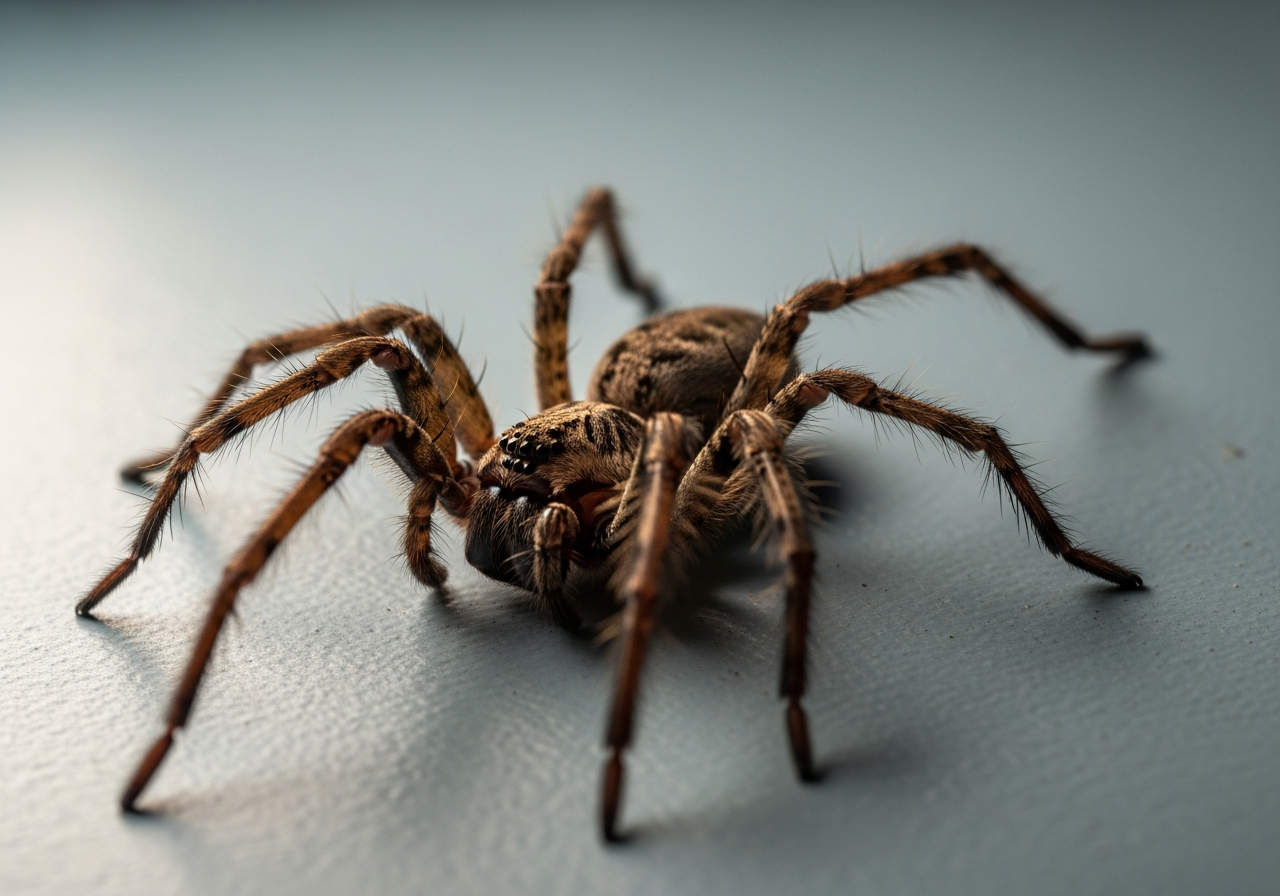 | Giant house spider Eratigena atrica | Among the largest spiders in the UK (leg span up to ~12 cm) | ~12 cm | Europe, especially UK |
Goliath birdeater: the heavyweight
Found in the rainforests of Venezuela, Brazil, Guyana, and Suriname, the Goliath birdeater is the undisputed record holder for spider mass. The heaviest specimen on record weighed 175 g and measured 28 cm across the legs. Despite its formidable size, its venom is mild — roughly equivalent to a wasp sting in its effect on humans. Its primary defence is a cloud of barbed urticating hairs that it flicks from its abdomen with its rear legs; these embed in the skin or eyes and cause intense irritation.
Like all tarantulas, it does not build a web to catch prey but instead hunts by ambush, lying in wait for prey to pass within striking distance. It preys mainly on large beetles, cockroaches, earthworms, frogs, lizards, and occasionally small mice. Birds are rarely taken. Females can live 15 to 25 years.
Giant huntsman: the long-legged record holder
Discovered in a cave in Laos in 2001, the giant huntsman holds the world record for leg span at approximately 30 cm (12 inches). Unlike the Goliath, the huntsman is not a tarantula — it is a member of the family Sparassidae, the huntsman spiders, which are found across the tropics and subtropics. Huntsmans are fast-moving ambush hunters that do not build webs, relying on speed and agility to catch prey.
The giant huntsman is not considered dangerous to humans. Its venom is not medically significant, though a bite would be painful. Several huntsman species are common household visitors across Southeast Asia and Australia, where they hunt cockroaches and other insects inside homes.
Are large spiders dangerous?
In most cases, no. The world's biggest spiders — the Goliath, the giant huntsman, and most large tarantulas — are not medically dangerous to healthy adults. The most venomous spider in terms of danger to humans is not on the "biggest" list: the Sydney funnel-web spider (Atrax robustus) of eastern Australia is small to medium-sized but has a powerful, fast-acting neurotoxin that, before antivenom, was potentially lethal.
The Brazilian wandering spider (Phoneutria) is the exception on this list: it is large, aggressive, fast, and carries venom potent enough to cause serious symptoms in humans. It is also the spider most frequently involved in spider-bite incidents in Brazil. The lesson: size and danger do not correlate in spiders.
Biggest spiders: FAQs
What is the biggest spider in the world?
It depends on how 'biggest' is measured. The Goliath birdeater (Theraphosa blondi) is the biggest spider by mass and body size — a large specimen can weigh around 175 g with a body (not leg span) up to 13 cm. The giant huntsman spider (Heteropoda maxima) holds the record for the largest leg span at around 30 cm across. Both records are documented in Guinness World Records.
Do Goliath birdeater spiders really eat birds?
Rarely. Despite the name (given by a Victorian naturalist who observed one eating a hummingbird), Goliath birdeaters prey mainly on large insects, worms, frogs, small rodents, and lizards. Birds are an opportunistic snack, not a dietary staple. The name stuck despite being misleading about the spider's actual diet.
Are the biggest spiders dangerous?
Mostly no, to humans. The Goliath birdeater's bite is painful but not medically dangerous to most people. Its main defence is flicking bristly 'urticating' hairs from its abdomen that cause intense itching and irritation. The giant huntsman is fast and alarming but not significantly venomous. The genuinely dangerous large spider on this list is the Brazilian wandering spider, whose venom is medically significant and can cause serious symptoms.
How long do Goliath birdeater spiders live?
Females can live 15 to 25 years, making them among the longer-lived spiders. Males live much shorter lives — typically 3 to 6 years — and often die after mating. This longevity gap between sexes is common in large tarantulas.
What is the largest spider in the UK?
The giant house spider (Eratigena atrica) and the cardinal spider (Tegenaria parietina) are among the largest by leg span in the UK, reaching up to about 12 cm across. The raft spider (Dolomedes fimbriatus) is also large but is confined to wetland habitats. None of these are dangerous to people.