Northern Mockingbird
Mimus polyglottos
Quick answer
The northern mockingbird (Mimus polyglottos) is a medium-sized grey North American songbird famous for extraordinary vocal mimicry — it can learn and replicate 200 or more songs, calls, and sounds, including other birds, frogs, insects, and even car alarms. Unmated males may sing continuously through the night during breeding season.
Northern Mockingbird facts at a glance
| Scientific name | Mimus polyglottos |
|---|---|
| Diet | Omnivore (insects in summer, berries in winter) |
| Habitat | Open woodland, gardens, parks, suburban areas, scrub |
| Lifespan | Up to 8 years in the wild |
| Length | 21–26 cm (8–10 in) |
| Conservation status | Least Concern (IUCN) |
| State bird of | Arkansas, Florida, Mississippi, Tennessee, Texas |
| Kingdom | Animalia |
|---|---|
| Phylum | Chordata |
| Class | Aves |
| Order | Passeriformes |
| Family | Mimidae |
| Genus | Mimus |
Where it lives
Widespread across the continental United States, southern Canada, Mexico, and the Caribbean year-round.
What is a group of northern mockingbirds called?
Group name (collective noun)
A group of Northern Mockingbirds is called a congress.
Baby name
A baby Northern Mockingbird is called a chick.
Explore more animal collective nouns and baby animal names .
The master mimic
The northern mockingbird is one of the most accomplished vocal mimics in the animal kingdom. It can learn and perform more than 200 distinct songs, calls, and environmental sounds during its lifetime, adding new ones continuously. The Latin name Mimus polyglottos means 'many-tongued mimic.' It does not simply copy sounds once — it integrates them into long, complex sequences, cycling through its repertoire and repeating each phrase several times before switching to the next. Individuals with larger repertoires attract mates more successfully, so mimicry is a genuine fitness signal.
Night singing and territorial defence
Mockingbirds are highly territorial and will vigorously defend their area against much larger birds and animals, sometimes dive-bombing cats, dogs, and people who approach their nest. Unmated males sing continuously through the night during breeding season — a behaviour admired by some and a source of sleep complaints from others. Once paired, night singing typically decreases. Their territoriality is intense enough that they will memorise and respond aggressively to specific individual people they identify as a threat.
Appearance and range
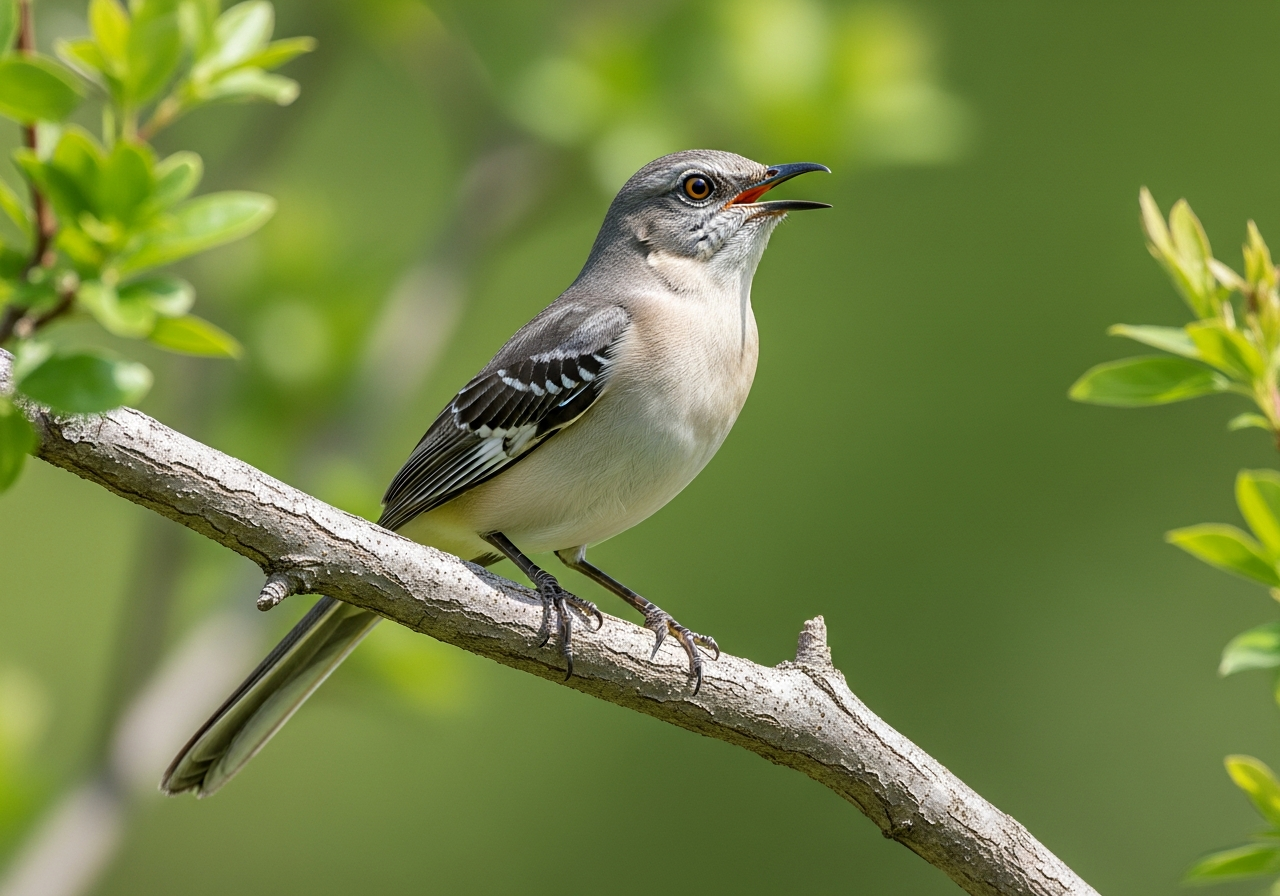
The northern mockingbird is a slender songbird with grey upper parts, whitish underparts, and white patches on its wings that flash conspicuously in flight. It is widespread across the continental United States, southern Canada, Mexico, and the Caribbean, and is a year-round resident in most of its range — it does not make long migrations. It is the official state bird of five US states.
Diet and wing-flashing
Mockingbirds shift their diet by season. In summer they eat mainly insects; in autumn and winter they switch to berries, fruit, and seeds. They forage on the ground with a distinctive run-and-stop style, and often spread their wings open in a display that may startle insects into moving, making them easier to catch. This wing-flashing behaviour is also used in territorial displays.
Dig deeper into the Northern Mockingbird
- How Long do Northern Mockingbird Live?
Dig deeper into northern mockingbird — how long do northern mockingbird live.
- What do Northern Mockingbird Eat
Dig deeper into northern mockingbird — what do northern mockingbird eat.
- Where do Northern Mockingbird Live?
Dig deeper into northern mockingbird — where do northern mockingbird live.
Explore the Northern Mockingbird
Related Birds
Range & geography
Did you know? Northern Mockingbird facts
- The northern mockingbird (Mimus polyglottos) is a medium-sized grey North American songbird famous for extraordinary vocal mimicry — it can learn and replicate 200 or more songs, calls, and sounds, including other birds, frogs, insects, and even car alarms.
- Individual northern mockingbirds can learn over 200 distinct songs and sounds during their lifetime, and they keep adding new ones. Males generally have larger repertoires than females and use their song range to attract mates and defend territory.
- Unmated males sing at night — particularly under bright conditions like a full moon or near streetlights — to advertise their availability to females. Once paired, night singing usually stops. The behaviour peaks in spring and early summer.
- Yes — they are notably territorial and will dive-bomb and physically strike animals many times their size, including cats, dogs, hawks, and people, if they perceive a threat to their nest. The attacks are genuine and can include contact.
- The northern mockingbird is the official state bird of Arkansas, Florida, Mississippi, Tennessee, and Texas.
- Conservation: Least Concern (IUCN).
Diet & feeding
Northern Mockingbird feeds primarily as a omnivore (insects in summer, berries in winter). The northern mockingbird is one of the most accomplished vocal mimics in the animal kingdom. It can learn and perform more than 200 distinct songs, calls, and environmental sounds during its lifetime, adding new ones continuously
Adaptations
- The northern mockingbird is one of the most accomplished vocal mimics in the animal kingdom. It can learn and perform more than 200 distinct songs, calls, and environmental sounds during its lifetime, adding new ones continuously. The Latin name Mimus polyglottos means 'many-tongued mimic.' It does not simply copy sounds once — it integrates them into long, complex sequences, cycling through its repertoire and repeating each phrase several times before switching to the next. Individuals with larger repertoires attract mates more successfully, so mimicry is a genuine fitness signal.
- Mockingbirds are highly territorial and will vigorously defend their area against much larger birds and animals, sometimes dive-bombing cats, dogs, and people who approach their nest. Unmated males sing continuously through the night during breeding season — a behaviour admired by some and a source of sleep complaints from others. Once paired, night singing typically decreases. Their territoriality is intense enough that they will memorise and respond aggressively to specific individual people they identify as a threat.
Behaviour & ecology
- The northern mockingbird is one of the most accomplished vocal mimics in the animal kingdom. It can learn and perform more than 200 distinct songs, calls, and environmental sounds during its lifetime, adding new ones continuously. The Latin name Mimus polyglottos means 'many-tongued mimic.' It does not simply copy sounds once — it integrates them into long, complex sequences, cycling through its repertoire and repeating each phrase several times before switching to the next. Individuals with larger repertoires attract mates more successfully, so mimicry is a genuine fitness signal.
- Mockingbirds are highly territorial and will vigorously defend their area against much larger birds and animals, sometimes dive-bombing cats, dogs, and people who approach their nest. Unmated males sing continuously through the night during breeding season — a behaviour admired by some and a source of sleep complaints from others. Once paired, night singing typically decreases. Their territoriality is intense enough that they will memorise and respond aggressively to specific individual people they identify as a threat.
- The northern mockingbird is a slender songbird with grey upper parts, whitish underparts, and white patches on its wings that flash conspicuously in flight. It is widespread across the continental United States, southern Canada, Mexico, and the Caribbean, and is a year-round resident in most of its range — it does not make long migrations. It is the official state bird of five US states.
Communication
- Northern Mockingbird uses calls and visual displays to communicate territory, alarm, and breeding status.
- Vocal repertoires vary by species and are often learned or refined during development.
Habitat & range
Open woodland, gardens, parks, suburban areas, scrub
Ecological role
Northern Mockingbird contributes to seed dispersal, insect control, or nutrient cycling depending on diet and foraging habits.
Frequently asked questions about the Northern Mockingbird
How many songs can a mockingbird imitate?
Individual northern mockingbirds can learn over 200 distinct songs and sounds during their lifetime, and they keep adding new ones. Males generally have larger repertoires than females and use their song range to attract mates and defend territory.
Why do mockingbirds sing at night?
Unmated males sing at night — particularly under bright conditions like a full moon or near streetlights — to advertise their availability to females. Once paired, night singing usually stops. The behaviour peaks in spring and early summer.
Are mockingbirds aggressive?
Yes — they are notably territorial and will dive-bomb and physically strike animals many times their size, including cats, dogs, hawks, and people, if they perceive a threat to their nest. The attacks are genuine and can include contact.
Which states have the mockingbird as their state bird?
The northern mockingbird is the official state bird of Arkansas, Florida, Mississippi, Tennessee, and Texas.
What does the mockingbird eat?
In warm months mockingbirds eat mainly insects; in autumn and winter they rely more on berries, fruit, and seeds. They are versatile omnivores that forage on the ground and in shrubs, and their diet shifts with seasonal availability.
What is a group of northern mockingbirds called?
A group of Northern Mockingbirds is called a congress.
What is a baby northern mockingbird called?
A baby Northern Mockingbird is called a chick.
Sources & references
This guide is compiled and reviewed against established zoological and conservation references. Key sources for the Northern Mockingbird:
-
IUCN Red List of Threatened Species
Conservation status (Least Concern) reflects the IUCN Red List category for Mimus polyglottos.
- IUCN Red List — Mimus polyglottos.
Conservation status (Least Concern) and population trends.
- Animal Diversity Web — Mimus polyglottos. University of Michigan Museum of Zoology.
Life history, morphology, and range.
- Wikipedia — Northern Mockingbird.
General taxonomy and overview (cross-check primary sources).
-
Global Animal Guide editorial standards
How we research, source, review, and update every guide for accuracy.