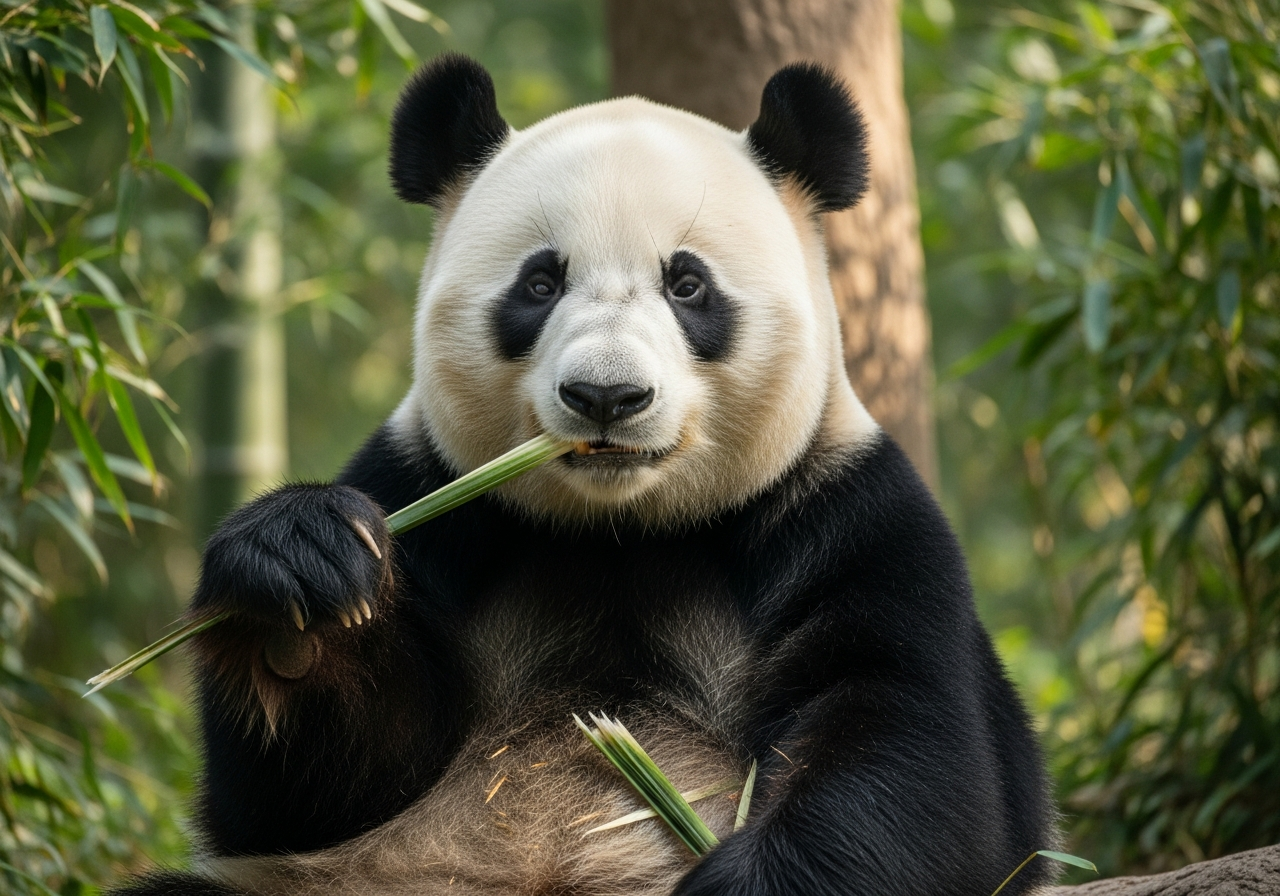
Quick answer
Giant pandas eat almost entirely bamboo — about 99% of the diet — typically 12–38 kg a day. They are bears with a carnivore gut, not true herbivores. A wrist-bone “pseudo-thumb” grips stalks. Never feed wild pandas. Figures checked 13 August 2026.
What do giant pandas actually eat?
Bamboo leaves, shoots and stems, shifting species and elevation with the season. Occasional meat or eggs exist in field notes; they do not rewrite the 99% rule. “Herbivore (almost entirely bamboo)” without the gut catch was the template line — the missing half is that they are inefficient bamboo processors, so volume has to be huge.
How do giant pandas find food?
They sit in a stand and process stalks for much of the day. Movement tracks shoot flushes upslope and down. A tourist fruit pile or bread roll is still a conflict pipeline. Cubs learn which culms to strip by watching the mother, not from a keeper’s bucket.
What do they do to the forest?
They prune bamboo and leave droppings that move seeds and nutrients. Empty panda range is still forest — but the umbrella of reserves built around them is why other species ride the same corridors. Diet conservation here is habitat conservation.
Does feeding start conflict?
Yes. Never feed wild pandas. Crop-edge gardens are a map of lost bamboo, not proof they “prefer” maize. Habituation for research still needs distance.
Why call them bears if they eat plants?
Because they are. Genetics and a carnivore digestive tract say bear; the menu says bamboo. That mismatch is why they must eat tens of kilograms a day, and why a flowering die-off can starve a valley.
What is the pseudo-thumb for?
Gripping bamboo. WARN’s habitat appeal describes proposed forest protection — not a Chengdu feeding demo.
Sources
Giant Panda FAQs
What do giant pandas eat?
About 99% of the diet is bamboo — leaves, shoots and stems — typically 12–38 kg a day depending on season and plant part. They are bears with a carnivore gut, not true herbivores. Occasional carrion or eggs happen; they do not change the calorie budget. Never feed wild pandas.
Why bamboo if they are bears?
An evolutionary switch, not a zoo quirk. A short gut extracts little from cellulose, so they eat almost constantly. The “pseudo-thumb” — an enlarged wrist bone — grips stalks. That adaptation is why a bamboo die-off is a conservation event, not a menu change.
Do they eat the same bamboo all year?
No. They shift elevation and species as shoots appear. Fragmented mountain blocks in Sichuan, Shaanxi and Gansu can trap a panda on the wrong slope when a stand flowers and dies. Climate models that cut bamboo habitat are diet models.
How does diet link to conservation?
IUCN lists them Vulnerable (2016); China matched that in 2021. Habitat corridors are the pantry. World Animal Rescue Network describes plans for habitat-protection partnerships — not Chengdu panda bases.
Who this page is for. This page is about wild diet. Skip it if you need a captive feeding plan from a veterinarian.