Image sourcing: see credits & licences
Quick answer
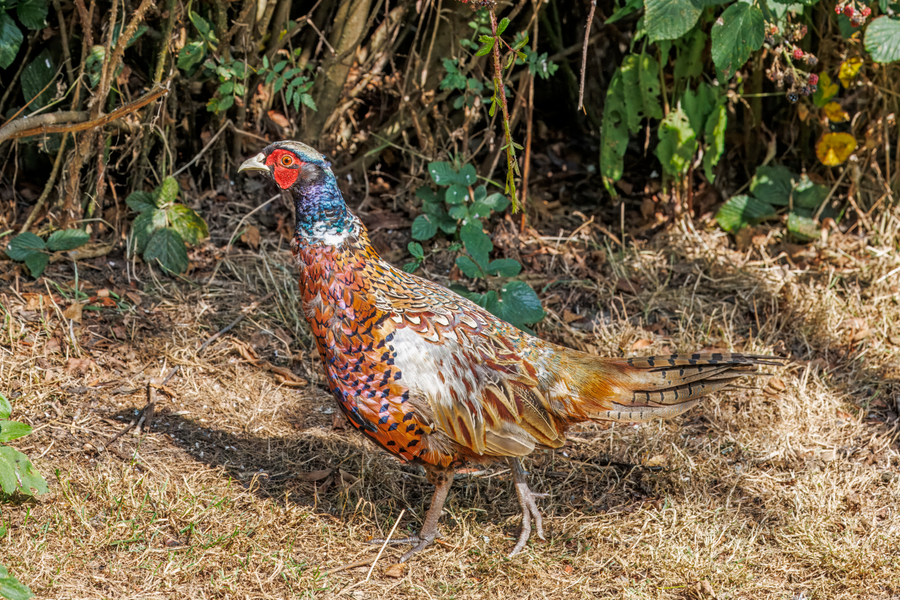
The common pheasant is a large colourful game bird native to Asia, with the cock's iridescent green head, red face wattles, and long barred tail familiar across European and American hunting estates. Introduced worldwide for sport shooting, it weighs 0.8–1.5 kg (1.8–3.3 lb) and is Least Concern globally.
Top questions about the Common Pheasant
Common Pheasant facts at a glance
- Weight 1.2 kg
- Length 75 cm
- Top speed 60 km/h
- Lifespan 3 years
| Scientific name | Phasianus colchicus |
|---|---|
| Diet | Omnivore — seeds, grain, insects, and berries |
| Habitat | Farmland, woodland edges, hedgerows, and grassland |
| Lifespan | 2–3 years in the wild (longer if not hunted) |
| Weight | Cocks 0.8–1.5 kg; hens about half that |
| Top speed | Explosive wing beats; strong short flight then running |
| Conservation status | Least Concern (IUCN) |
| Kingdom | Animalia |
|---|---|
| Phylum | Chordata |
| Class | Aves |
| Order | Galliformes |
| Family | Phasianidae |
| Genus | Phasianus |
Where it lives
The common pheasant (Phasianus colchicus) is native to Native to forest edges and farmland from the Caucasus through China; introduced to Europe, North America, New Zealand, and elsewhere for game shooting on managed estates. — recorded across Asia, Europe, North America, Oceania in this guide’s range summary.
For occurrence records, see GBIF species search and sources below.
How big is a common pheasant?
An adult common pheasant measures 75 cm long — about 43% of the height of an average adult person (1.73 m) — and weighs around 1.2 kg, about 2% of an average adult’s body weight (70 kg).
Length vs an average adult’s height (to scale)
What is a group of common pheasants called?
Group name (collective noun)
A group of Common Pheasants is called a bouquet.
Baby name
A baby Common Pheasant is called a chick.
Explore more animal collective nouns and baby animal names .
Game bird introductions
Romans and later medieval hunters spread pheasants from Asia across Europe. Mass releases on shooting estates in Britain, the United States, and New Zealand sustain populations far beyond what natural reproduction alone would support — millions are released annually for sport.
Sexual dimorphism
Cocks are spectacularly coloured with iridescent plumage and long tails; hens are mottled brown for camouflage while incubating ground nests. Cocks crow and beat wings in display, sometimes fighting viciously during the breeding season.
Ecological impact
Released pheasants compete with native ground-nesting birds, eat crop seed, and spread disease to wild galliformes. In Britain they are among the most numerous birds in autumn after releases. In native Asia, wild populations occupy forest edges and agricultural mosaic.
Hunting culture
Driven pheasant shoots on European and American estates are a traditional autumn sport. Bag limits and release regulations vary. Wild Asian populations remain Least Concern, though local declines occur from habitat loss and overhunting.
Dig deeper into the Common Pheasant
- How Fast Is A Common Pheasant?
Common Pheasant top speed is about Explosive wing beats; strong short flight then running. Sprint vs endurance and what limits pace.
- How Long Do Common Pheasants Live?
Common Pheasant lifespan is typically 2–3 years in the wild (longer if not hunted). What shortens or extends life, life stages, and status (Least Concern).
- Common Pheasant: Key Facts
The common pheasant is a large colourful game bird native to Asia, with the cock's iridescent green head, red face wattles, and long barred tail familiar…
- What Do Common Pheasants Eat?
What common pheasants eat: Omnivore — seeds, grain, insects, and berries, foraging style, and seasonal shifts in Farmland, woodland edges, hedgerows, and grassland.
- Where Do Common Pheasants Live?
Where common pheasants live: Farmland, woodland edges, hedgerows, and grassland, native range cues, and human overlap. Status Least Concern.
Explore the Common Pheasant
Did you know? Common Pheasant facts
- The common pheasant is a large colourful game bird native to Asia, with the cock's iridescent green head, red face wattles, and long barred tail familiar across European and American hunting estates.
- No — common pheasants originate from Asia. They were introduced to Britain by the Romans and Normans and are now naturalised, especially on shooting estates.
- Seeds, grain, insects, berries, and green shoots — diet shifts seasonally between farmland foraging and woodland edge browsing.
- Yes — they burst into strong short flight when flushed, then prefer running through cover. Sustained flight is limited compared with migratory birds.
- Males (cocks) are colourful with long tails and a white neck ring in the common subspecies. Females (hens) are cryptic brown for nest camouflage.
- Conservation: Least Concern (IUCN).
Diet & feeding
Common Pheasant feeds primarily as a omnivore — seeds, grain, insects, and berries. Cocks are spectacularly coloured with iridescent plumage and long tails; hens are mottled brown for camouflage while incubating ground nests. Cocks crow and beat wings in display, sometimes fighting viciously during the breeding season.
Adaptations
- Romans and later medieval hunters spread pheasants from Asia across Europe. Mass releases on shooting estates in Britain, the United States, and New Zealand sustain populations far beyond what natural reproduction alone would support — millions are released annually for sport.
- Cocks are spectacularly coloured with iridescent plumage and long tails; hens are mottled brown for camouflage while incubating ground nests. Cocks crow and beat wings in display, sometimes fighting viciously during the breeding season.
Behaviour & ecology
- Romans and later medieval hunters spread pheasants from Asia across Europe. Mass releases on shooting estates in Britain, the United States, and New Zealand sustain populations far beyond what natural reproduction alone would support — millions are released annually for sport.
- Cocks are spectacularly coloured with iridescent plumage and long tails; hens are mottled brown for camouflage while incubating ground nests. Cocks crow and beat wings in display, sometimes fighting viciously during the breeding season.
- Released pheasants compete with native ground-nesting birds, eat crop seed, and spread disease to wild galliformes. In Britain they are among the most numerous birds in autumn after releases. In native Asia, wild populations occupy forest edges and agricultural mosaic.
Communication
- Common Pheasant uses calls and visual displays to communicate territory, alarm, and breeding status.
- Vocal repertoires vary by species and are often learned or refined during development.
Habitat & range
Farmland, woodland edges, hedgerows, and grassland
Ecological role
Common Pheasant contributes to seed dispersal, insect control, or nutrient cycling depending on diet and foraging habits.
Conservation status of the Common Pheasant
The common pheasant (Phasianus colchicus) is listed as Least Concern on the IUCN Red List. Least Concern (LC) is the IUCN's lowest-risk category, assigned to widespread, abundant species that have been evaluated and found not to be threatened. It does not mean a species faces no pressures — only that it is not currently at risk of extinction.
The common pheasant (Phasianus colchicus) is assessed on the IUCN Red List. Look up on the IUCN Red List .
Frequently asked questions about the Common Pheasant
Are pheasants native to the UK?
No — common pheasants originate from Asia. They were introduced to Britain by the Romans and Normans and are now naturalised, especially on shooting estates.
What do pheasants eat?
Seeds, grain, insects, berries, and green shoots — diet shifts seasonally between farmland foraging and woodland edge browsing.
Can pheasants fly?
Yes — they burst into strong short flight when flushed, then prefer running through cover. Sustained flight is limited compared with migratory birds.
Male vs female pheasant?
Males (cocks) are colourful with long tails and a white neck ring in the common subspecies. Females (hens) are cryptic brown for nest camouflage.
Where are pheasants originally from?
Asia — from the Caucasus and Black Sea region through China. Most introduced populations derive from Chinese and ring-necked subspecies.
What is a group of common pheasants called?
A group of Common Pheasants is called a bouquet.
What is a baby common pheasant called?
A baby Common Pheasant is called a chick.
Sources & references
This guide is compiled and reviewed against established zoological and conservation references. Key sources for the Common Pheasant:
-
IUCN Red List of Threatened Species
Conservation status (Least Concern) reflects the IUCN Red List category for Phasianus colchicus.
-
iNaturalist — observations & photos
Search citizen-science observations and community IDs for Phasianus colchicus. Useful for range checks and recent sightings — not a substitute for formal Red List status.
-
GBIF — occurrence data
Global Biodiversity Information Facility species search for Phasianus colchicus. Explore published occurrence records used in range research.
-
eBird — bird observations
Cornell Lab eBird target search for Common Pheasant. Check recent checklists and seasonal abundance where birders report this species.
- IUCN Red List — Phasianus colchicus.
Conservation status (Least Concern) and population trends.
- Animal Diversity Web — Phasianus colchicus. University of Michigan Museum of Zoology.
Life history, morphology, and range.
-
Global Animal Guide editorial standards
How we research, source, review, and update every guide for accuracy.